
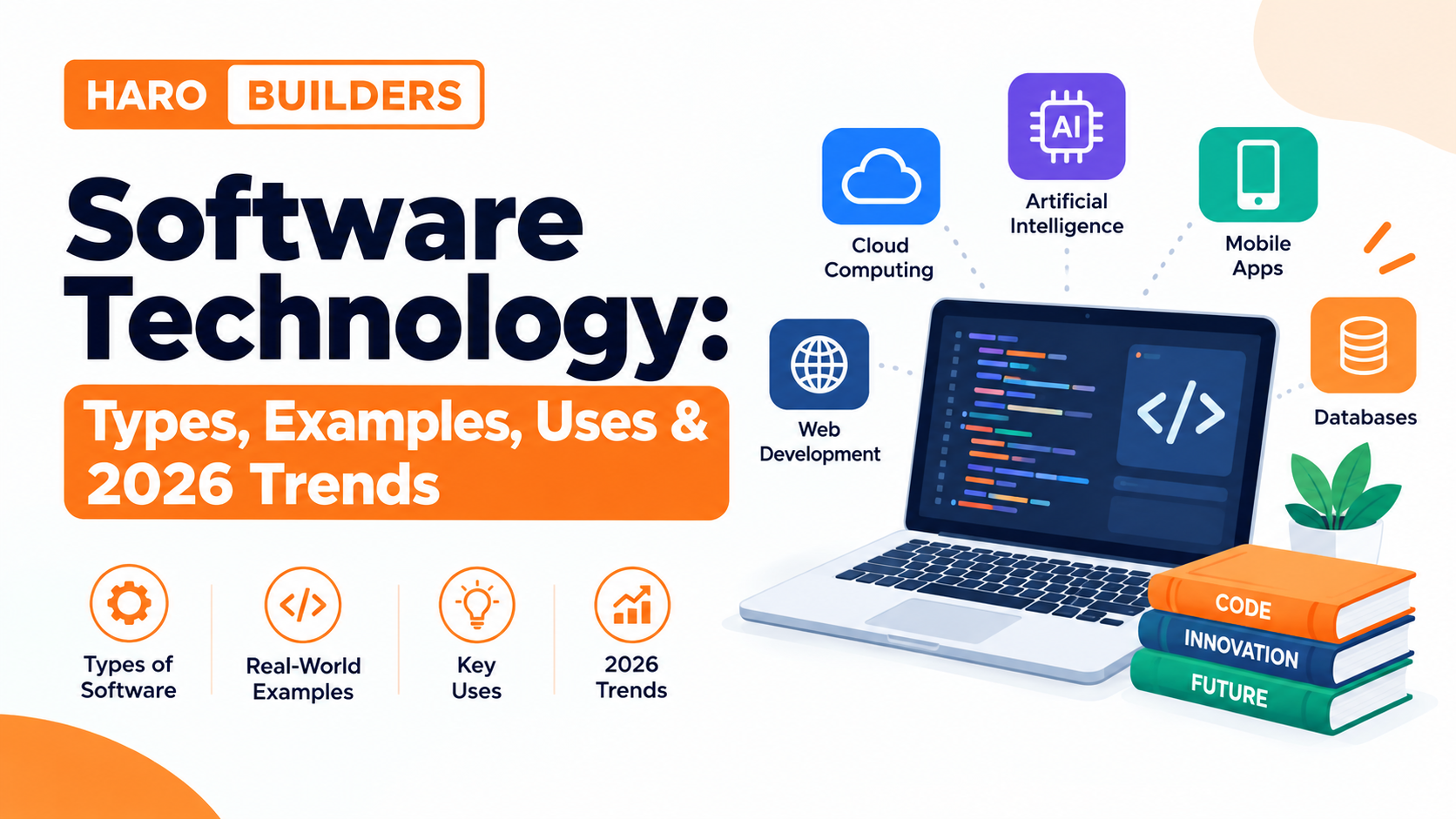
Software technology is the collection of programming languages, development tools, frameworks, databases, APIs, cloud platforms, security technologies, and engineering practices used to create, run, maintain, and improve software.
It is not one specific program or product. Instead, software technology describes the broader technical ecosystem behind websites, mobile apps, desktop applications, enterprise systems, cloud services, AI applications, and other digital products.
In 2026, software technology is increasingly shaped by artificial intelligence, cloud-native development, automation, cybersecurity, and software systems that can perform increasingly complex tasks with AI assistance.
Quick Answer: What Is Software Technology?
Software technology refers to the technologies and technical methods used to build, operate, secure, integrate, and maintain software. It includes programming languages, frameworks, databases, APIs, cloud infrastructure, development tools, testing technologies, cybersecurity, artificial intelligence, and software engineering practices.
A useful way to understand it is:
Software technology = tools + platforms + infrastructure + development methods used to create and operate software.
You may also encounter the phrase “software technolotal” online. It is not the standard name of a particular software product, programming language, or recognized technology category. For technical discussions, software technology is the clearer term.
Software Technology at a Glance
| Area | Main purpose | Examples |
|---|---|---|
| Programming languages | Write software instructions | Python, Java, JavaScript |
| Frameworks | Speed up application development | React, Django, .NET |
| Databases | Store and retrieve information | PostgreSQL, MySQL, MongoDB |
| APIs | Connect software systems | REST, GraphQL |
| Cloud computing | Provide computing infrastructure and services | Cloud platforms, serverless services |
| DevOps | Build, test, deploy, and operate software | CI/CD, containers |
| Cybersecurity | Protect software and data | Authentication, encryption, firewalls |
| Artificial intelligence | Add intelligent capabilities | Machine learning, generative AI |
| Testing | Find defects and verify behavior | Unit, integration, end-to-end testing |
| Monitoring | Observe application performance | Logs, metrics, traces |
What Does Software Technology Include?
Software technology covers much more than programming code. Modern software normally depends on several layers working together.
Programming Languages
Programming languages allow developers to express instructions that computers can execute.
Common examples include:
- Python
- JavaScript
- TypeScript
- Java
- C#
- C++
- Go
- Rust
- Swift
- Kotlin
The appropriate language depends on the application’s requirements, ecosystem, performance needs, team expertise, and target platform.
Frameworks and Libraries
Frameworks and libraries provide reusable functionality so developers do not have to build every component from scratch.
For example, a web application might use a frontend framework, a backend framework, authentication libraries, database drivers, and testing libraries.
Frameworks can improve development speed and consistency, but they also introduce dependencies that need to be maintained and updated.
Databases
Most useful applications need to store data.
Database technology can include:
- relational databases
- document databases
- key-value stores
- graph databases
- distributed databases
- caching systems
The database choice depends on the application’s data model, consistency requirements, workload, scale, and operational needs.
APIs
An API, or application programming interface, provides a defined way for software components to communicate.
For example, an ecommerce website might use APIs to connect:
Website → Product service → Payment service → Inventory system → Database
APIs therefore form an important part of modern software architecture.
Cloud Computing
Cloud technology provides access to computing resources such as servers, storage, databases, networking, and managed application services.
Cloud-native development goes further by designing applications around capabilities such as containers, orchestration, managed services, automation, and scalable infrastructure.
Development and Testing Tools
Developers also rely on tools for:
- writing code
- managing source code
- testing applications
- tracking issues
- building software
- deploying releases
- monitoring applications
- managing infrastructure
These tools form part of the software technology ecosystem even though they are not themselves the final application.
Security Technologies
Security is another fundamental part of software technology.
Modern applications may use:
- authentication
- authorization
- encryption
- secure APIs
- vulnerability scanning
- access controls
- firewalls
- security monitoring
- secure development practices
Security should be considered throughout the software lifecycle rather than added only after an application has been built.
What Are the Main Types of Software Technology?
There is no single universal classification because software can be categorized by purpose, platform, architecture, or development method.
A practical classification is:
| Type | Main purpose | Example use |
|---|---|---|
| System software | Supports computer operation | Operating systems |
| Application software | Performs user-focused tasks | Accounting software |
| Web software | Runs through web technologies | Online stores |
| Mobile software | Runs on mobile devices | Banking apps |
| Enterprise software | Supports organizational processes | ERP systems |
| SaaS | Delivers software as an online service | Business applications |
| Embedded software | Controls hardware devices | Automotive systems |
| Development software | Helps create other software | IDEs and compilers |
| AI software | Performs AI-based tasks | AI assistants |
System Software
System software provides the underlying environment required for computers and other devices to operate.
Operating systems, device drivers, and system utilities are common examples.
Application Software
Application software is designed to help users perform specific tasks.
Examples include:
- word processors
- image editors
- accounting applications
- project-management platforms
- communication tools
Web Software
Web applications use browser and server technologies to provide functionality over the internet or an internal network.
A modern web application may combine:
HTML/CSS/JavaScript → frontend framework → API → backend → database → cloud infrastructure
Mobile Software
Mobile applications are designed for smartphones and tablets.
They can be developed specifically for platforms such as Android or iOS, or built using cross-platform technologies.
👉Enterprise Software
Enterprise software supports business operations such as:
- finance
- human resources
- customer management
- inventory
- supply chains
- analytics
- collaboration
Enterprise applications often require strong integration, security, reliability, scalability, and governance.
SaaS Technology
Software as a Service, or SaaS, delivers software through a service model rather than requiring users to manage the underlying application infrastructure themselves.
Examples include online productivity, communication, accounting, and customer-management applications.
How Does Software Technology Work?
Software technology works through multiple connected layers rather than a single component.
A simplified modern application can look like this:
User → Frontend → API → Backend → Database → Infrastructure
Security, monitoring, authentication, caching, and other services can operate across these layers.
For example, when someone places an order on an ecommerce website:
- The user interacts with the website or mobile application.
- The frontend sends a request.
- An API carries the request to backend services.
- The backend validates the request and applies business rules.
- The database stores or retrieves information.
- A payment or inventory service may be contacted.
- The result is returned to the user.
- Monitoring and security systems observe the application’s operation.
For a deeper explanation of how clients and servers communicate, see HaroBuilder’s client-server architecture guide.
Applications may also use dedicated application servers to process business logic and connect different components. HaroBuilder’s application server guide provides more detail on that layer.
Software Technology vs Software Development vs Software Engineering
These terms are related but they do not mean exactly the same thing.
| Term | Meaning |
|---|---|
| Software technology | The technologies, tools, platforms, and technical methods used around software |
| Software development | The process of creating, deploying, and maintaining software |
| Software engineering | Applying engineering principles and systematic practices to software development |
| Programming | Writing and modifying computer instructions |
| Software architecture | Designing the major structure and relationships within a software system |
IBM describes software development as the activities involved in creating, designing, deploying, and supporting software, including the software development lifecycle.
A simple relationship is:
👉Software technology provides the technical building blocks.
Software development uses those building blocks to create software.
Software engineering applies systematic engineering practices to make software reliable, maintainable, and fit for its intended purpose.
What Is the Software Development Lifecycle?
Software technology is used throughout the software development lifecycle, commonly abbreviated as SDLC.
1. Requirements
Teams identify what the software needs to accomplish and who will use it.
2. Planning
Developers and stakeholders determine scope, resources, technologies, risks, and delivery requirements.
3. Design
The team designs the application’s architecture, data structures, interfaces, and components.
For more detail about software design, see HaroBuilder’s low-level design guide and LLD vs HLD comparison.
4. Development
Developers write and integrate the application code.
5. Testing
The software is tested to identify defects and verify that it behaves as expected.
6. Deployment
The application is released into an environment where users or other systems can access it.
7. Maintenance
Teams fix problems, improve features, update dependencies, address security issues, and adapt the application to changing requirements.
Modern development increasingly uses AI-assisted tools, automation, and DevOps practices across these stages. IBM notes that generative AI tools are increasingly being used to assist software development teams with producing and testing code.
Real-World Applications of Software Technology
Software technology is used across almost every major industry.
Banking and Finance
Financial organizations use software for:
- online banking
- payment processing
- fraud detection
- trading systems
- financial reporting
- customer management
These systems often require strong security, reliability, data management, and auditability.
Healthcare
Healthcare software can support:
- patient records
- appointment systems
- medical imaging
- telehealth
- billing
- analytics
- clinical workflows
Because healthcare applications can handle sensitive information, privacy and security are especially important.
Ecommerce
Ecommerce platforms use software technology for:
- product catalogs
- search
- shopping carts
- payments
- inventory
- recommendations
- order tracking
Education
Educational technology includes:
- learning-management systems
- online classrooms
- assessment systems
- student portals
- educational applications
Manufacturing
Manufacturing organizations use software for:
- production planning
- inventory management
- quality control
- automation
- equipment monitoring
- supply-chain management
Transportation
Software technology supports:
- navigation
- fleet management
- ticketing
- logistics
- route optimization
- real-time tracking
Entertainment
Streaming services, games, digital publishing, and social platforms all rely on software technology to deliver content and manage users.
Why Is Software Technology Important?
Software technology allows organizations and individuals to automate processes, manage information, connect systems, deliver digital services, and build products at scale.
Its importance can be seen in several areas.
Automation
Software can execute repetitive processes with limited manual intervention.
Scalability
Well-designed systems can support increasing workloads without requiring every operation to be performed manually.
For a deeper explanation, see HaroBuilder’s guide to scalability.
Integration
APIs and other integration technologies allow different applications to exchange information.
Data Processing
Software can collect, transform, analyze, and present large quantities of information.
Accessibility
Cloud and web-based applications can make software available across devices and locations.
Innovation
Software provides the foundation for technologies such as AI applications, digital platforms, automation systems, and connected services.
Modern Software Technology Trends in 2026
The software industry continues to change rapidly, but several developments are particularly important in 2026.
1. AI-Assisted Software Development
AI is increasingly being integrated into software development workflows.
AI tools can assist with tasks such as:
- code generation
- code explanation
- testing
- debugging
- documentation
- vulnerability detection
- application design
Google Cloud reported in 2026 that AI is accelerating code creation and shifting some engineering bottlenecks toward operations, validation, security, governance, and production readiness.
The important point is that AI-generated code still requires appropriate testing, review, security controls, and human oversight.
2. Agentic AI
AI systems are increasingly being designed to perform multi-step tasks rather than simply return a single response.
Google Cloud’s 2026 research describes a shift toward agents capable of orchestrating more complex workflows.
For software technology, this can affect:
- application architecture
- APIs
- workflow automation
- developer tools
- security
- infrastructure management
3. Cloud-Native Applications
Cloud-native development continues to emphasize architectures designed for cloud environments.
Common technologies and practices include:
- containers
- orchestration
- serverless computing
- microservices
- managed databases
- automated deployment
- infrastructure automation
Google Cloud’s 2026 cloud-native platform discussion highlights serverless, containerized, and agentic deployment approaches as part of modern application environments.
4. AI-Native Infrastructure
AI workloads are influencing infrastructure design because modern AI applications can require substantial computing, storage, networking, and inference capacity.
This means software technology is increasingly connected with specialized infrastructure and AI platforms.
5. Security Built Into Development
As software development accelerates, security cannot be treated as an optional final step.
AI-generated code creates additional reasons to validate software continuously. Google has described AI-assisted vulnerability detection and patching as part of its own development-security approach.
6. Automation Across the Software Lifecycle
Automation increasingly affects:
- testing
- deployment
- infrastructure
- monitoring
- incident response
- security checks
The goal is not simply to automate coding. Modern software organizations are also automating repetitive operational and quality-control processes.
7. Low-Code and No-Code Development
Low-code and no-code platforms allow users to build certain applications with less traditional programming.
They can be useful for:
- internal business applications
- workflows
- prototypes
- forms
- automation
They do not eliminate the need for professional software development in complex systems.
Benefits of Software Technology
The benefits depend on the technology and how it is implemented.
Common advantages include:
- faster execution of repetitive tasks
- easier access to information
- better system integration
- scalable digital services
- improved data processing
- automated workflows
- remote accessibility
- more consistent business processes
- new digital products and services
However, adopting technology does not automatically produce these outcomes. Poor architecture, weak security, inadequate training, or inappropriate technology choices can create new problems.
Common Challenges of Software Technology
Security Risks
Software can contain vulnerabilities, insecure configurations, or poorly protected data.
Complexity
Large systems may involve many services, dependencies, databases, APIs, and infrastructure components.
Technical Debt
Short-term development decisions can make future maintenance more difficult.
Compatibility
Applications may need to work with older software, different platforms, third-party services, or legacy systems.
Maintenance
Software requires ongoing updates, testing, monitoring, security work, and infrastructure management.
Cost
Costs can include development, infrastructure, licenses, support, maintenance, training, and migration.
Vendor Dependence
Depending heavily on one provider or proprietary technology can make future migration more difficult.
Software Technology for Businesses
Businesses typically use software technology to solve specific operational or customer problems.
Common applications include:
| Business need | Software technology |
|---|---|
| Customer management | CRM systems |
| Financial operations | Accounting/finance software |
| Communication | Collaboration platforms |
| Sales | Ecommerce and sales platforms |
| Data | Databases and analytics |
| Automation | Workflow automation |
| Infrastructure | Cloud platforms |
| Security | Identity and security systems |
| Integration | APIs and middleware |
The right solution depends on the organization’s requirements rather than simply choosing the newest technology.
How to Choose the Right Software Technology
1. Define the Problem
Start with the business or user problem rather than the technology.
2. Identify Users
Understand who will use the system and what they need to accomplish.
3. Define Requirements
Separate essential requirements from optional features.
4. Consider Scale
Estimate expected users, traffic, data volume, and future growth.
5. Evaluate Security
Consider authentication, authorization, data protection, vulnerability management, and compliance requirements.
6. Check Integration Requirements
Determine which existing systems need to communicate with the new application.
7. Consider Maintenance
Ask who will maintain the software, update dependencies, monitor it, and resolve incidents.
8. Compare Total Cost
Consider the full lifecycle cost rather than only the initial purchase or development price.
Software Technology Tools
Different stages of software work require different categories of tools.
| Stage | Common tool category |
|---|---|
| Coding | IDEs and code editors |
| Source control | Git-based version control |
| Project management | Issue/task management |
| Testing | Testing frameworks |
| Build | Build automation |
| Deployment | CI/CD platforms |
| Infrastructure | Cloud and infrastructure tools |
| Data | Database platforms |
| Monitoring | Logs, metrics, traces |
| Security | Vulnerability and security tools |
There is no single toolset that is best for every project. Technology choices should follow requirements, team capabilities, compatibility, security, and maintenance considerations.
How to Learn Software Technology
Someone starting from scratch does not need to learn every technology at once.
A practical learning path is:
Computer fundamentals
↓
One programming language
↓
Git and version control
↓
Data structures and basic algorithms
↓
Databases
↓
APIs
↓
Web or mobile development
↓
Software architecture
↓
Testing
↓
Cloud
↓
Security
↓
DevOps and deployment
↓
AI-assisted development
Learning by building projects is generally more useful than memorizing long lists of technologies.
For example, a beginner could build a simple application with:
- frontend
- backend
- database
- authentication
- API
- deployment
That single project introduces many relationships within the software technology ecosystem.
For programming concepts, HaroBuilder’s OOP concepts guide can provide a useful supporting resource. Developers working on performance-sensitive or concurrent applications can also explore the site’s introduction to concurrency.
Common Software Technology Mistakes to Avoid
Choosing Technology Before Defining the Problem
A popular framework cannot compensate for unclear requirements.
Following Every New Trend
Not every new technology is appropriate for every project.
Ignoring Security
Security should be considered during design, development, deployment, and maintenance.
Overengineering
Adding unnecessary services and complexity can increase development and maintenance costs.
Ignoring Scalability
A system that works for a small workload may require architectural changes as usage grows.
Skipping Testing
Untested software can introduce defects that become more expensive to fix later.
Neglecting Maintenance
Software dependencies, infrastructure, security requirements, and user needs change over time.
Poor Documentation
Documentation helps teams understand architecture, configuration, APIs, deployment procedures, and operational requirements.
Software Technology and Security
Security is not a separate layer that can simply be added after development.
It should be considered across the software lifecycle.
Important areas include:
- identity management
- authentication
- authorization
- encryption
- secure APIs
- dependency management
- vulnerability testing
- network security
- logging
- monitoring
- incident response
Firewalls can form part of a broader network-security strategy. For a related explanation, see HaroBuilder’s guide to types of firewalls in computers.
The appropriate security controls depend on the application, data, architecture, users, infrastructure, and risk profile.
What Is the Future of Software Technology?
The future of software technology is likely to involve deeper integration between software development, AI, cloud infrastructure, automation, and security.
Three developments are especially significant:
AI Becomes More Integrated Into Development
AI is moving beyond simple code suggestions toward assistance with design, testing, debugging, operations, and security. Current 2026 developments from major cloud providers show this broader software-lifecycle integration.
Software Becomes More Cloud-Native
Cloud platforms increasingly provide managed infrastructure and application services that allow development teams to focus more on application logic and less on manually managing infrastructure.
Security and Governance Become More Important
As software is generated and deployed faster, organizations need stronger validation, monitoring, governance, and security controls to ensure that increased development speed does not introduce unacceptable risk.
The exact technologies that become dominant will continue to change, so organizations should focus on durable principles such as security, maintainability, interoperability, scalability, and user value.
Frequently Asked Questions
What is software technology?
Software technology is the collection of technologies, tools, platforms, and technical practices used to create, operate, secure, integrate, and maintain software.
Is software technology a specific software product?
No. Software technology is a broad category rather than one particular software product.
What are examples of software technology?
Examples include programming languages, databases, APIs, cloud computing, software frameworks, DevOps tools, cybersecurity technologies, artificial intelligence, testing systems, and monitoring platforms.
What are the main types of software technology?
Common categories include system software, application software, web software, mobile software, enterprise software, SaaS, embedded software, and software development technologies.
How does software technology work?
Modern software usually combines multiple components such as a user interface, APIs, backend services, databases, infrastructure, security controls, and monitoring systems.
Is software technology the same as software development?
No. Software development is the process of creating and maintaining software. Software technology refers more broadly to the technologies and technical methods used within that process and the resulting software ecosystem.
Is software engineering the same as software technology?
No. Software engineering applies systematic engineering principles to software development, while software technology refers to the broader technical tools, platforms, and technologies used to build and operate software.
What are the latest software technology trends in 2026?
Important 2026 developments include AI-assisted development, agentic AI, cloud-native applications, AI-focused infrastructure, automation, and stronger integration of security into the software lifecycle.
How is software technology used in business?
Businesses use software technology for customer management, finance, ecommerce, communication, automation, analytics, infrastructure, security, and integration.
What should beginners learn first?
A practical starting sequence is computer fundamentals, one programming language, version control, databases, APIs, application development, software architecture, testing, cloud, and security.
What is “software technolotal”?
“Software technolotal” is a phrase that appears in some online content, but it is not the standard name of a specific software technology. Software technology is the clearer and more established term for the broad technical field described by these concepts.
Key Takeaways
- Software technology is an ecosystem, not one software product.
- It includes programming languages, frameworks, databases, APIs, cloud platforms, security technologies, AI, testing, and development tools.
- Software technology supports websites, mobile apps, enterprise systems, cloud services, AI applications, and many other digital products.
- Software development is the process of creating software, while software engineering applies systematic engineering practices to that process.
- Modern software increasingly combines cloud infrastructure, automation, AI, APIs, databases, security, and observability.
- In 2026, AI-assisted development, agentic AI, cloud-native applications, automation, and security are important areas of development.
- The right technology depends on the project’s requirements rather than simply following the newest trend.
- Strong software technology decisions consider security, scalability, maintainability, integration, cost, and user needs.
Conclusion
Software technology is the technical foundation behind much of the digital world. It combines programming, software architecture, databases, APIs, cloud infrastructure, security, automation, AI, testing, and other technologies to create and operate useful software.
Understanding the field is easier when you stop treating each technology as an isolated tool. Programming languages create the logic, databases manage information, APIs connect systems, cloud platforms provide infrastructure, security protects the environment, and development practices bring everything together.
For HaroBuilder’s broader technology resources and related technical guides, explore HaroBuilder.


💬 Comments 0
No comments yet. Be the first to share your thoughts! 💬
✍️ Leave a Comment