
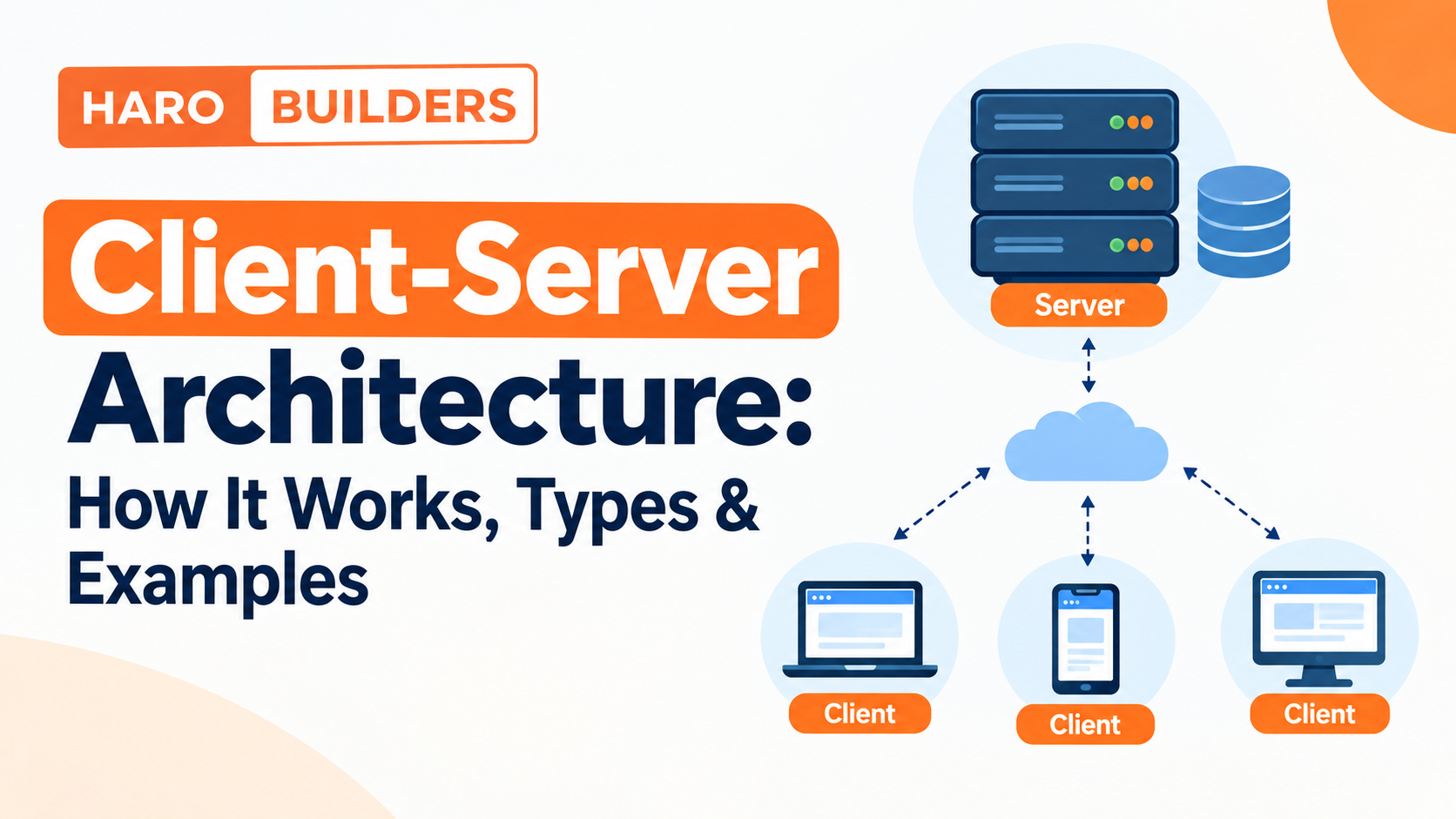
Client-server architecture is a computing model in which a client requests data, services, or resources from a server, and the server processes the request and returns a response over a network. The client is usually the application or device used to access a service, while the server provides the requested resource or performs the required processing.
This model is used in websites, email systems, online banking, enterprise applications, database systems, file sharing, SaaS platforms, and many other networked applications. A client can communicate with one or several servers, and a server can handle requests from many clients.
In simple terms: the client asks for something, the server handles the request, and the server sends the result back.
Basic flow:
Client → Request → Network → Server → Processing → Response → Client
What Is Client-Server Architecture?
Client-server architecture is a network and software architecture in which responsibilities are divided between clients and servers.
A client initiates a request for a service or resource. The server receives that request, performs the required processing, accesses resources such as databases or files when necessary, and sends a response.
For example, when you open a website, your web browser acts as the client. It communicates with server-side infrastructure to request the resources needed to display the page.
The important point is that “client” and “server” describe roles, not necessarily specific physical computers. A single machine can perform different roles in different situations, and modern applications can contain multiple servers, services, databases, caches, and load balancers.
Client-Server Architecture at a Glance
| Component | Main role |
|---|---|
| Client | Initiates requests and presents or uses responses |
| Server | Provides services, processes requests, or manages resources |
| Network | Carries communication between components |
| Protocol | Defines how communication takes place |
| Database | Stores and retrieves application data |
| Application server | Executes application or business logic |
| Web server | Handles web requests and related content/proxy functions |
| API | Provides a structured way for software components to communicate |
The exact architecture depends on the application. A simple system might have one client and one server, while a larger application can contain several specialized services.
How Does Client-Server Architecture Work?
Most client-server systems follow a request-and-response pattern.
1. The Client Sends a Request
The process begins when a user or another application needs a service.
Examples include:
- Opening a webpage
- Logging into an account
- Requesting customer information
- Sending an email
- Downloading a file
- Checking an order
- Submitting an online form
The client creates a request containing the information required by the server.
2. The Request Travels Through a Network
The request is transmitted through a network using the communication protocols required by the system.
For an internet-based web application, the request may pass through several components before reaching the application that ultimately handles it.
A private company network can also use the same client-server model without relying on the public Internet.
3. The Server Receives the Request
The server receives the request and determines what needs to happen.
Depending on the application, it may:
- Authenticate the user
- Check permissions
- Validate submitted information
- Execute business logic
- Query a database
- Retrieve a file
- Call another API
- Process data
- Return an error if the request cannot be completed
4. The Server Processes the Request
The server performs the work required to satisfy the request.
For example, an online shopping application might receive a request for product information. The application could query its database, check inventory, apply business rules, and prepare the required response.
5. The Server Sends a Response
After processing the request, the server returns a response.
The response might contain:
- HTML
- JSON
- XML
- Database results
- A file
- An authentication result
- An error message
- Another type of application data
6. The Client Uses the Response
The client receives the response and uses it appropriately.
A browser may render HTML and display a webpage. A mobile application may convert JSON data into a product screen. A desktop application may display information returned from a database server.
Simple request-response model
User action → Client → Request → Server → Processing → Response → Client → User
This request-and-response relationship is one of the defining characteristics of client-server computing.
Client-Server Architecture Example: Opening a Website
Consider what happens when someone opens an online store.
A simplified architecture might look like this:
Browser → Web Server/Proxy → Application Server → Database
The browser is the client. The web or proxy layer receives and routes the request. The application layer applies business logic, and the database provides stored information.
A simplified process could be:
- The user enters a website address.
- The browser initiates a request.
- Network services help locate the destination.
- Web infrastructure receives the request.
- Application logic determines what information is needed.
- The application retrieves data from the database.
- The application prepares the response.
- The response travels back toward the browser.
- The browser displays the result.
In a modern application, these responsibilities may be distributed across multiple machines or services rather than a single physical server.
What Are the Main Component s of Client-Server Architecture?
Client
The client is the requesting side of the system.
Common clients include:
- Web browsers
- Mobile applications
- Desktop applications
- Email applications
- Database tools
- IoT applications
- Other backend services
A client usually handles some combination of user interaction, presentation, local processing, and request generation.
Server
👉A server provides a service or resource to clients.
A server can:
- Process requests
- Run application logic
- Store data
- Authenticate users
- Manage files
- Provide APIs
- Handle network services
A server does not have to mean one physical computer.
Network
The network provides the communication path between the client and server.
It might be:
- A local area network
- Corporate network
- Private cloud network
- Wide-area network
- Public Internet
Therefore, client-server architecture does not require the public Internet.
Protocol
Protocols define how components communicate.
Depending on the system, protocols can include HTTP, HTTPS, TCP/IP, SMTP, FTP, database protocols, or application-specific protocols.
Database
Many client-server applications rely on databases to store information such as:
- Users
- Products
- Orders
- Customer records
- Transactions
- Content
- Application settings
The application does not necessarily expose the database directly to the client. In a three-tier architecture, the application layer commonly sits between the client and data layer.
Web Server vs Application Server vs Database Server
These terms are related but describe different responsibilities.
| Server type | Primary responsibility | Example role |
|---|---|---|
| Web server | Handles web requests and web-facing resources | Serves or routes HTTP traffic |
| Application server | Runs application/business logic | Processes orders or user actions |
| Database server | Stores and retrieves data | Returns customer or product records |
| File server | Provides shared files | Stores documents for authorized users |
For a deeper explanation of the application layer, see HaroBuilder’s guide to what an application server does.
An application server is a software role rather than necessarily a dedicated physical machine. It can run on physical infrastructure, a virtual machine, a cloud instance, or a containerized environment.
What Are the Types of Client-Server Architecture?
Client-server systems can be organized into different tiers depending on where presentation, business logic, and data responsibilities are located.
1-Tier Architecture
In a one-tier architecture, the user interface, application logic, and data may operate within the same environment.
For example:
User Interface + Application Logic + Data
This model is common in standalone applications and simpler systems.
Strictly speaking, a one-tier application is not the classic networked client-server arrangement because the major responsibilities may reside within the same environment.
2-Tier Architecture
Two-tier architecture separates the client from a server.
A common structure is:
Client → Database Server
The client may handle:
- User interface
- Some application logic
- Request generation
The server generally handles:
- Database operations
- Data storage
- Data retrieval
Two-tier architecture can be straightforward to build, but large deployments can become difficult to maintain if many clients contain significant application logic.
3-Tier Architecture
Three-tier architecture separates the application into three logical tiers:
- Presentation tier
- Application/business logic tier
- Data tier
A simplified model is:
Client → Application Server → Database
The presentation tier handles interaction with the user. The application tier processes business rules, while the data tier manages application data.
IBM describes the three tiers as presentation, application, and data tiers and notes that separating these responsibilities can allow individual tiers to be developed, maintained, and scaled independently.
For more information about how application servers fit into this structure, see HaroBuilder’s application server guide.
N-Tier or Multi-Tier Architecture
N-tier architecture extends the layered approach by separating additional responsibilities.
A larger system might include:
Client → Web Layer → Application Layer → Authentication Service → Cache → Database → External APIs
The advantage is that different responsibilities can be isolated and managed independently.
The trade-off is complexity.
More components mean more:
- Network communication
- Monitoring
- Deployment requirements
- Failure points
- Security boundaries
- Operational decisions
Three-tier architecture and n-tier architecture are therefore not simply “more servers.” They describe how application responsibilities are divided into logical or physical tiers.
Client-Server Architecture Diagram
A basic client-server model looks like this:
Client
↓
Network
↓
Server
↓
Database / Resources
A modern web application can be more complex:
Browser / Mobile App
↓
Web Server / Reverse Proxy
↓
Application Server
↓
Database / Cache / External APIs
The important concept is the separation of responsibilities rather than the number of physical machines.
Logical tiers also do not always correspond one-to-one with physical servers. Multiple tiers can run on one machine in a small deployment, while larger systems can distribute them across several machines.
What Technologies Support Client-Server Communication?
HTTP and HTTPS
Web browsers and web applications commonly use HTTP or HTTPS to exchange requests and responses.
HTTPS adds encrypted transport through TLS, helping protect information while it travels between communicating endpoints.
DNS
DNS helps applications locate network destinations using domain names rather than requiring users to remember IP addresses.
TCP/IP
TCP/IP provides core networking protocols used by many client-server systems.
APIs
APIs provide defined interfaces through which software components can request data or services.
For example:
Mobile App → API → Application → Database
The mobile application does not necessarily need direct access to the database.
Real-World Examples of Client-Server Architecture
| Example | Client | Server-side component |
|---|---|---|
| Website | Web browser | Web/application infrastructure |
| Email application | Mail server | |
| Online banking | Browser/mobile app | Application and database services |
| E-commerce | Browser/mobile app | Web, application and database services |
| Database application | Business application | Database server |
| File sharing | File client | File server |
| SaaS application | Browser/mobile app | Cloud application services |
| Enterprise software | Desktop/web client | Application and database infrastructure |
The exact architecture varies by product. Modern systems frequently use several backend services rather than a single server.
What Are the Advantages of Client-Server Architecture?
1. Centralized Data Management
Important information can be managed through centralized server infrastructure.
This can simplify:
- Data policies
- Access control
- Backups
- Data management
- Administration
2. Resource Sharing
Multiple clients can access shared:
- Databases
- Files
- Applications
- Storage
- Authentication services
- Other resources
3. Centralized Access Control
Authentication and authorization can be managed centrally.
That makes it possible to establish consistent policies across multiple clients.
4. Easier Administration
Important services can often be managed from the server side rather than individually configuring every client.
5. Centralized Backup
Organizations can build backup procedures around centrally managed application and database resources.
However, centralization does not automatically guarantee successful disaster recovery. Backups still need appropriate retention, testing, redundancy, and recovery procedures.
6. Support for Multiple Clients
A server can provide services to many clients at the same time, subject to the application’s capacity and architecture.
7. Centralized Business Logic
Important application rules can reside on the server side instead of being duplicated across every client.
8. Potential for Scalability
Server infrastructure can be expanded as demand increases through additional resources, additional instances, caching, load balancing, or other techniques.
What Are the Disadvantages of Client-Server Architecture?
1. Server Dependency
If a critical server becomes unavailable, clients may lose access to important services.
2. Network Dependency
Network problems can result in:
- Slow responses
- Timeouts
- Failed requests
- Interrupted sessions
- Unavailable services
3. Server Bottlenecks
A server can become overloaded when request volume exceeds its available resources.
Possible bottlenecks include:
- CPU
- Memory
- Database performance
- Storage
- Network bandwidth
- Application code
- Concurrent connections
If the problem is server overload or service availability, HaroBuilder’s guide to HTTP 503 Service Unavailable errors provides additional context.
4. Infrastructure Costs
Client-server environments can require:
- Servers
- Storage
- Networking
- Security controls
- Monitoring
- Backups
- Maintenance
- Skilled administration
Cloud services change how these resources are provisioned, but they do not eliminate operational requirements.
5. Greater Administrative Complexity
Larger systems require careful management of servers, databases, applications, security, monitoring, backups, and deployments.
6. Centralized Security Risk
Centralized systems may contain valuable data and services in a relatively concentrated infrastructure.
A security failure can therefore have significant consequences.
7. Availability Risks
A poorly designed architecture can contain a critical component whose failure affects many users.
Redundancy, failover, replication, monitoring, and load balancing can reduce this risk.
Client-Server Architecture Pros and Cons
| Advantages | Disadvantages |
|---|---|
| Centralized data management | Server dependency |
| Shared resources | Network dependency |
| Centralized access control | Potential bottlenecks |
| Easier administration | Infrastructure costs |
| Centralized backups | Greater operational complexity |
| Supports multiple clients | Centralized security risks |
| Can scale with infrastructure | Availability challenges |
| Centralized business logic | Requires technical administration |
The right choice depends on the application’s workload, security requirements, availability expectations, budget, and operating environment.
Is Client-Server Architecture Secure?
Client-server architecture can support strong security controls, but the architecture itself does not automatically make a system secure.
Important controls include:
Authentication
Authentication verifies who a user or system is.
Examples include:
- Passwords
- Security tokens
- Certificates
- Multi-factor authentication
Authorization
Authorization determines what an authenticated entity is allowed to do.
For example, an employee might be allowed to view a record while an administrator can create, modify, or delete it.
Authentication and authorization are separate concepts. OWASP specifically distinguishes identity verification from determining whether a requested action is permitted.
Encryption
Encryption can protect data while it travels between systems and, depending on the implementation, while data is stored.
Access Control
Access-control policies restrict users or services from accessing resources they do not need.
Monitoring
Logs and monitoring can help identify suspicious behavior, errors, availability problems, and operational issues.
Security therefore depends on implementation, configuration, maintenance, and operational practices.
How Does Client-Server Architecture Affect Performance?
Performance depends on the entire request path rather than the server alone.
Important factors include:
- Network latency
- Server CPU
- Memory
- Database performance
- Storage
- Application code
- Number of concurrent users
- API response time
- Caching
- Load distribution
For example, adding more application servers will not necessarily solve a problem if the database is already the bottleneck.
Useful performance techniques include:
- Caching
- Database optimization
- Connection pooling
- Load balancing
- Code optimization
- Faster storage
- Query optimization
- Performance monitoring
The correct solution depends on the actual bottleneck.
Is Client-Server Architecture Scalable?
Yes. Client-server architecture can scale, but scalability depends on the design and deployment.
A small system might start with one server. As demand increases, the organization can add resources or additional server instances.
Vertical Scaling
Vertical scaling means increasing the resources of an existing machine.
Examples:
- More CPU
- More RAM
- More storage
Horizontal Scaling
Horizontal scaling means adding additional machines or service instances.
For example:
Users → Load Balancer → Server A
** → Server B**
** → Server C**
Horizontal scaling can improve capacity and redundancy, but it also introduces challenges involving distributed state, networking, monitoring, and data consistency.
For a deeper explanation of scaling strategies, see HaroBuilder’s guide to scalability. That guide also covers load balancing, caching, database bottlenecks, horizontal scaling, and performance measurement.
Client-Server vs Peer-to-Peer Architecture
These architectures organize responsibilities differently.
| Factor | Client-Server | Peer-to-Peer |
|---|---|---|
| Control | Generally centralized | More distributed |
| Main service provider | Dedicated server infrastructure | Participating peers |
| Resource management | Often centralized | More distributed |
| Administration | Centralized management | More decentralized |
| Server dependency | Usually higher | Often lower |
| Scaling | Add server capacity or instances | Depends on peer participation |
| Security management | Can be centrally controlled | More distributed |
| Typical use | Websites, enterprise systems, databases | Peer-based resource sharing |
Neither model is automatically appropriate for every application. The architecture should follow the requirements of the system.
When Should You Use Client-Server Architecture?
Client-server architecture is a strong architectural fit when an application needs centralized services, shared resources, or controlled access.
It can make sense when you need:
- Centralized data
- Multiple users
- Shared databases
- Centralized authentication
- Centralized business logic
- Controlled access
- Shared files or resources
- Centralized administration
- Server-side processing
- Consistent application rules
For example, an enterprise application used by many employees may benefit from centralizing important business data and application services rather than maintaining independent copies on every employee’s computer.
When Might Client-Server Architecture Be a Poor Fit?
It may not be appropriate when:
- The application is completely standalone
- Centralized services provide little benefit
- Reliable network communication is unavailable
- The requirements favor decentralized operation
- Infrastructure and administration costs outweigh the benefits
Architecture should be selected according to the application’s actual requirements rather than simply because a particular pattern is common.
Common Misconceptions About Client-Server Architecture
“There is only one server.”
Not necessarily.
A client-server application can use multiple application servers, databases, caches, load balancers, and other services.
“The client does no processing.”
Incorrect.
Clients can handle presentation, validation, local processing, state management, and other tasks.
“The server must be a physical computer.”
Not necessarily.
A server can describe a software role running on physical hardware, a virtual machine, container, cloud instance, or managed platform.
“Client-server architecture requires the Internet.”
No.
A client and server need a communication network, but that network can be local, private, enterprise-based, or public.
“Centralized means automatically secure.”
No.
Centralization can make some security controls easier to administer, but vulnerabilities can still exist.
“Client-server architecture cannot scale.”
Incorrect.
Client-server systems can scale vertically or horizontally when designed appropriately.
“Three-tier architecture and client-server architecture are identical.”
Not exactly.
Client-server describes the relationship between requesting and providing components. Three-tier architecture describes a particular separation of presentation, application, and data responsibilities.
Client-Server Architecture Best Practices
When designing or evaluating a client-server system:
- Define clear responsibilities between clients and servers.
- Secure communication between components.
- Use authentication and authorization appropriately.
- Avoid unnecessary direct database access from clients.
- Monitor the actual system bottlenecks.
- Design for failure where availability matters.
- Use caching where repeated data access justifies it.
- Use load balancing when multiple service instances are required.
- Keep sensitive data and business rules appropriately protected.
- Plan backups and recovery procedures.
- Measure performance before adding infrastructure.
- Choose architecture complexity according to actual requirements.
A scalable architecture is not simply one with more servers. Adding infrastructure without identifying the real bottleneck can increase complexity without solving the underlying problem. HaroBuilder’s scalability guide discusses this distinction in greater detail.
Frequently Asked Questions
What is client-server architecture?
Client-server architecture is a computing model where a client requests services or resources from a server over a network. The server processes the request and returns a response.
How does client-server architecture work?
A client sends a request, the server receives and processes it, the server may access databases or other resources, and then it sends a response back to the client.
What are the main components of client-server architecture?
The main components are clients, servers, a communication network, communication protocols, and backend resources such as databases or file systems.
What are the types of client-server architecture?
Common architectural arrangements include one-tier, two-tier, three-tier, and n-tier or multi-tier architectures.
What is two-tier client-server architecture?
Two-tier architecture commonly separates the client from a server, such as a desktop application communicating directly with a database server.
What is three-tier architecture?
Three-tier architecture separates presentation, application/business logic, and data responsibilities into three logical tiers.
What is an example of client-server architecture?
A website is a common example. A browser acts as the client while web and application infrastructure processes requests and provides the required response.
What are the advantages of client-server architecture?
Advantages include centralized data management, resource sharing, centralized access control, easier administration, support for multiple clients, and the ability to scale server infrastructure.
What are the disadvantages of client-server architecture?
Common disadvantages include server dependency, network dependency, infrastructure costs, potential bottlenecks, operational complexity, and availability risks.
Is client-server architecture scalable?
Yes. A client-server system can scale vertically by increasing resources on existing infrastructure or horizontally by adding additional servers or service instances.
Is client-server architecture secure?
It can be secure when implemented correctly, but security depends on authentication, authorization, encryption, access control, patching, monitoring, configuration, and other controls.
Does client-server architecture require the Internet?
No. Client-server communication only requires a network connection between the relevant components. That network can be local, private, enterprise-based, or public.
What is the difference between client-server and peer-to-peer architecture?
Client-server architecture generally uses dedicated server infrastructure to provide services to clients, while peer-to-peer systems allow participating devices to provide services or resources to each other.
What is the difference between a web server and an application server?
A web server primarily handles web-facing requests and resources, while an application server provides an environment for application or business logic. In larger systems, both can work together.
Key Takeaways
- Client-server architecture divides responsibilities between requesting clients and service-providing servers.
- The basic pattern is request → processing → response.
- A server does not have to mean one physical machine.
- Two-tier, three-tier, and n-tier architectures divide responsibilities in different ways.
- Modern applications can use web servers, application servers, databases, caches, APIs, and load balancers together.
- Client-server architecture can provide centralized data, resource sharing, access control, and administration.
- Its challenges include server dependency, network dependency, bottlenecks, infrastructure costs, and operational complexity.
- Security depends on implementation rather than the architecture label.
- Client-server systems can scale vertically or horizontally.
- The appropriate architecture depends on workload, security, availability, budget, and system requirements.
Conclusion
Client-server architecture remains a fundamental model for building networked applications and services. Its basic idea is simple: a client requests something, a server provides or processes it, and the result is returned to the client.
The implementation can be much more sophisticated than the traditional image of one computer talking to another. Modern systems can distribute responsibilities across web servers, application servers, databases, caches, APIs, load balancers, and redundant infrastructure.
The best architecture is therefore not determined by the number of servers or tiers alone. It should be based on what the application needs to accomplish, how many users it must support, how sensitive its data is, how much availability is required, and how much operational complexity the organization can manage.
For more practical technology and SEO resources, explore HaroBuilder’s guides and resources.


💬 Comments 0
No comments yet. Be the first to share your thoughts! 💬
✍️ Leave a Comment