
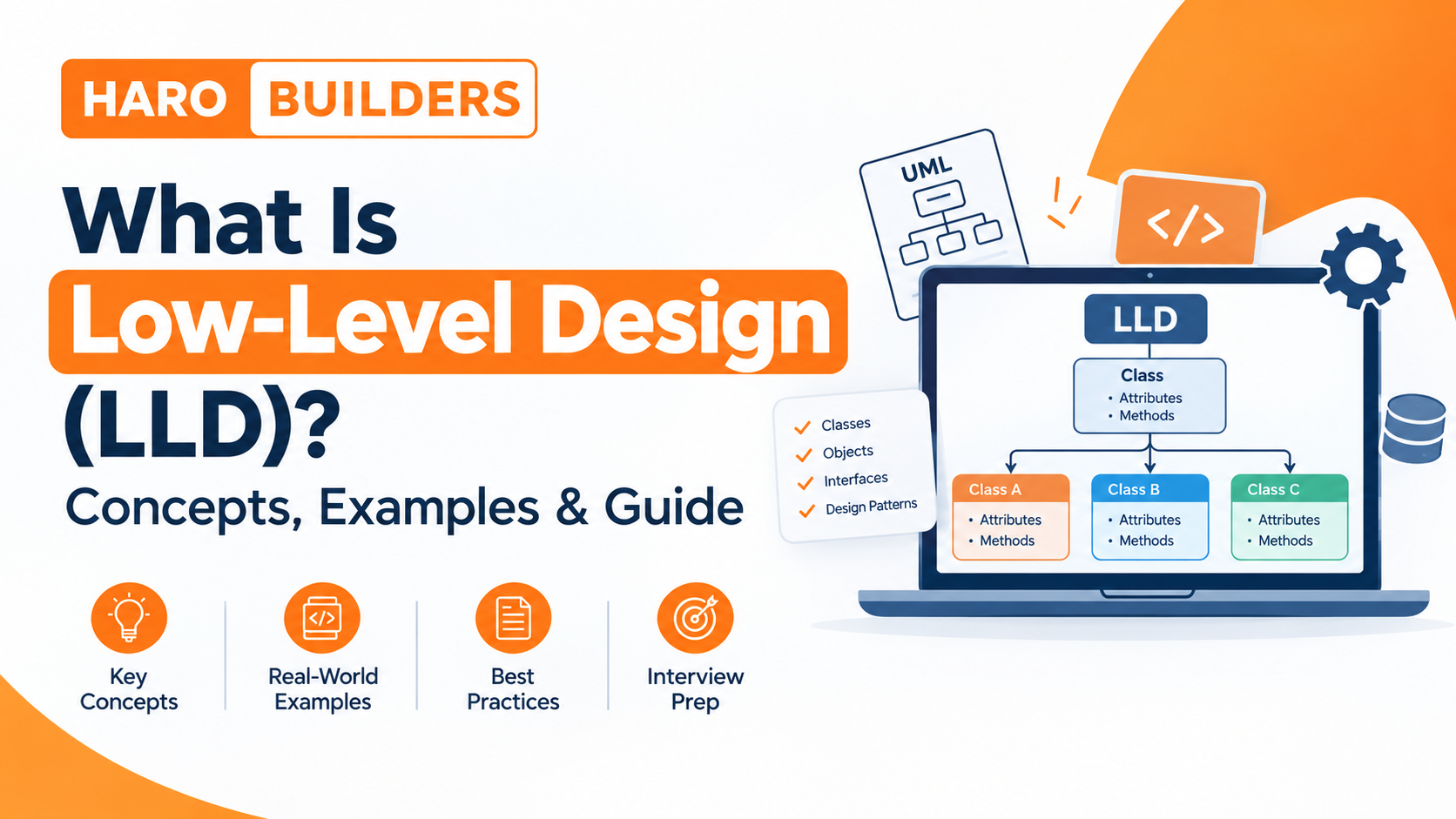
Low-level design (LLD) is the detailed design stage of software development where a system or component is broken down into classes, objects, interfaces, methods, relationships, data structures, and implementation-level behavior.
In simple terms, high-level design explains what major parts a system needs, while low-level design explains how those parts should be structured and work together in code.
LLD is useful in real software development as well as software engineering interviews. It helps developers think through responsibilities, dependencies, extensibility, and edge cases before implementation.
Quick Answer: What Is Low-Level Design (LLD)?
Low-level design (LLD) is the detailed, component-level design of software. It describes how individual modules or components should be implemented, including their classes, methods, interfaces, relationships, responsibilities, and interactions.
A good LLD acts as a bridge between a broader architecture and working code. It gives developers enough detail to understand how a component should behave without prescribing every line of the final implementation.
What Does LLD Mean in Software Engineering?
In software engineering, LLD focuses on the internal structure of a software component.
Suppose a high-level design says that an application needs a Notification Service.
That statement does not explain:
- Which classes are required
- Which class sends the notification
- How email and SMS should be supported
- How new notification channels can be added
- Which methods each class exposes
- How objects communicate
- Where validation belongs
- How failures are handled
LLD addresses those questions.
A simplified flow looks like this:
Requirements → High-Level Design → Low-Level Design → Code → Testing
HLD establishes the broader system structure. LLD takes an individual component or module and works out its internal design.
That distinction is also reflected in current software-engineering references, which describe LLD as detailed component-level design while HLD concentrates on the broader architecture.
How Does Low-Level Design Fit Into Software Development?
LLD should not be viewed as a completely separate activity from architecture.
A typical software-development process might look like:
- Understand the requirements.
- Identify the major system components.
- Create the high-level architecture.
- Break important components into smaller responsibilities.
- Design classes, interfaces, methods, and relationships.
- Review edge cases and dependencies.
- Implement the design.
- Test and refine it.
For example, an application’s HLD might identify an API server, database, authentication service, and payment service.
The LLD for the payment component could then define classes such as:
Payment
PaymentProcessor
PaymentMethod
CardPayment
BankTransfer
PaymentRepository
PaymentValidator
The exact classes depend on the requirements. LLD is not about creating as many classes as possible; it is about creating a structure that makes the required behavior clear and manageable.
For a broader understanding of how system components communicate, see HaroBuilder’s guide to client-server architecture.
What Are the Main Components of LLD?
There is no single mandatory LLD document format for every project. The details depend on the software being designed.
However, several concepts commonly appear in low-level design.
Classes and Objects
A class defines the structure and behavior that objects created from it can have.
For example:
Class: Order

Attributes:
- orderId
- customer
- items
- status

Methods:
- addItem()
- removeItem()
- calculateTotal()
- cancelOrder()
An object is a concrete instance of that class.
The important LLD question is not simply:
“What classes can I create?”
It is:
“What responsibilities should each class own?”
A well-designed class should have a clear purpose rather than becoming a container for unrelated functionality.
Interfaces and Abstraction
An interface can define a contract without forcing other components to depend on a specific implementation.
For example:
NotificationSender

+ send(message)
Different implementations could then provide:
EmailNotificationSender
SMSNotificationSender
PushNotificationSender
The rest of the application can work with the NotificationSender abstraction instead of depending directly on one provider.
This becomes particularly useful when behavior may change or when multiple implementations need to coexist.
Methods and Method Signatures
LLD can specify the operations a component exposes.
For example:
PaymentProcessor

processPayment(amount, paymentMethod)
refund(transactionId)
getPaymentStatus(transactionId)
A method’s inputs, outputs, visibility, errors, and responsibilities can all influence the design.
The goal is to make the component’s contract understandable before implementation details become complicated.
Relationships Between Classes
Classes rarely work independently.
Common relationships include:
Association
Two classes know about or interact with each other.
Customer → OrderAggregation
One object contains or groups other objects, but the contained objects can conceptually exist independently.
Team → PlayerComposition
One object strongly owns another object’s lifecycle.
Order → OrderItemInheritance
A class derives behavior or structure from another class.
Vehicle
   ↓
Car
Dependency
One component temporarily relies on another to perform an operation.
Understanding these relationships helps prevent designs where every class becomes tightly connected to everything else.
LLD Principles Every Developer Should Understand
Low-level design is not simply about drawing class diagrams. The quality of the design depends heavily on the principles used to make decisions.
Encapsulation
Encapsulation keeps an object’s internal state and the operations that control it together.
Instead of allowing unrelated code to modify internal data freely, a class can expose controlled methods.
For example:
BankAccount

deposit()
withdraw()
getBalance()
Rather than allowing arbitrary code to manipulate the balance directly.
Abstraction
Abstraction hides unnecessary implementation details behind a simpler interface.
A payment component might expose:
processPayment()while internally handling validation, provider communication, retries, and transaction processing.
The caller does not need to know every internal step.
Inheritance
Inheritance allows one class to derive from another.
It can be useful when there is a genuine is-a relationship.
However, inheritance should not automatically be used whenever two classes share some attributes.
In many designs, composition provides a more flexible way to reuse behavior.
Polymorphism
Polymorphism allows different implementations to be used through a common abstraction.
For example:
PaymentMethod
    ↓
CardPayment
BankTransfer
WalletPayment
A payment processor can work with the PaymentMethod abstraction without needing separate logic for every implementation.
SOLID Principles
SOLID is a group of object-oriented design principles commonly applied when designing maintainable software.
Single Responsibility Principle
A class should have a focused responsibility rather than handling unrelated jobs.
For example, a User class should not necessarily handle authentication, email delivery, report generation, and database administration all at once.
Open/Closed Principle
Software components should generally be open to extension without requiring unnecessary modification to stable existing behavior.
Liskov Substitution Principle
Subtypes should behave consistently enough that they can be used where their parent abstraction is expected.
Interface Segregation Principle
Clients should not be forced to depend on methods they do not need.
Dependency Inversion Principle
Higher-level logic should depend on suitable abstractions rather than being tightly coupled to low-level implementation details.
SOLID principles are guidelines rather than mechanical rules. Applying them blindly can create unnecessary abstractions. Good LLD balances principles with the actual requirements.
Common LLD Design Patterns
Design patterns are reusable approaches to recurring design problems.
The important point is not to memorize patterns and insert them everywhere.
A pattern should solve a real problem.
| Pattern | Typical problem | Example |
|---|---|---|
| Factory | Object creation varies | Payment provider creation |
| Strategy | Behavior can change | Pricing algorithms |
| Observer | Multiple components need updates | Notification events |
| Adapter | Interfaces are incompatible | External API integration |
| Decorator | Add behavior without changing the core class | Logging or optional features |
| Facade | Hide subsystem complexity | Simplified service interface |
For example, suppose an application supports multiple pricing strategies:
PricingStrategy
      ↓
StandardPricing
DiscountPricing
PremiumPricing
A CheckoutService can depend on the PricingStrategy abstraction instead of containing a large collection of conditional statements.
That is more useful than choosing the Strategy pattern merely because it is a popular interview pattern.
UML Diagrams Used in LLD
UML can help developers communicate a design before writing implementation code.
Class Diagram
A class diagram can show:
- Classes
- Attributes
- Methods
- Relationships
- Visibility
- Multiplicity
For example:
+----------------+
|   Customer     |
+----------------+
| customerId     |
| name           |
+----------------+
| placeOrder()   |
+----------------+
        |
        | places
        ↓
+----------------+
|     Order      |
+----------------+
| orderId        |
| status         |
+----------------+
| calculateTotal |
| cancel()       |
+----------------+
Sequence Diagram
A sequence diagram focuses on the order of interactions.
For example:
Customer
   |
   | placeOrder()
   ↓
OrderService
   |
   | validate()
   ↓
Order
   |
   | save()
   ↓
OrderRepository
This helps answer:
Which object calls which component, and in what order?
Use-Case Diagram
Use-case diagrams are generally more focused on actors and their interactions with system functionality. They can help establish requirements before detailed component design.
The important thing is not to create diagrams for their own sake. A diagram should make a design easier to understand.
Low-Level Design Example: Notification System
A simple notification system provides a useful way to see LLD in practice.
Imagine the requirement is:
Users should be able to receive notifications through email or SMS, and the system should be easy to extend with additional notification channels later.
Step 1: Identify the behavior
The application needs to send a message.
Instead of creating separate high-level application logic for every channel, identify a common capability:
NotificationSender

send(message)
Step 2: Create implementations
EmailNotificationSender
SMSNotificationSender
Both implement the common notification contract.
Step 3: Create a coordinator
A service can coordinate the operation:
NotificationService

sendNotification(sender, message)
Conceptually:
                  NotificationSender
                         |
              +----------+----------+
              |                     |
        EmailSender             SMSSender
              |                     |
              +----------+----------+
                         |
                NotificationService
Step 4: Think about future change
Suppose the business later asks for push notifications.
A poorly structured design might require changes throughout the application.
With a suitable abstraction, another implementation can be introduced:
PushNotificationSenderThe exact implementation will depend on the system, but the important LLD principle is clear:
Design the abstraction around the behavior that genuinely needs to vary.
This is one reason interfaces, polymorphism, and appropriate design patterns appear so often in LLD discussions.
How to Create a Low-Level Design Step by Step
A practical LLD process can be more useful than memorizing definitions.
1. Understand the Requirements
Before creating classes, determine what the system actually needs to do.
Ask:
- What are the main use cases?
- Who interacts with the system?
- What information must be stored?
- What behavior can change?
- What constraints matter?
Do not start by drawing classes.
2. Identify the Main Entities
Look for important concepts in the requirements.
For an online ordering system, these might include:
Customer
Order
Product
Cart
Payment
Shipment
These are candidates, not automatic classes.
Each candidate should be evaluated based on its responsibility.
3. Assign Responsibilities
Ask:
What should this component own?
For example:
Order
- Track order information
- Manage order state
- Calculate order-related values
Payment
- Represent payment information
- Track payment state
PaymentProcessor
- Coordinate payment processing
This separation prevents one class from becoming a “god object.”
4. Define Relationships
Next determine how components interact.
Ask:
- Which class owns this data?
- Which class uses this behavior?
- Is the relationship permanent?
- Can one component exist independently?
- Should the relationship use an interface?
This is where association, composition, aggregation, inheritance, and dependency decisions become useful.
5. Identify Behavior That May Change
This is one of the most valuable LLD questions:
What is likely to vary?
Examples:
- Payment methods
- Notification channels
- Pricing algorithms
- Authentication providers
- File-storage providers
- Shipping strategies
Potentially changing behavior can often be isolated behind an interface or suitable abstraction.
6. Define Interfaces
Use interfaces when they provide a meaningful contract.
For example:
PaymentGateway

authorize()
capture()
refund()
Possible implementations might include:
CardGateway
BankGateway
WalletGateway
The goal is to reduce unnecessary coupling, not to create an interface for every class.
7. Apply Design Principles
Review the design using principles such as:
- Encapsulation
- Abstraction
- Single Responsibility
- Open/Closed
- Dependency Inversion
- Low coupling
- High cohesion
Do not treat these as rigid checkboxes.
The right question is:
Does this principle improve this particular design?
8. Choose Design Patterns Only When Needed
If the design has a recurring problem that a pattern addresses, use one.
If the design does not need a pattern, don’t add one simply to make the diagram look sophisticated.
Overengineering can make a small application harder to understand.
9. Define Methods and State
At this stage, clarify:
- Method responsibilities
- Parameters
- Return values
- Object state
- Valid transitions
- Error conditions
- Dependencies
For example:
Order

place()
cancel()
pay()
ship()
deliver()
You should also think about whether every transition is valid.
Can a delivered order be cancelled?
Can an unpaid order be shipped?
LLD should make these rules explicit where they matter.
10. Test the Design Against Change
This is one of the best ways to review an LLD.
Ask:
What happens if a new requirement is added?
For the notification example:
Current: Email + SMS
New: Push notification
If adding push notifications requires changing many unrelated classes, the design may have excessive coupling.
If a new implementation can be added behind an existing abstraction with limited changes, the design may be easier to extend.
The objective is not zero changes. A good design simply keeps necessary changes localized.
LLD vs HLD: What’s the Difference?
The easiest way to understand the difference is to ask what question each design answers.
| Area | HLD | LLD |
|---|---|---|
| Main question | What major components does the system need? | How should a component be implemented? |
| Focus | Overall architecture | Detailed component design |
| Typical scope | System | Module, component, or feature |
| Examples | Services, databases, queues | Classes, methods, interfaces |
| Abstraction | Higher | Lower |
| Common artifacts | Architecture diagrams | Class/sequence diagrams |
| Main concerns | System structure and interactions | Responsibilities, behavior, relationships |
| Design patterns | Architectural patterns | Object-oriented/design patterns |
| Output | System-level blueprint | Implementation-level blueprint |
Current technical references make a similar distinction: HLD focuses on system architecture, while LLD focuses on detailed components and their internal behavior.
Simple example
Imagine an e-commerce application.
HLD might define:
Web App
   ↓
API Layer
   ↓
Order Service
   ↓
Payment Service
   ↓
Database
LLD for the Order Service might define:
Order
OrderItem
OrderService
OrderRepository
OrderValidator
PaymentProcessor
The two levels are related, but they answer different questions.
Why Is LLD Important?
A thoughtful low-level design can make software easier to understand and change.
Maintainability
Clear responsibilities make it easier to locate and modify behavior.
Testability
Smaller, well-defined components can be easier to test independently.
Extensibility
Good abstractions can make future changes more localized.
Readability
A clear design helps developers understand how the code is organized.
Collaboration
Explicit interfaces and responsibilities can make it easier for multiple developers to work on different parts of a system.
Reusability
Well-designed components can sometimes be reused without copying large amounts of logic.
LLD does not automatically make software scalable, fast, or reliable. Those qualities also depend on architecture, implementation, infrastructure, data design, testing, and operational decisions.
For a broader explanation of software scalability and the difference between scalability and performance, see HaroBuilder’s scalability guide.
Is LLD Only for Interviews?
No.
LLD is a real software-development activity, not simply an interview exercise.
Developers use detailed design thinking when deciding how modules, classes, interfaces, and components should interact.
Interviews emphasize LLD because candidates can demonstrate how they break down an ambiguous problem into responsibilities, relationships, abstractions, and implementable components.
A good interview answer therefore shouldn’t be a memorized class diagram.
It should show a reasoning process:
Requirements → Entities → Responsibilities → Relationships → Interfaces → Behavior → Trade-offs
LLD in Software Engineering Interviews
LLD interviews often test whether a candidate can translate requirements into a clean object-oriented design.
Common areas include:
- Object-oriented programming
- Classes and objects
- Encapsulation
- Abstraction
- Inheritance
- Polymorphism
- SOLID principles
- Design patterns
- Class relationships
- Interfaces
- Extensibility
- Error handling
- Trade-offs
Interviewers may also ask candidates to design systems such as:
- Parking lot
- Vending machine
- Elevator
- Library management system
- Notification system
- Payment system
- Task management system
- Meeting scheduler
The exact problem is less important than the design reasoning behind it.
Common LLD Interview Questions
Here are useful questions to practice:
1. What is low-level design?
Be able to explain LLD in one or two clear sentences.
2. How is LLD different from HLD?
Explain the difference in scope, abstraction, artifacts, and purpose.
3. How would you identify classes?
Start from requirements, entities, responsibilities, and behavior rather than blindly turning every noun into a class.
4. When should you use an interface?
Explain the need for a stable contract or interchangeable implementations.
5. When should you use composition instead of inheritance?
Discuss the relationship and how behavior needs to vary.
6. How do you apply SOLID principles?
Give an example rather than simply reciting the acronym.
7. Which design pattern would you use?
First explain the problem. Then explain why the selected pattern fits.
8. How would your design handle a new requirement?
This tests extensibility and coupling.
9. How would you test the design?
Think about unit boundaries, component interactions, validation, and important edge cases.
10. How would you simplify an overengineered design?
This tests whether you understand that good LLD is not the same as maximum abstraction.
Common Low-Level Design Mistakes
Starting With Classes Too Early
Requirements should come before the class diagram.
Creating Too Many Classes
More classes do not automatically mean better design.
Overusing Inheritance
Inheritance can create rigid relationships when composition would be simpler.
Forcing Design Patterns
A pattern should solve a real problem.
Creating Giant Classes
A class that manages validation, persistence, notifications, payments, and reporting is usually carrying too many responsibilities.
Ignoring State
Objects often behave differently depending on their current state.
Ignoring Edge Cases
An apparently simple design can break when invalid input, duplicate requests, failures, or unexpected transitions occur.
Tight Coupling
If changing one implementation requires modifications across many unrelated components, the design may be too tightly coupled.
Overengineering
Designing for hypothetical requirements can make a simple system harder to maintain.
A good LLD should be detailed enough to make implementation clear without becoming unnecessarily complicated.
LLD Best Practices Checklist
Before considering an LLD complete, ask:
- Have the requirements been clarified?
- Are the main responsibilities clearly assigned?
- Does each class have a focused purpose?
- Are relationships between classes understandable?
- Are interfaces used where they provide real value?
- Is unnecessary coupling avoided?
- Is the design reasonably cohesive?
- Are changing behaviors isolated where appropriate?
- Are design patterns justified?
- Are important edge cases considered?
- Are state transitions clear?
- Can the design accommodate realistic changes?
- Is the design understandable to another developer?
- Can important components be tested independently?
If the answer is yes to most of these questions, the design is much easier to review and implement.
A Practical Way to Think About LLD
When you face a new design problem, don’t immediately ask:
“Which design pattern should I use?”
Start with:
What does the system need to do?
Then:
What are the important entities?
Then:
What responsibility belongs to each entity?
Then:
How should those entities communicate?
Then:
What behavior is likely to change?
Then:
What abstraction would make that change easier?
Only after that should you decide whether a particular design pattern or principle is useful.
This approach keeps the design connected to the actual requirements.
Key Takeaways
- LLD means Low-Level Design.
- It focuses on the detailed structure and behavior of software components.
- LLD commonly deals with classes, objects, methods, interfaces, relationships, and implementation-level behavior.
- HLD describes the broader architecture; LLD goes deeper into individual components.
- OOP concepts and SOLID principles are important foundations for LLD.
- Design patterns are useful when they solve recurring design problems.
- UML diagrams can help communicate structure and interactions.
- A good LLD should consider responsibilities, dependencies, state, extensibility, and edge cases.
- LLD is useful in real software development as well as technical interviews.
- The goal is not maximum abstraction. The goal is a design that is clear, maintainable, testable, and appropriate for the requirements.
For more technology and software-development resources, explore HaroBuilder.
Frequently Asked Questions About LLD
What is low-level design?
Low-level design is the detailed design of software components. It describes classes, objects, interfaces, methods, relationships, responsibilities, and interactions so developers can implement the required functionality.
What does LLD stand for?
LLD stands for Low-Level Design. It is also commonly described as detailed or component-level design.
What is LLD in software engineering?
LLD in software engineering focuses on how individual components or modules should be structured and implemented. It bridges broader architectural decisions and actual code.
What is the difference between LLD and HLD?
HLD focuses on the overall architecture and major system components. LLD focuses on the internal structure and behavior of individual components, such as classes, methods, interfaces, and relationships.
Is LLD the same as object-oriented design?
They overlap significantly, particularly in systems built using object-oriented programming. However, LLD can include more than object-oriented concepts, depending on the technology and system being designed.
What are the main components of LLD?
Common components include classes, objects, interfaces, methods, relationships, data structures, state, behavior, and sometimes UML diagrams or pseudocode.
What are common LLD design patterns?
Common examples include Factory, Strategy, Observer, Adapter, Decorator, and Facade. The appropriate pattern depends on the design problem rather than the popularity of the pattern.
Is LLD important for software developers?
Yes. Detailed design helps developers reason about responsibilities, dependencies, interactions, testability, and future changes before or during implementation.
Is LLD important for interviews?
Yes. LLD interviews commonly evaluate object-oriented design, SOLID principles, design patterns, class relationships, extensibility, and the ability to explain design decisions.
How do you create an LLD?
Start by understanding requirements, identify important entities, assign responsibilities, define relationships, identify changing behavior, create appropriate interfaces, apply relevant principles, select patterns where justified, and test the design against realistic changes.
Can LLD improve scalability?
LLD can contribute to maintainability and extensibility, but scalability is a broader system property. It also depends on architecture, infrastructure, databases, workload, performance, and operational design. HaroBuilder’s software scalability guide covers those broader considerations.
Conclusion
Low-level design is where software architecture becomes concrete.
Instead of stopping at statements such as “the system needs a payment service” or “the application needs notifications,” LLD asks what those components actually look like internally: which classes exist, what responsibilities they have, how they communicate, what interfaces they expose, and how the design can handle realistic changes.
The strongest LLD is not necessarily the most complicated one.
It is the design that makes the required behavior clear, keeps responsibilities manageable, limits unnecessary coupling, and gives developers a practical path toward implementation.
If you’re learning LLD for interviews, focus less on memorizing patterns and more on learning how to move from requirements → responsibilities → relationships → abstractions → implementation. That reasoning process is useful far beyond interview questions.


💬 Comments 0
No comments yet. Be the first to share your thoughts! 💬
✍️ Leave a Comment