
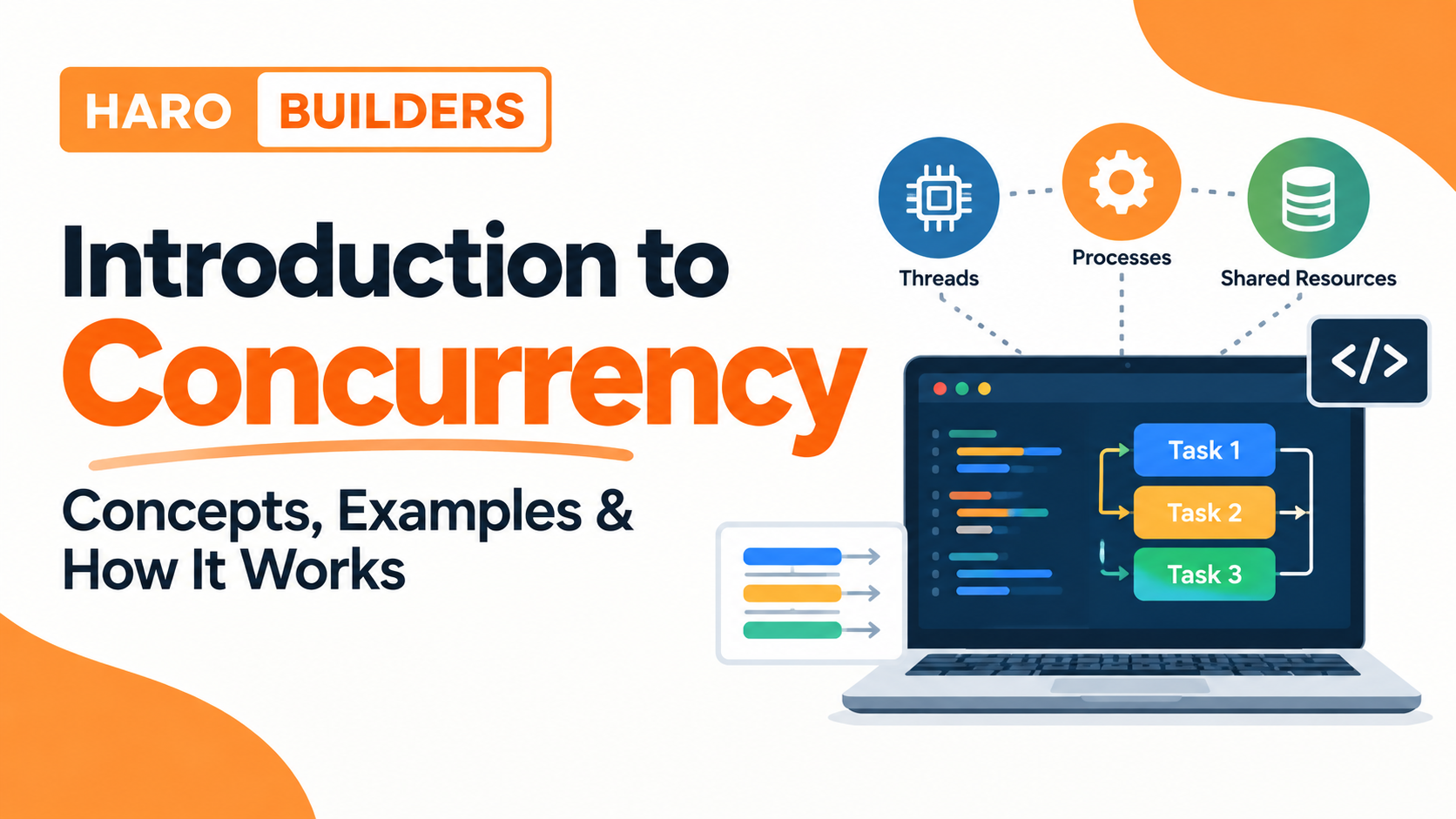
Modern software rarely performs only one task at a time. A web server may handle multiple requests, an application may download data while remaining responsive, and a database may process many operations from different users.
That is where concurrency becomes important.
Concurrency is the ability to structure a program so multiple tasks can make progress during overlapping periods. Those tasks do not necessarily execute at the exact same moment. A system can switch between tasks, allow one task to wait while another runs, or execute tasks simultaneously when suitable hardware and runtime support are available.
This guide explains what concurrency means, how it works, how it differs from parallelism, multithreading, and asynchronous programming, and why concepts such as race conditions, deadlocks, locks, and synchronization matter.
Quick Answer: What Is Concurrency in Programming?
Concurrency in programming is the ability to manage multiple tasks whose execution overlaps in time. A concurrent system can switch between tasks, let waiting tasks pause, and coordinate several independent activities without requiring every task to execute simultaneously.
For example, a web application can begin processing one user’s database request while another request is waiting for a network response. The application can use that waiting time to make progress on other work.
Concurrency is not the same as parallelism: concurrency is primarily about structuring and coordinating multiple activities, while parallelism means executing multiple computations at the same time.
What Does Concurrency Mean in Programming?
Imagine a developer has three tasks:
- Download a file.
- Query a database.
- Process user input.
A purely sequential program might handle them one after another:
Download → Database Query → User Input
If downloading takes several seconds because the network is slow, the program may spend much of that time waiting.
A concurrent design can allow the application to make progress on other work while one task is waiting:
Download ──────── waiting ───────── done
Database    ─────── processing ─── done
User Input  ── active ── active ── active
The exact implementation depends on the programming language, operating system, runtime, and application architecture.
The important idea is overlapping progress, not necessarily simultaneous execution.
On a single CPU core, the operating system or runtime can switch between tasks. On a multicore system, some concurrent tasks may also execute in parallel.
How Does Concurrency Work?
A concurrent program generally involves several related pieces.
1. Work Is Divided Into Tasks
The application identifies independent pieces of work.
For example, an e-commerce application might need to:
- validate a user’s request
- retrieve product information
- check inventory
- contact a payment service
- send a notification
Some of these operations may be independent or may spend time waiting for external resources.
2. Tasks Are Scheduled
The system needs a way to determine which task should run.
Scheduling may be handled by an operating system, language runtime, framework, event loop, executor, or another concurrency mechanism.
Some systems use preemptive scheduling, where the operating system can interrupt running work. Other models allow tasks to yield voluntarily.
3. Tasks May Be Interleaved
On a single execution core, the system can switch between tasks:
Task A → Task A → Task B → Task B → Task A → Task C
The tasks are making progress during overlapping periods even though the processor is not literally executing all of them at the same instant.
4. Tasks Can Wait
Waiting is one of the reasons concurrency is especially useful for I/O-heavy applications.
A task might be waiting for:
- a database response
- a network request
- a file operation
- user input
- another service
- a message from another component
Instead of leaving the entire application idle, the system can work on another task.
5. Tasks May Need Coordination
Concurrency becomes more complicated when multiple tasks access the same resource.
For example, two threads might attempt to update the same account balance or modify the same shared data structure.
Without appropriate coordination, the result can depend on timing.
That is where synchronization mechanisms become important.
Concurrency vs. Parallelism
Concurrency and parallelism are closely related, but they describe different ideas.
| Feature | Concurrency | Parallelism |
|---|---|---|
| Core idea | Multiple tasks make overlapping progress | Multiple computations execute simultaneously |
| Requires multiple CPU cores? | No | Physical simultaneous execution generally requires multiple execution resources |
| Main focus | Coordination and structure | Simultaneous execution |
| Single-core system | Possible | Not simultaneous |
| Multicore system | Can also run in parallel | Yes |
| Example | Handling several waiting network requests | Processing separate calculations on different CPU cores |
A useful mental model is:
Concurrency = dealing with multiple things
Parallelism = doing multiple things simultaneously
A concurrent program may therefore run sequentially at certain moments, interleave tasks on one core, or execute independent work in parallel on multiple cores.
Concurrency vs. Multithreading
Multithreading is one way to implement concurrency; concurrency itself is the broader concept.
A thread is an execution path inside a process. Multiple threads in the same process generally share resources such as memory and open files, which makes communication convenient but also creates synchronization challenges.
For example:
Process
│
├── Thread A
├── Thread B
└── Thread C
The threads can perform different tasks concurrently.
However, concurrent software does not have to rely exclusively on traditional threads. Other approaches include processes, asynchronous tasks, event loops, message passing, worker pools, and language-specific concurrency models.
So:
Concurrency is the goal or structure.
Multithreading is one implementation technique.
Concurrency vs. Asynchronous Programming
Asynchronous programming is another concept that often gets confused with concurrency.
An asynchronous operation can start work and allow the program to continue instead of blocking until that operation finishes.
For example:
Start API request
        ↓
Do other work
        ↓
API response arrives
        ↓
Process response
This can create concurrent progress, particularly when operations spend time waiting for external resources.
But asynchronous programming and concurrency are not perfect synonyms.
Concurrency describes overlapping activities. Asynchronous programming describes a way of structuring operations so that work can continue without waiting synchronously for completion.
Modern programming environments provide different approaches. Python, for example, provides threading, multiprocessing and asynchronous execution tools, with the appropriate approach depending partly on whether work is CPU-bound or I/O-bound.
Processes vs. Threads in Concurrent Programming
Processes and threads are two important execution units.
| Feature | Process | Thread |
|---|---|---|
| Memory | Usually isolated from other processes | Shares process resources |
| Communication | Often requires explicit inter-process mechanisms | Shared memory can make communication easier |
| Resource overhead | Generally higher | Generally lower |
| Isolation | Stronger | Weaker |
| Shared-state risk | Lower across process boundaries | Higher |
| Typical use | Independent workloads or stronger isolation | Concurrent tasks within an application |
Every process contains at least one thread, while a process can contain multiple threads. Threads share resources belonging to their process, which can make communication efficient but requires careful management of shared state.
This distinction becomes especially useful when designing software that needs to handle many concurrent operations.
Benefits of Concurrency
Concurrency can provide several practical advantages, but the benefit depends on the workload and implementation.
Better Responsiveness
A user interface can remain responsive while background work is occurring.
For example, an application can process a file in the background while still responding to keyboard and mouse events.
Java’s concurrency documentation uses similar examples: applications may need to handle network data, playback, display updates, and user interaction without making the entire interface unresponsive.
Better Use of Waiting Time
A program can start another useful operation while one task is waiting for I/O.
This is particularly relevant to applications that communicate with databases, APIs, files, or remote services.
Higher Throughput for Suitable Workloads
A server handling many independent requests can often make better use of available resources when requests can progress concurrently.
This is one reason concurrency is important in web applications and other server-side systems.
For example, HaroBuilder’s guide to client-server architecture explains how servers receive and process requests from multiple clients.
Support for Complex Applications
Modern applications frequently need to coordinate:
- user interactions
- network communication
- background jobs
- database operations
- notifications
- external APIs
- scheduled tasks
Concurrency provides programming models for managing these activities.
Common Concurrency Problems
Concurrency also introduces problems that do not usually appear in simple sequential programs.
Race Conditions
A race condition occurs when the result depends on the timing or ordering of concurrent operations.
Consider a shared counter:
counter = 10

Task A reads 10
Task B reads 10

Task A writes 11
Task B writes 11
If both tasks were supposed to increment the counter, the expected result might be 12, but the actual result could be 11.
The problem is not simply that two tasks exist. The problem is that their operations interact with shared state without adequate coordination.
Race conditions are a fundamental concurrency issue discussed in both operating-system and programming-language materials.
Deadlocks
A deadlock occurs when concurrent tasks become permanently blocked because each is waiting for a resource held by another.
A simple example:
Thread A:
Lock 1 → waits for Lock 2

Thread B:
Lock 2 → waits for Lock 1
Neither thread can continue.
Careful lock ordering, timeouts, resource design, and reducing unnecessary shared state can help prevent deadlocks.
Starvation
Starvation occurs when a task repeatedly fails to receive the resources or execution time it needs because other work continually gets priority.
Livelock
In a livelock, tasks remain active and respond to one another but fail to make useful progress.
Non-Deterministic Behavior
Concurrent programs can behave differently depending on timing and scheduling.
That can make bugs difficult to reproduce.
A program may work correctly during one test and fail under another timing pattern.
What Is Synchronization in Concurrency?
Synchronization is the coordination of concurrent tasks so shared resources and operations are handled safely.
Common synchronization mechanisms include:
- locks
- mutexes
- semaphores
- condition variables
- atomic operations
- barriers
A critical section is a portion of code where access to shared state needs controlled coordination.
A mutex or lock can provide mutual exclusion so that only an appropriate task enters a protected section at a time.
A semaphore can be used when a limited number of tasks should access a resource concurrently.
OpenStax describes locks, mutexes, semaphores, condition variables and critical sections as important mechanisms for coordinating concurrent activities and protecting shared resources.
What Is a Critical Section?
A critical section is code that accesses shared state and therefore requires controlled execution.
For example:
Acquire lock
     ↓
Read shared data
     ↓
Update shared data
     ↓
Release lock
The purpose is not to make the entire program sequential.
Instead, only the part that requires protection should be controlled.
Overusing synchronization can itself reduce concurrency and introduce unnecessary waiting.
What Are Atomic Operations?
An atomic operation is treated as a single indivisible action from the perspective of other concurrent operations.
For example, a simple-looking operation such as:
counter = counter + 1
may actually involve multiple lower-level steps.
Another task can potentially interact with the same value between those steps.
Atomic operations are designed for situations where an operation needs to occur without another concurrent operation observing an unsafe intermediate state.
Real-World Examples of Concurrency
Concurrency appears in many everyday systems.
Web Servers
A web server may receive requests from many users around the same time.
Requests may involve:
- database queries
- authentication
- API calls
- file access
- business logic
Handling these requests concurrently can prevent one slow operation from unnecessarily blocking unrelated work.
This connects naturally with application server architecture, where backend systems process requests and communicate with databases and other services.
Databases
Databases routinely deal with operations from multiple clients.
They need mechanisms for managing concurrent access while preserving data consistency.
Mobile and Desktop Applications
A mobile application might:
- respond to user input
- download data
- update its interface
- process notifications
- perform background work
These activities can overlap.
Background Workers
An application might place tasks into a queue and have worker processes or threads handle them concurrently.
This pattern is common for:
- sending emails
- generating reports
- processing images
- importing data
- running scheduled jobs
APIs and Distributed Systems
A modern application may communicate with several services at once.
For example:
Application
   ├── Payment API
   ├── User Service
   ├── Inventory Service
   └── Notification Service
The application may need to coordinate these operations while handling failures and timeouts.
For API-related design, HaroBuilder’s guide to idempotency is a useful related resource because repeated or concurrent requests can create problems when operations are not designed carefully.
Concurrency for I/O-Bound vs. CPU-Bound Work
One of the most useful practical distinctions is whether a workload is I/O-bound or CPU-bound.
I/O-Bound Work
An I/O-bound task spends significant time waiting for external resources.
Examples include:
- network requests
- database queries
- file operations
- API calls
Concurrency can be particularly useful here because one task can make progress while another is waiting.
CPU-Bound Work
A CPU-bound task spends most of its time performing computation.
Examples include:
- image processing
- large mathematical calculations
- compression
- certain simulations
- computational algorithms
For CPU-heavy workloads, parallel execution may be more important than simply creating more concurrent tasks.
The correct strategy depends on the language runtime, hardware and workload. Python’s documentation, for example, explicitly distinguishes concurrency tools based partly on CPU-bound versus I/O-bound work.
How Concurrency Relates to Scalability
Concurrency and scalability are related, but they are not the same thing.
Concurrency concerns how multiple activities are handled.
Scalability concerns how a system continues to handle increasing workload as demand grows.
A system may support concurrent requests but still fail to scale because of:
- database bottlenecks
- limited CPU
- insufficient memory
- connection limits
- lock contention
- slow external services
- inefficient algorithms
HaroBuilder’s guide to scalability explains how techniques such as horizontal scaling, load balancing, caching, queues and database strategies can help systems handle growing workloads.
The key lesson is:
More concurrency does not automatically mean better performance.
A concurrent design still needs appropriate resource management.
When Should You Use Concurrency?
Concurrency is worth considering when multiple activities can make useful progress independently or when tasks spend significant time waiting.
| Situation | Possible approach |
|---|---|
| Many network requests | Async or controlled concurrency |
| Database-heavy application | Concurrent request handling |
| Background jobs | Worker pools or task queues |
| CPU-heavy independent calculations | Parallel execution |
| Shared mutable state | Synchronization or redesign |
| Simple sequential workflow | Keep it sequential |
| High request volume | Concurrent server architecture |
The last point matters.
Do not add concurrency simply because the word sounds like an optimization.
Concurrent systems are harder to reason about. If a task is naturally sequential and performance is already acceptable, a simple sequential design may be the better engineering choice.
Common Concurrency Mistakes
1. Confusing Concurrency With Parallelism
A concurrent program does not automatically execute everything simultaneously.
2. Assuming More Threads Means More Speed
More threads can create scheduling, memory, synchronization, and communication overhead.
3. Sharing Too Much Mutable State
The more shared state a system has, the more coordination may be required.
4. Ignoring Race Conditions
If multiple tasks can access the same state, determine whether their operations are safe.
5. Holding Locks Too Long
Long critical sections can reduce concurrency and increase waiting.
6. Creating Unlimited Tasks
An application that launches an unbounded number of concurrent operations can overwhelm CPU, memory, databases, APIs, or other resources.
7. Ignoring Timeouts and Cancellation
External operations can fail or take much longer than expected. Concurrent systems need ways to stop or abandon work when appropriate.
8. Adding Concurrency to Simple Code
Concurrency increases complexity. It should solve a real problem rather than become an unnecessary architectural layer.
Concurrency in Software Design
Concurrency is not only an implementation detail.
It can influence how software components are designed.
When designing a system, developers should consider:
- Which tasks can run independently?
- Which resources are shared?
- Which operations must be ordered?
- Where can tasks wait?
- How are failures handled?
- How are tasks cancelled?
- What happens when workload increases?
- Which data needs synchronization?
- Can shared state be reduced?
These questions fit naturally into low-level software design.
For a broader introduction to component-level software design, see HaroBuilder’s Low-Level Design (LLD) guide.
A Simple Mental Model for Concurrency
Think about a restaurant.
A restaurant may have:
- customers placing orders
- cooks preparing meals
- servers delivering food
- cashiers processing payments
- suppliers delivering ingredients
The restaurant does not finish every customer’s entire process before starting the next one.
Different activities overlap.
That does not mean every activity happens at exactly the same moment.
This is a useful way to understand concurrency:
Multiple independent activities are organized so the overall system can make progress efficiently.
If several cooks actually prepare different meals at the same time, that adds an element of parallelism.
The distinction is subtle but important.
Frequently Asked Questions
What is concurrency in programming?
Concurrency is the ability to organize multiple tasks so their execution or progress overlaps in time. Tasks may be interleaved on one execution core or run simultaneously on multiple execution resources.
What is concurrency in computer science?
Concurrency is a way of structuring and coordinating multiple independently executing activities. It appears in operating systems, applications, databases, servers, distributed systems, and programming languages.
How does concurrency work?
A system divides work into tasks and uses scheduling, threads, processes, asynchronous operations, event loops, or other mechanisms to coordinate their progress. Tasks may alternate, wait for resources, communicate, or execute simultaneously when the environment allows it.
What is an example of concurrency?
A web server handling several user requests is a common example. While one request waits for a database response, the server can continue processing other requests.
What is the difference between concurrency and parallelism?
Concurrency means multiple tasks can make overlapping progress. Parallelism means multiple computations execute simultaneously. A concurrent system can exist on a single CPU core, while simultaneous parallel execution requires multiple execution resources.
Is concurrency the same as multithreading?
No. Multithreading is one technique for implementing concurrent software. Concurrency is the broader concept and can also be implemented using processes, asynchronous operations, event loops, message passing, and other models.
Is asynchronous programming the same as concurrency?
No. Asynchronous programming is a programming model that allows work to continue without synchronously waiting for an operation to finish. It can be used to build concurrent systems, but the terms describe different concepts.
What are the benefits of concurrency?
Potential benefits include better responsiveness, improved utilization of waiting time, higher throughput for suitable workloads, and the ability to manage many independent activities.
What are common concurrency problems?
Common problems include race conditions, deadlocks, starvation, livelocks, synchronization errors, excessive resource usage, and difficult-to-reproduce timing-dependent bugs.
What is a race condition?
A race condition occurs when the result of concurrent operations depends on their timing or ordering, especially when multiple tasks access shared state without sufficient coordination.
What is a deadlock?
A deadlock occurs when concurrent tasks become stuck waiting for resources held by one another, preventing the involved tasks from continuing.
Does concurrency always make programs faster?
No. Concurrency can improve responsiveness or throughput for appropriate workloads, but it can also introduce overhead, contention, synchronization costs, and additional complexity. More concurrency is not automatically better.
Key Takeaways
- Concurrency means managing multiple activities whose progress overlaps in time.
- Concurrency does not require multiple CPU cores.
- Parallelism means simultaneous execution, while concurrency is a broader organizational concept.
- Multithreading is one way to implement concurrency.
- Asynchronous programming can support concurrent workloads but is not synonymous with concurrency.
- Threads share process resources, which makes communication easier but increases shared-state risks.
- Race conditions and deadlocks are major concurrency problems.
- Locks, mutexes, semaphores, atomic operations, and other synchronization tools help coordinate concurrent work.
- I/O-bound workloads can benefit significantly from controlled concurrency.
- CPU-bound workloads may benefit more from parallel execution when the problem can be divided effectively.
- Concurrency should be introduced because it solves a real problem, not simply because it is technically possible.
Conclusion
Concurrency is one of the foundations of modern software development.
It allows applications to manage multiple activities without requiring every operation to finish before another can begin. That can improve responsiveness, resource utilization, and throughput when the workload and architecture are appropriate.
The most important distinction to remember is simple:
Concurrency is about dealing with multiple activities. Parallelism is about doing multiple computations simultaneously.
Once that distinction is clear, concepts such as threads, processes, asynchronous programming, synchronization, race conditions, and deadlocks become much easier to understand.
Concurrency also connects directly to larger software-engineering concerns such as application architecture, scalability, API design, and low-level design. For more practical software and technology resources, explore HaroBuilder.


💬 Comments 0
No comments yet. Be the first to share your thoughts! 💬
✍️ Leave a Comment