
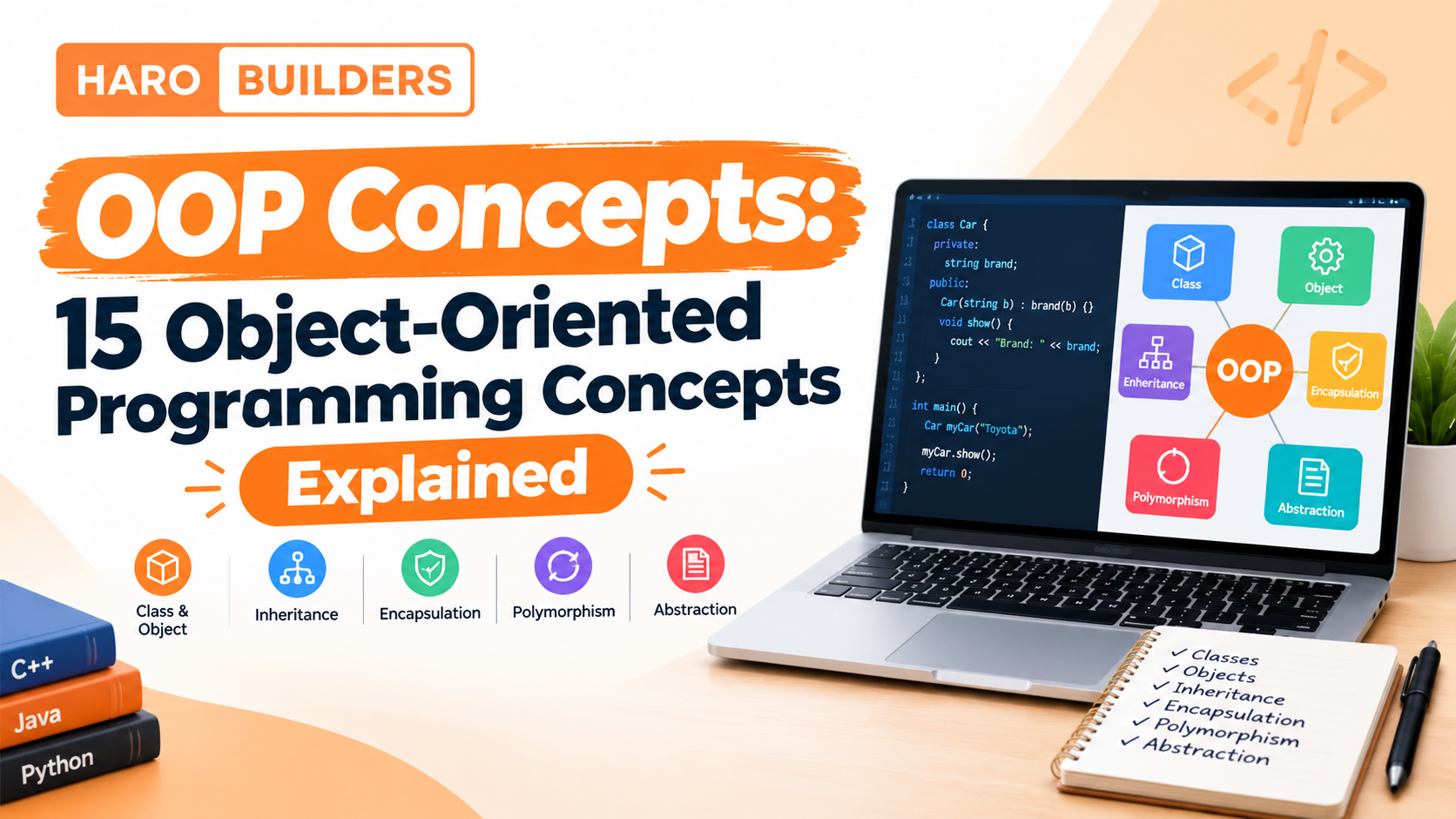
Object-oriented programming (OOP) is a programming paradigm that organizes software around objects, classes, data, and behavior. Instead of structuring a program only as a sequence of procedures, OOP groups related state and behavior into reusable components.
The most important OOP concepts include classes, objects, encapsulation, abstraction, inheritance, polymorphism, constructors, interfaces, abstract classes, association, aggregation, composition, dependency, method overloading, and method overriding.
Understanding these concepts helps developers write software that is easier to organize, maintain, extend, and reason about.
For developers moving from OOP fundamentals toward software architecture and detailed component design, [HaroBuilder’s Low-Level Design guide] provides a useful next step because LLD builds on concepts such as classes, objects, interfaces, relationships, encapsulation, abstraction, inheritance, and polymorphism.
Quick Answer: What Are OOP Concepts?
OOP concepts are the core ideas used to design software around objects and their interactions. The four commonly recognized pillars of OOP are encapsulation, abstraction, inheritance, and polymorphism. Other important concepts include classes, objects, constructors, interfaces, abstract classes, and relationships such as association, aggregation, composition, and dependency.
There is no universal official list containing exactly 15 OOP concepts. The 15 concepts in this guide provide a practical learning framework that combines foundational OOP ideas with commonly used object relationships and programming techniques.
OOP Concepts at a Glance
| # | OOP Concept | Simple Meaning |
|---|---|---|
| 1 | Class | A blueprint or definition for objects |
| 2 | Object | An instance of a class |
| 3 | Encapsulation | Controlling access to internal state and behavior |
| 4 | Abstraction | Hiding unnecessary implementation details |
| 5 | Inheritance | Creating a class based on another class |
| 6 | Polymorphism | Allowing different implementations through a common interface or abstraction |
| 7 | Constructor | Initializes an object when it is created |
| 8 | Interface | Defines a contract that implementations can follow |
| 9 | Abstract Class | A partially implemented base class that can define common behavior |
| 10 | Association | A general relationship between objects |
| 11 | Aggregation | A whole-part relationship with relatively independent lifecycles |
| 12 | Composition | A strong whole-part relationship |
| 13 | Dependency | A relationship where one component relies on another |
| 14 | Method Overloading | Multiple methods with the same name but different parameters where supported |
| 15 | Method Overriding | A subclass provides a new implementation of inherited behavior |
What Is Object-Oriented Programming?
Object-oriented programming is a programming approach that models software using objects that contain data and behavior.
For example, an online store might contain objects representing:
- Customers
- Products
- Shopping carts
- Orders
- Payments
- Shipping addresses
A Customer object might contain information such as a name and email address, along with behavior related to managing the customer’s account.
A simplified model could look like this:
Customer
├── name
├── email
└── updateProfile()
The goal isn’t simply to turn every noun into a class. Good OOP design assigns clear responsibilities to components and defines how those components interact.
How Does OOP Work?
A typical object-oriented application can be understood as a collection of interacting objects.
Class
  ↓
Object
  ↓
State + Behavior
  ↓
Interaction with other objects
  ↓
Application behavior
A class defines what an object can contain and do. Objects are created from those definitions and communicate with other objects to perform the application’s work.
Why Is OOP Used?
OOP can help developers organize larger software systems by separating responsibilities into understandable components.
Common benefits include:
- Modularity
- Encapsulation
- Reusability
- Maintainability
- Extensibility
- Testability
- Clear separation of responsibilities
OOP is not automatically the best approach for every programming problem. The appropriate programming model depends on the requirements, language, system architecture, and complexity of the application.
1. Classes
A class is a definition or blueprint that describes the data and behavior associated with objects.
For example:
Class: Car

Attributes:
- brand
- model
- speed

Methods:
- start()
- accelerate()
- brake()
The class describes what a car object can contain and do.
A class does not necessarily represent one physical car. It defines the structure from which individual objects can be created.
Why Are Classes Important?
Classes help group related:
- Data
- Methods
- Rules
- Responsibilities
A well-designed class generally has a focused purpose.
For example, an Order class might manage order-related state and behavior. It should not automatically become responsible for unrelated concerns such as email delivery, user authentication, analytics, and database administration.
2. Objects
An object is a concrete instance of a class.
If Car is a class, individual cars can be objects:
Car class
   ↓
Car object 1 → Toyota, Corolla
Car object 2 → Honda, Civic
Car object 3 → Ford, Mustang
Each object can have its own state while sharing the structure and behavior defined by the class.
Class vs Object
| Class | Object |
|---|---|
| Definition or blueprint | Concrete instance |
| Describes structure | Contains actual state |
| Defines possible behavior | Performs behavior |
| Can be used to create objects | Exists during program execution |
A simple analogy is:
Class = blueprint
Object = building created from the blueprint
The analogy is useful for beginners, although actual programming languages have additional details around memory, inheritance, constructors, and object lifecycle.
3. Encapsulation
Encapsulation means keeping an object’s internal state and the operations that control it together while controlling how other code accesses that state.
For example, consider a bank account:
BankAccount

- balance

+ deposit()
+ withdraw()
+ getBalance()
Instead of allowing unrelated code to change the balance arbitrarily, the class can expose controlled operations.
The exact mechanism depends on the programming language. Some languages provide explicit access modifiers such as private, protected, and public, while others use different conventions or mechanisms.
Why Does Encapsulation Matter?
Encapsulation can:
- Protect internal state
- Reduce unintended changes
- Define clear interfaces
- Keep business rules close to the data they govern
- Reduce unnecessary coupling
For example, a BankAccount can ensure that withdrawals follow the rules defined by the application instead of allowing arbitrary code to manipulate the balance directly.
4. Abstraction
Abstraction means exposing the important behavior of a component while hiding implementation details that the caller does not need to know.
Consider a payment system.
A caller may only need:
processPayment()
The payment component may internally handle:
- Validation
- Provider communication
- Authentication
- Transaction processing
- Error handling
The caller does not necessarily need to understand every internal step.
Abstraction vs Encapsulation
These concepts are related but not identical.
| Abstraction | Encapsulation |
|---|---|
| Focuses on what a component exposes | Focuses on how state and behavior are contained/protected |
| Hides unnecessary implementation details | Controls access to internal state and behavior |
| Simplifies usage | Helps protect and organize implementation |
| Often expressed through interfaces and abstractions | Often implemented through classes, access control and controlled methods |
A simple way to remember the difference:
Abstraction asks: “What does the user need to know?”
Encapsulation asks: “How do we control what is exposed or changed?”
5. Inheritance
Inheritance allows one class to derive characteristics or behavior from another class.
For example:
Vehicle
   ↓
  Car
A Car may inherit general vehicle behavior while adding or changing behavior specific to cars.
Inheritance is often associated with an is-a relationship.
Car is a Vehicle
Dog is an Animal
Manager is an Employee
Benefits of Inheritance
Inheritance can provide:
- Code reuse
- Shared behavior
- A hierarchical model
- Polymorphic behavior
When Can Inheritance Become a Problem?
Inheritance can create strong coupling between parent and child classes.
If developers use inheritance simply because two classes share some code, the resulting hierarchy can become difficult to change.
For this reason, developers often consider composition when designing reusable components.
6. Polymorphism
Polymorphism allows different implementations to be used through a common abstraction or interface.
Consider:
PaymentMethod
      ↓
 ┌────┼──────────┐
Card  Bank     Wallet
A payment processor can work with the general PaymentMethod abstraction while each implementation handles its own behavior.
Conceptually:
paymentMethod.process()
could produce different behavior depending on the actual object.
Why Is Polymorphism Useful?
It can allow software to:
- Work with abstractions
- Replace implementations
- Reduce conditional logic
- Support extensibility
- Separate high-level behavior from implementation details
Polymorphism is particularly important in object-oriented design because it allows code to depend on a contract rather than a specific implementation.
7. Constructors
A constructor is a mechanism used by many object-oriented languages to initialize an object when it is created.
For example:
User
- name
- email

constructor(name, email)
When a new user object is created, the constructor can establish its initial state.
What Do Constructors Commonly Do?
They may:
- Initialize attributes
- Validate initial values
- Establish required dependencies
- Prepare an object’s initial state
Constructor behavior varies between programming languages, so the exact syntax and rules differ between Java, C++, Python, and other languages.
8. Interfaces
An interface generally defines a contract that implementing classes agree to follow.
For example:
NotificationSender

send(message)
Possible implementations could include:
EmailNotificationSender
SMSNotificationSender
PushNotificationSender
The rest of the application can depend on the NotificationSender abstraction instead of being tightly coupled to one notification mechanism.
Why Use Interfaces?
Interfaces can be useful when:
- Multiple implementations are expected
- A stable contract is needed
- Components should depend on abstractions
- Implementation details may change
- Testing requires interchangeable components
The exact meaning and capabilities of an interface depend on the programming language.
9. Abstract Classes
An abstract class is a class intended to serve as a base for other classes and may contain both implemented behavior and abstract operations that subclasses must provide.
For example:
Animal
├── eat()
└── makeSound()

     ↓

Dog
└── makeSound()

Cat
└── makeSound()
An abstract class can provide common behavior while leaving certain behavior to subclasses.
Interface vs Abstract Class
| Interface | Abstract Class |
|---|---|
| Primarily defines a contract | Can define a shared base |
| Useful for interchangeable implementations | Useful for related classes sharing behavior |
| Implementation rules depend on language | Can contain implemented and abstract behavior |
| Often supports multiple contracts | Often represents a common base type |
The exact distinction varies by language, so the implementation should always be understood in the context of Java, Python, C++, or the language being used.
10. Association
Association is a general relationship between two objects or classes.
For example:
Customer → Order
A customer can have a relationship with one or more orders.
Association does not automatically imply ownership.
The objects can have independent lifecycles.
Example
Doctor ↔ Patient
Teacher ↔ Student
Customer ↔ Order
The precise implementation depends on the application’s requirements.
Association is a broad relationship, while aggregation and composition describe more specific whole-part relationships.
11. Aggregation
Aggregation represents a whole-part relationship where the contained objects can exist independently of the containing object.
For example:
Team
 ↓
Players
A player can exist even if a particular team is dissolved.
The important idea is that the relationship does not necessarily control the lifecycle of the contained object.
Aggregation vs Association
Association is a broad relationship.
Aggregation communicates a stronger whole-part relationship.
Association:
Customer ↔ Order

Aggregation:
Team → Player
The exact distinction can be implementation-dependent, but the ownership/lifecycle concept is the key idea.
12. Composition
Composition is a strong whole-part relationship in which the containing object controls or strongly owns the lifecycle of its component.
A common conceptual example is:
Order
 ↓
OrderItem
An OrderItem is closely tied to the order it belongs to.
Composition can be represented conceptually as:
Order
 ├── OrderItem
 ├── OrderItem
 └── OrderItem
Aggregation vs Composition
| Aggregation | Composition |
|---|---|
| Weaker ownership relationship | Stronger ownership relationship |
| Parts can generally exist independently | Parts are strongly tied to the whole |
| Lifecycle is relatively independent | Lifecycle is closely connected |
| Example: Team → Player | Example: Order → OrderItem |
These distinctions matter when designing class relationships and object lifecycles.
13. Dependency
A dependency exists when one component relies on another to perform some operation.
For example:
OrderService
     ↓
PaymentGateway
OrderService may depend on PaymentGateway to process payments.
A dependency does not necessarily mean ownership.
It can simply mean that one component needs another component’s functionality.
Why Does Dependency Matter?
Understanding dependencies helps developers identify coupling.
If one class depends directly on dozens of concrete implementations, changing one implementation may require changes across the application.
Using appropriate abstractions can sometimes reduce this coupling.
This concept becomes particularly important in Low-Level Design, where developers reason about interfaces, responsibilities, dependencies, and relationships between components.
14. Method Overloading
Method overloading generally means defining multiple methods with the same name but different parameter lists, where the programming language supports this feature.
For example:
calculateTotal()
calculateTotal(quantity)
calculateTotal(quantity, discount)
The programming language determines which version is selected based on the method signature and invocation.
Why Use Overloading?
Overloading can make related operations easier to express when they naturally share the same conceptual name but accept different inputs.
However, not every programming language implements traditional method overloading in the same way. For example, Python commonly handles similar situations through default arguments, *args, or other techniques rather than Java-style compile-time method overloading.
15. Method Overriding
Method overriding occurs when a subclass provides its own implementation of a method inherited from a parent class, subject to the rules of the programming language.
For example:
Animal
└── makeSound()

Dog
└── makeSound()

Cat
└── makeSound()
Both Dog and Cat can provide their own implementation of makeSound().
Overriding is closely associated with runtime polymorphism in languages that support dynamic dispatch.
The Four Pillars of OOP
The four concepts most commonly described as the pillars of object-oriented programming are:
- Encapsulation
- Abstraction
- Inheritance
- Polymorphism
| Pillar | Main Idea | Simple Example |
|---|---|---|
| Encapsulation | Control access to internal state | BankAccount.withdraw() |
| Abstraction | Hide unnecessary implementation details | processPayment() |
| Inheritance | Extend an existing class | Car from Vehicle |
| Polymorphism | Different implementations through a common abstraction | Different PaymentMethod implementations |
These four should not be confused with the broader list of OOP concepts.
For example, classes and objects are foundational OOP building blocks, while association and composition describe relationships between objects.
OOP vs Procedural Programming
OOP and procedural programming organize programs differently.
| Area | OOP | Procedural Programming |
|---|---|---|
| Main organization | Objects/classes | Procedures/functions |
| Primary focus | State + behavior | Sequence of operations |
| Data handling | Often associated with objects | Often passed between functions |
| Reuse | Classes, composition, inheritance, abstractions | Functions/modules |
| Modeling | Objects and relationships | Procedures and data flow |
| Best fit | Many systems with interacting entities | Many algorithmic or procedure-focused problems |
This does not mean one paradigm is universally better.
A simple script may not need a complex object hierarchy, while a large application with many interacting entities may benefit from object-oriented design.
Class Relationships in OOP
Understanding relationships is just as important as memorizing definitions.
The main relationships discussed in this guide can be summarized as:
Association
    ↓
General relationship

Aggregation
    ↓
Whole-part relationship
    ↓
Independent lifecycle

Composition
    ↓
Whole-part relationship
    ↓
Strong lifecycle ownership

Inheritance
    ↓
Is-a relationship

Dependency
    ↓
Uses/requires another component
Association vs Aggregation vs Composition
| Relationship | Main Idea | Ownership | Example |
|---|---|---|---|
| Association | Objects are related | Not implied | Customer ↔ Order |
| Aggregation | Whole contains parts | Relatively weak | Team → Player |
| Composition | Whole strongly owns parts | Strong | Order → OrderItem |
These distinctions become particularly important in detailed object-oriented design.
Encapsulation vs Abstraction
This is one of the most common areas of confusion for beginners.
| Encapsulation | Abstraction |
|---|---|
| Controls access to state/behavior | Hides unnecessary implementation complexity |
| Protects internal details | Simplifies the interface presented to users |
| Often uses classes and access control | Often uses interfaces or abstract types |
| Focuses on containment and controlled access | Focuses on essential behavior |
Easy way to remember
Encapsulation = control what can be accessed or changed.
Abstraction = expose what matters and hide how it works.
They frequently work together.
Inheritance vs Composition
Inheritance represents an is-a relationship.
Composition represents a has-a or whole-part relationship.
For example:
Inheritance:

Car
 ↓
Vehicle

Car is a Vehicle
Composition:
Car
 ↓
Engine

Car has an Engine
When Should You Consider Composition?
Composition can be preferable when:
- Behavior needs to change independently
- You want to avoid rigid class hierarchies
- Components should be replaceable
- Reuse does not represent a genuine is-a relationship
Inheritance can still be appropriate when the relationship is conceptually strong and the subclass genuinely represents a specialized form of the parent abstraction.
There is no universal rule that composition must always replace inheritance.
OOP Concepts in Java, Python, and C++
The underlying concepts appear across many object-oriented languages, but the implementation differs.
| Concept | Java | Python | C++ |
|---|---|---|---|
| Classes | Yes | Yes | Yes |
| Objects | Yes | Yes | Yes |
| Inheritance | Yes | Yes | Yes |
| Polymorphism | Yes | Yes | Yes |
| Encapsulation | Access modifiers and class design | Conventions and language mechanisms | Access specifiers and class design |
| Interfaces | Explicit interface construct | Often protocols/ABCs or duck typing | Commonly modeled through abstract classes/pure virtual functions |
| Constructors | Constructors | __init__ commonly initializes instances | Constructors |
The important lesson is that OOP is a set of design concepts, not a single syntax shared identically by every language.
Real-World OOP Example: Online Shopping System
An online shopping application provides a useful way to connect multiple OOP concepts.
Possible entities include:
Customer
Product
Cart
Order
OrderItem
Payment
PaymentMethod
Class and Object
Customer can be a class.
A particular registered customer can be an object created from that class.
Encapsulation
An Order can control how its status changes:
Order
├── status
├── place()
├── cancel()
└── ship()
Instead of allowing unrelated code to change the status without rules, the class can control valid state transitions.
Inheritance
Different payment methods could share a common abstraction:
PaymentMethod
├── CardPayment
├── BankPayment
└── WalletPayment
Polymorphism
The checkout process can work with the general payment abstraction while each payment method implements its own processing behavior.
Composition
An order can contain order items:
Order
├── OrderItem
├── OrderItem
└── OrderItem
The order and its items have a strong whole-part relationship.
Dependency
An OrderService might depend on a PaymentGateway to process a transaction.
This single example demonstrates why OOP concepts are interconnected rather than isolated definitions.
Benefits of OOP
OOP can provide several practical benefits when the design fits the problem.
Modularity
Related behavior can be grouped into understandable components.
Encapsulation
Internal state can be controlled rather than exposed indiscriminately.
Reusability
Well-designed components can sometimes be reused in multiple parts of an application.
Maintainability
Clear responsibilities can make code easier to understand and modify.
Extensibility
Abstractions and polymorphism can make certain changes easier to localize.
Testability
Well-separated components can provide clearer boundaries for testing.
These benefits are not automatic. Poor object-oriented design can create excessive coupling, unnecessary abstractions, large class hierarchies, or difficult-to-maintain code.
Common OOP Mistakes
1. Using Inheritance Only for Code Reuse
Two classes sharing code does not automatically mean one should inherit from the other.
2. Confusing Encapsulation With Abstraction
They are related but solve different design problems.
3. Creating Too Many Classes
A large number of tiny classes can make a system harder to understand if the abstractions do not provide real value.
4. Creating Giant Classes
A single class responsible for authentication, payments, notifications, reporting, and database operations can become difficult to maintain.
5. Overusing Interfaces
Interfaces are useful when they provide meaningful contracts or interchangeable implementations. Creating an interface for every class can add unnecessary complexity.
6. Ignoring Object Relationships
Understanding association, aggregation, composition, dependency, and inheritance helps developers create clearer designs.
7. Overengineering
Not every application requires elaborate inheritance trees, patterns, or abstractions.
Good OOP is about solving the actual design problem, not maximizing the number of concepts used.
OOP and Low-Level Design
OOP concepts provide many of the building blocks used in Low-Level Design (LLD).
A simplified relationship is:
OOP Fundamentals
       ↓
Classes + Objects
       ↓
Relationships + Interfaces
       ↓
Encapsulation + Abstraction
       ↓
Polymorphism + Composition
       ↓
SOLID Principles
       ↓
Design Patterns
       ↓
Low-Level Design
HaroBuilder’s [Low-Level Design guide] covers classes, objects, interfaces, methods, association, aggregation, composition, inheritance, dependency, encapsulation, abstraction, polymorphism, SOLID principles, design patterns, UML and practical design examples.
LLD goes beyond simply knowing OOP definitions. It asks developers to decide:
- Which class should own a responsibility?
- Which components should depend on each other?
- Where should an abstraction be introduced?
- Should a relationship use inheritance or composition?
- Which behavior is likely to change?
- How can unnecessary coupling be reduced?
That makes OOP knowledge an important foundation for developers learning detailed software design.
OOP Interview Questions
If you’re preparing for an OOP or LLD interview, practice explaining these questions in simple language:
1. What is object-oriented programming?
Explain OOP in one or two sentences and give a simple example.
2. What are the four pillars of OOP?
Know encapsulation, abstraction, inheritance, and polymorphism.
3. What is the difference between a class and an object?
A class defines structure and behavior; an object is an instance of that class.
4. What is encapsulation?
Explain controlled access to internal state and behavior.
5. What is abstraction?
Explain exposing essential behavior while hiding unnecessary implementation details.
6. What is inheritance?
Explain how one class can derive from another.
7. What is polymorphism?
Explain how different implementations can be used through a common abstraction.
8. What is the difference between aggregation and composition?
Focus on ownership and lifecycle.
9. When should you use composition instead of inheritance?
Discuss the difference between has-a and is-a relationships and consider coupling.
10. What is an interface?
Explain it as a contract that implementations can follow.
11. What is method overriding?
Explain how a subclass can provide a different implementation of inherited behavior.
12. What is method overloading?
Explain multiple methods with the same conceptual name but different parameters where the language supports it.
Frequently Asked Questions About OOP
What are the main OOP concepts?
The main OOP concepts include classes, objects, encapsulation, abstraction, inheritance, and polymorphism. Broader OOP design also includes constructors, interfaces, abstract classes, association, aggregation, composition, dependency, method overloading, and method overriding.
What are the four pillars of OOP?
The four commonly recognized pillars are encapsulation, abstraction, inheritance, and polymorphism.
What are the 15 OOP concepts?
A practical 15-concept framework includes classes, objects, encapsulation, abstraction, inheritance, polymorphism, constructors, interfaces, abstract classes, association, aggregation, composition, dependency, method overloading, and method overriding.
This is an educational framework rather than a universally standardized list of exactly 15 concepts.
What is object-oriented programming?
Object-oriented programming is a programming paradigm that organizes software around objects containing data and behavior and the interactions between those objects.
What is encapsulation in OOP?
Encapsulation keeps related data and behavior together while controlling how other parts of a program access or modify the object’s internal state.
What is inheritance in OOP?
Inheritance allows a class to derive characteristics or behavior from another class, often representing an is-a relationship.
What is polymorphism in OOP?
Polymorphism allows different implementations to be used through a shared interface or abstraction, allowing software to work with general types rather than depending on one concrete implementation.
What is abstraction in OOP?
Abstraction exposes the important behavior of a component while hiding implementation details that users of that component do not need to understand.
What is the difference between a class and an object?
A class defines the structure and behavior that objects can have. An object is a concrete instance created from that class.
What are the benefits of OOP?
OOP can support modularity, encapsulation, code reuse, maintainability, extensibility, and clearer separation of responsibilities when applied appropriately.
Why is OOP important?
OOP provides a way to model complex software as interacting components with defined responsibilities, state, and behavior. This can make large codebases easier to organize and maintain when the paradigm fits the problem.
How does object-oriented programming work?
OOP works by defining classes and creating objects from them. Objects maintain state, expose behavior through methods, and interact with other objects to perform application operations.
Key Takeaways
- OOP organizes software around objects, data, behavior, and relationships.
- Classes define the structure and behavior that objects can have.
- Objects are instances of classes.
- Encapsulation controls access to internal state and behavior.
- Abstraction hides unnecessary implementation details.
- Inheritance represents a relationship in which one class derives from another.
- Polymorphism allows different implementations to work through a common abstraction.
- Constructors initialize objects.
- Interfaces define contracts.
- Abstract classes can provide shared behavior while leaving some behavior to subclasses.
- Association describes a general relationship between objects.
- Aggregation represents a weaker whole-part relationship.
- Composition represents a stronger whole-part relationship.
- Dependencies describe situations where one component relies on another.
- Method overloading and overriding are related to different forms of method reuse and specialization.
- The four pillars are encapsulation, abstraction, inheritance, and polymorphism.
- OOP concepts form an important foundation for Low-Level Design.
- Good OOP is not about creating the maximum number of classes or patterns.
- The best design is the one that makes responsibilities clear and manages real requirements without unnecessary complexity.
For more practical software and technology guides, explore [HaroBuilder’s resources] and related technical content.


💬 Comments 0
No comments yet. Be the first to share your thoughts! 💬
✍️ Leave a Comment