

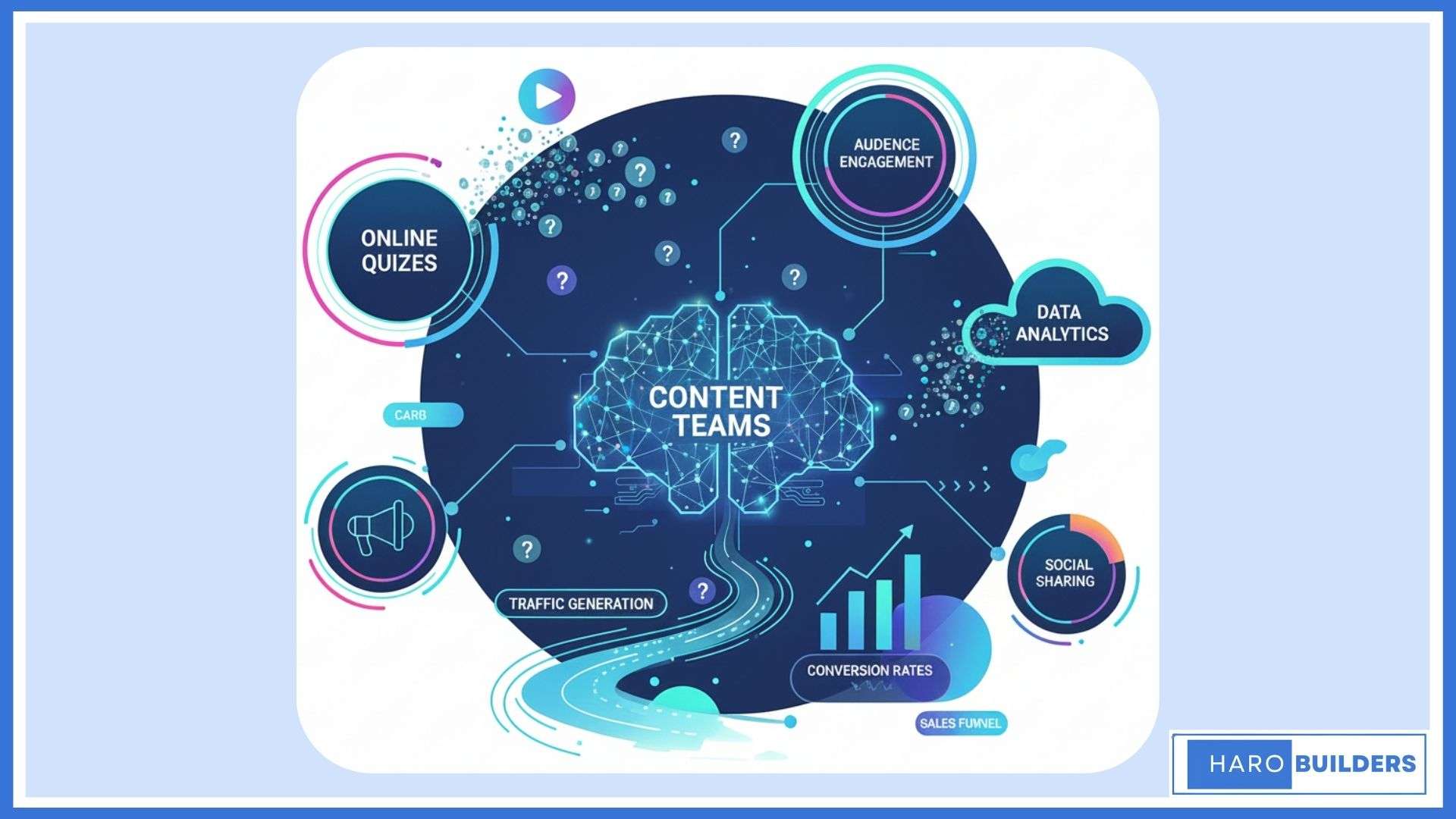
Online quizzes in content marketing are useful because they do two jobs at once. They pull people into an experience, and they tell you what those people actually want. That second part is the one most teams underuse.
A lot of content marketing still runs on guesses. You publish an article, see traffic, and hope the right audience found it. But traffic rarely tells you intent.
A quiz can. It can show whether someone is looking for quick wins or a long-term strategy, whether they’re struggling with conversions or consistency, whether they’re a team of one or a team of twenty.
If you build quizzes the right way, they stop being “interactive content” and start acting like a lightweight discovery call that runs at scale.
This blog breaks down how quizzes fit into a modern content strategy, what they’re best used for, and how to build them so they feel genuinely helpful.
What Online Quizzes Are and Where They Fit in a Content Strategy
A quiz is a short flow of questions that ends in a result. That result can be a score, a type, or a recommendation. In content marketing, the real asset is the outcome plus the path that gets someone there.
Quizzes fit best in moments where your audience is uncertain. They’re not looking for a 40-minute deep dive. They want direction.
Here are the most useful quiz styles for content teams:
1. Diagnostic Quizzes (Where Do I Stand?)
These help people assess a situation, like content distribution maturity, messaging clarity, lead gen readiness, or content workflow health. They work well because the result can include a clear explanation plus targeted next steps.
2. Recommendation Quizzes (What Should I Do Next?)
These guide choices. Examples include picking a content format, prioritizing channels, choosing a lead magnet type, or identifying the best content angle for a campaign.
3. Knowledge Quizzes (Do I Understand This Well Enough to Apply It?)
These work for education-heavy brands, training content, communities, and B2B audiences that want confidence before acting.
If you only remember one thing: a quiz is not “content with questions.” It is a decision tool. If your quiz does not help the user decide something, it’s likely to perform like a novelty.
Why Online Quizzes in Content Marketing Are Working Right Now
Quizzes are not new. The reason they’re working now is that the internet is louder, audiences are pickier, and generic content blends into the background.
Quizzes cut through because they change the visitor’s role. Instead of observing, they’re participating.
1. They create a reason to stay.
People don’t always finish articles, but they often finish quizzes because they want the result. The result becomes a finish line, and finish lines are motivating.
2. They make personalization feel fair.
Many marketing experiences try to personalize based on tracking. Quizzes personalize based on volunteered context. That difference matters, especially as people become more cautious about how their data is used.
3. They turn interest into intent signals.
A pageview tells you someone was curious. A quiz answer can tell you someone needs leads in 30 days, has a small team, and struggles with distribution. That’s not just curiosity. That’s direction.
4. They offer feedback without demanding a big commitment.
A consultation is great, but it is expensive in time and effort. A quiz sits between a blog post and a call. It gives the user a “mini consult” feeling without friction.
The role of online quizzes is basically this: they can turn content into a two-way interaction, and that makes your marketing smarter.
How Quizzes Create Engagement That Leads Somewhere
Engagement is only useful when it moves people forward. Quizzes tend to create that “forward motion” because they’re built around small decisions.
This is why quizzes keep attention without needing flashy language:
1. They break the experience into small steps.
A blog asks for continuous attention. A quiz asks for a sequence of quick answers. That’s easier in real life, especially on mobile.
2. They reward completion.
The result feels like closure. People like closure. It’s simple, but it works.
3. They mirror how people think.
When a quiz is written well, it feels like someone is asking smart questions, one at a time, in a logical order. That is very different from reading an article that tries to cover everything at once.
4. They naturally encourage sharing.
People share outcomes that feel specific: a score, a type, a category that sounds accurate. They don’t share vague fluff.
An actionable takeaway here: if you want to create a quiz to drive real engagement, don’t optimize for “fun.” Optimize for “clarity.” Clarity makes people finish. Clarity makes people trust the result. Trust makes people take the next step.
How Quizzes Support Lead Generation Without Feeling Pushy
Quizzes can generate leads, but lead capture should never feel like the whole point. The moment a quiz feels like a trap, you lose completion rate and trust.
The cleaner approach is to treat the email opt-in as an upgrade.
Here’s a practical structure that works well:
1. Let people see the result on-page first.
Give them the payoff they earned. This alone improves trust and reduces drop-offs.
2. Offer something extra by email.
This can be a deeper breakdown, a checklist tied to their result, or a short “next 7 days” plan. The key is that it must match the result.
3. Keep the opt-in minimal.
Email is usually enough. If you need more fields, explain why, and make it worth it.
4. Use quiz answers to improve lead quality.
Quiz answers can reveal buying stage and urgency. That is more helpful than collecting a job title and guessing.
If you want to make this actionable, here are intent-rich question angles you can use without making people uncomfortable:
- Timeline questions: “When do you want to see results?” with options like “this month,” “this quarter,” “later.”
- Resource questions: “What’s your current setup?” with options like “solo,” “small team,” “cross-functional team.”
- Priority questions: “What are you trying to improve most?” with options tied to outcomes: traffic, engagement, conversions, retention.
- Process questions: “How consistent is your content production?” with realistic options, not idealized ones.
These questions help you segment leads by readiness and need, not by labels.
Segmentation and Personalization With One Asset
Most segmentation efforts are messy because they rely on assumptions. Quizzes reduce assumptions because the user tells you what bucket they belong to.
The simplest segmentation models for quiz-based content marketing look like this:
- Segment by Goal: Lead generation, brand awareness, conversion improvements, retention.
- Segment by Bottleneck: Content ideas, writing bandwidth, distribution, messaging clarity, conversion.
- Segment by Maturity: Beginner, building, scaling.
- Segment by Urgency: Immediate need vs planning mode.
Once you have these segments, you can personalize without doing anything fancy:
- Personalized result pages that recommend the right next resource.
- Email nurture sequences that match the bottleneck.
- Retargeting that aligns with the result category, not generic “come back” ads.
- Content hubs where the quiz acts like a router, directing users to the right path.
Here’s a concrete example of how this becomes actionable:
Say you run a quiz called “What’s Holding Back Your Content Growth?”
- If someone lands in “Distribution Gap,” your result page points them to distribution frameworks, channel prioritization, and repurposing workflows.
- If they land in “Messaging Gap,” you give positioning prompts, audience clarity exercises, and headline testing methods.
- If they land in “Conversion Gap,” you provide CTA mapping, offer clarity, and landing page improvement tips.
The same quiz becomes three different experiences. That is why it works.
How to Build Quizzes That Feel Helpful (And Convert)
Most online quizzes fail because the outcomes are weak, the questions feel generic, or the experience drags.
Start with outcomes. Not questions.
Write 3 to 5 outcomes that are genuinely different. Each outcome should have its own “what this means” plus a short action plan.
Then reverse engineer questions that route people correctly.
Here is a practical build checklist you can apply:
1. Define one primary purpose.
Is the quiz meant to qualify leads, recommend content, educate, or drive signups? Pick one as the anchor.
2. Choose 3 to 5 outcomes you can defend.
If outcomes are too similar, the quiz will feel fake. Make them distinct enough that users can recognize themselves in one.
3. Write questions that change the result.
If a question does not influence routing, cut it.
4. Keep questions short and concrete.
Avoid multi-part questions and jargon. Avoid “choose all that apply.”
5. Write answer choices that sound like real people.
Avoid options like “We always follow a documented strategy.” People do not talk like that. Use realistic ranges and honest phrasing.
6. Keep the quiz length honest.
Most marketing quizzes do well at 6 to 10 questions. If you need more, make sure each one earns its place.
7. Make the result page the real asset.
A result page should not be a label. It should be a mini guide:
- what the result suggests
- why it matters
- two to three actions to take next
- one focused CTA
8. Make the CTA match the outcome.
One CTA per outcome usually works best. If someone’s result is “Distribution Gap,” your CTA should not be “Book a demo.” It should be something aligned, like “Get the distribution checklist.”
If your team is short on time, focus 70% of your effort on outcomes and result pages. That is what people remember. That is what converts.
Measuring Quiz Success in a Way That Improves the Next Version
Online Quizzes are easier to optimize than many content formats because the funnel is visible. You can see where the experience breaks.
Here’s what to track, and what it tells you:
1. View-to-Start Rate: Low start rate usually means the promise is unclear or the quiz does not feel relevant to the visitor.
2. Completion Rate: Low completion rate usually means friction: confusing questions, unrealistic options, too many steps, or weak motivation.
3. Drop-off by Question: The question where people quit is your first fix. Often it’s a wording issue, not the topic itself.
4. Result Distribution: This is audience research. If one result dominates, that’s a signal about what your audience struggles with most.
5. Result-Page Conversion: If people finish but don’t act, your outcomes may feel generic or your CTA may not match the result.
6. Assisted Conversions: Many quiz-takers convert later. Track influence, not only last-click, especially in B2B.
A practical optimization habit: every month, look at the top drop-off question and rewrite it. Small copy tweaks can improve completion without changing the quiz logic.
Conclusion: What to Do Next With Quizzes in Your Strategy
Quizzes are not a replacement for strong content. They are a way to make strong content more responsive. They help you earn attention, collect intent signals, and guide users toward the right next step without pushing too hard.
If you want to integrate online quizzes in content marketing in a way that drives real outcomes, start with one quiz that solves one clear uncertainty. Build outcomes that feel honest and useful. Use the answers to personalize follow-up. Then iterate based on what the data tells you.
That’s the role of online quizzes at its best: helping the audience get clarity, while helping your team stop guessing.