
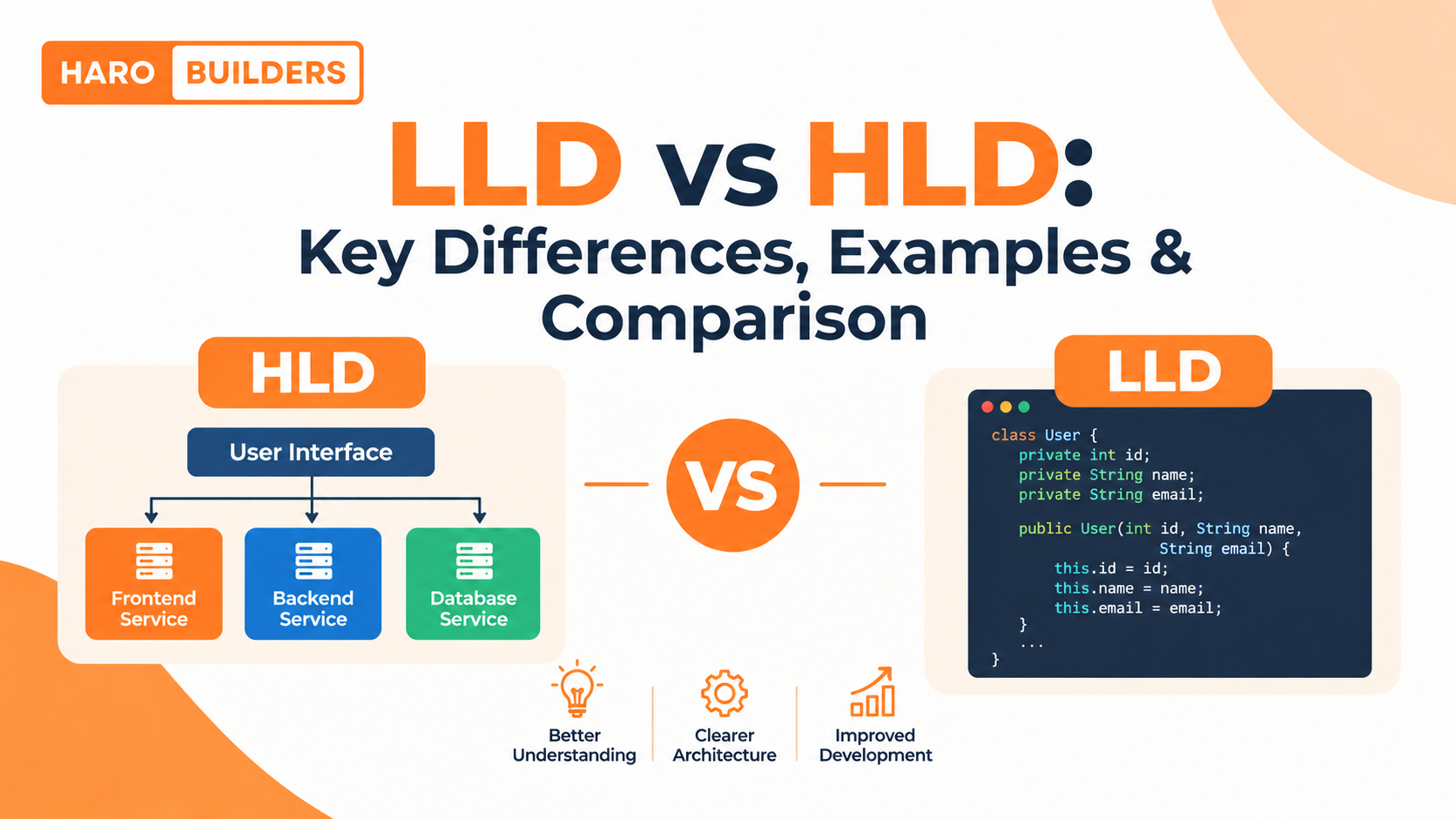
When designing software, High-Level Design (HLD) and Low-Level Design (LLD) answer two different questions.
HLD explains how the major parts of a software system fit together. LLD explains how individual components are structured and how they should behave internally.
In simple terms:
HLD = system-level architecture
LLD = component-level design
They are not competing approaches. HLD provides the architectural direction, while LLD turns individual parts of that architecture into detailed designs that developers can implement.
LLD vs HLD: Quick Answer
The main difference between HLD and LLD is their level of abstraction. HLD focuses on the overall architecture, major components, services, databases, APIs, communication, scalability, and system boundaries. LLD focuses on the internal structure of those components, including classes, interfaces, methods, object relationships, responsibilities, and design patterns.
| Aspect | HLD | LLD |
|---|---|---|
| Full name | High-Level Design | Low-Level Design |
| Main focus | Overall system architecture | Detailed component design |
| Main question | How should the system be structured? | How should a component work internally? |
| Scope | Entire system or major subsystem | Individual component or module |
| Abstraction | Higher | Lower |
| Major concerns | Architecture, scalability, availability | Classes, interfaces, behavior, relationships |
| Typical artifacts | Architecture diagrams, system flows | Class, sequence, state diagrams |
| Common users | Architects, senior engineers, engineering teams | Developers and software engineers |
| Output | Architectural blueprint | Detailed implementation design |
| Relationship | Provides context for LLD | Turns HLD components into implementable designs |
What Is High-Level Design (HLD)?
High-Level Design is the architectural view of a software system.
It describes the major building blocks of an application and the relationships between them without going deeply into individual classes or methods.
For example, an e-commerce application might contain:
- Web and mobile clients
- API gateway
- User service
- Product service
- Order service
- Payment service
- Database
- Cache
- Message queue
- External payment provider
An HLD explains how these pieces interact.
A simplified architecture could look like this:
Users
  ↓
Web / Mobile Application
  ↓
API Gateway
  ↓
 ┌──────────────┬──────────────┬──────────────┐
 │ User Service │ Order Service│ Payment      │
 │              │              │ Service      │
 └──────────────┴──────────────┴──────────────┘
          ↓              ↓
       Database       Payment Provider
The goal is not to decide exactly which class will process a payment. The goal is to establish the major system boundaries and communication paths.
What Does HLD Focus On?
Depending on the project, HLD may cover:
- System architecture
- Major components
- Services and modules
- APIs and service boundaries
- Database architecture
- Data flow
- External integrations
- Authentication and authorization boundaries
- Scalability
- Availability
- Reliability
- Caching
- Load balancing
- Message queues
- Deployment architecture
For example, decisions about adding application instances, load balancing, caching, or separating services are generally architectural concerns. HaroBuilder’s existing guide to client-server architecture provides additional context on how clients, servers, application logic, databases, and scaling considerations can fit together.
What Is Low-Level Design (LLD)?
Low-Level Design describes the detailed structure and behavior of software components.
Once HLD identifies a component such as Payment Service, LLD can describe what classes, interfaces, methods, relationships, and responsibilities are needed inside that component.
For example:
PaymentService
      ↓
PaymentProcessor
   ↙       ↘
CardPayment  WalletPayment
      ↓
PaymentRepository
The LLD may define:
- Classes
- Interfaces
- Methods
- Objects
- Responsibilities
- Relationships
- Data structures
- State changes
- Error handling
- Design patterns
- Dependencies
- Component interactions
For a deeper explanation of LLD principles, UML, SOLID, design patterns, and detailed component design, see HaroBuilder’s Low-Level Design guide.
HLD vs LLD: Key Differences
The easiest way to understand the distinction is to compare the decisions made at each level.
| Design Area | HLD | LLD |
|---|---|---|
| System scope | Entire application or major subsystem | Individual module or component |
| Architecture | Defines overall architecture | Works within the architecture |
| Components | Identifies major components | Defines internal component structure |
| Services | Defines service boundaries | Defines service implementation details |
| APIs | Defines major interfaces/contracts | Defines detailed request handling |
| Database | Architectural database choices | Detailed schema or data-access design |
| Classes | Usually not the main focus | Major focus |
| Methods | Usually not defined in detail | Frequently defined |
| Object relationships | Limited | Detailed |
| Design patterns | Architectural patterns where appropriate | Object-oriented/design patterns |
| Scalability | Major consideration | Considered within component behavior |
| Availability | Major system concern | May influence component design |
| UML | Architecture/component diagrams | Class, sequence, state diagrams |
| Main output | Architecture blueprint | Detailed design blueprint |
The boundary is useful, but it is not always absolute. A decision can be considered HLD or LLD depending on the scope of the system being designed.
HLD vs LLD Example: E-Commerce System
A practical example makes the difference much easier to understand.
Imagine you are designing an online store.
HLD of an E-Commerce Platform
At the HLD level, you might decide that the application needs:
- User Service
- Product Service
- Order Service
- Payment Service
- Database
- Cache
- API Gateway
- Message queue
The architecture could look like:
Customer
   ↓
Web / Mobile App
   ↓
API Gateway
   ↓
 ┌───────────────┬────────────────┬────────────────┐
 │ Product       │ Order          │ Payment        │
 │ Service       │ Service        │ Service        │
 └───────────────┴────────────────┴────────────────┘
          ↓               ↓
       Database       Payment Provider
At this level, you might ask:
- How should requests reach the services?
- Should orders and payments be separate services?
- Where should product data be stored?
- How should the system handle increasing traffic?
- Where should caching be used?
- Which components communicate synchronously?
- Which operations should use asynchronous processing?
These are primarily system-level questions.
LLD of the Order Service
Now focus only on the Order Service.
The LLD might define:
Order
 ├── orderId
 ├── customerId
 ├── items
 ├── status
 └── totalAmount

OrderService
 ├── createOrder()
 ├── cancelOrder()
 └── calculateTotal()

OrderRepository
 ├── save()
 ├── findById()
 └── update()
You may then define interfaces and relationships between these components.
For example:
OrderService
      ↓
OrderRepository
      ↓
Database
At this level, the questions become:
- What responsibilities belong to
OrderService? - Which interface should
OrderRepositoryexpose? - How should order status change?
- How should validation work?
- Which classes should depend on each other?
- How can the design remain maintainable if payment methods change?
That is LLD thinking.
How HLD and LLD Work Together
HLD and LLD are normally connected rather than isolated.
A simplified software design process looks like this:
Requirements
     ↓
High-Level Design
     ↓
Major Components
     ↓
Low-Level Design
     ↓
Implementation
     ↓
Testing
     ↓
Monitoring & Iteration
For example:
Requirement
Customers need to place orders online.
HLD decision
Create an Order Service responsible for order processing.
LLD decision
Create classes such as:
OrderOrderItemOrderServiceOrderRepositoryOrderValidator
Implementation
Develop the classes and their interactions.
This relationship is one of the most important ideas to understand:
HLD defines the boundaries and architecture; LLD defines the detailed design inside those boundaries.
HLD vs LLD Documentation
The documentation produced at each level can also differ.
| Documentation | HLD | LLD |
|---|---|---|
| System architecture | ✓ | |
| Component architecture | ✓ | ✓ |
| Service boundaries | ✓ | |
| Data-flow diagrams | ✓ | Sometimes |
| Deployment architecture | ✓ | |
| API architecture | ✓ | ✓ |
| Class diagrams | ✓ | |
| Sequence diagrams | ✓ | |
| State diagrams | ✓ | |
| Detailed interfaces | ✓ | |
| Method responsibilities | ✓ | |
| Design-pattern decisions | Sometimes | ✓ |
| Database architecture | ✓ | ✓ |
| Detailed data-access design | ✓ |
The exact documentation depends on the project’s size, architecture, team, and requirements. Not every software project needs every diagram.
HLD vs LLD Diagrams
Diagrams are useful because they make complex relationships easier to understand.
Common HLD diagrams
HLD may use:
- System architecture diagrams
- Component diagrams
- Data-flow diagrams
- Deployment diagrams
- Service interaction diagrams
- System context diagrams
These diagrams generally help answer:
What are the major parts of the system, and how do they communicate?
Common LLD diagrams
LLD may use:
- Class diagrams
- Sequence diagrams
- State diagrams
- Object diagrams
- Detailed component diagrams
These help answer:
How do the individual components behave and interact?
For example, an HLD may show a Payment Service.
An LLD can then show:
PaymentService
      ↓
PaymentProcessor
   ↙       ↘
Card       Wallet
Processor  Processor
The first describes the system boundary. The second describes internal structure.
When Should You Use HLD?
HLD is especially useful when you need to establish the overall architecture before implementation details become the focus.
Typical situations include:
- Starting a new application
- Designing a large feature
- Defining service boundaries
- Choosing architectural approaches
- Planning integrations
- Evaluating scalability
- Planning availability
- Communicating architecture to a team
- Identifying major technical dependencies
For example, if a website is expected to handle rapidly increasing traffic, architectural decisions around load balancing, caching, application instances, and database capacity belong primarily in the HLD discussion.
HaroBuilder’s scalability guide covers these concepts in more detail, including horizontal and vertical scaling, caching, load balancing, database bottlenecks, and performance measurement.
When Should You Use LLD?
LLD becomes particularly useful when the architecture is understood and developers need to work out how specific components should be implemented.
Typical situations include:
- Designing classes
- Defining interfaces
- Planning object relationships
- Designing business logic
- Handling complex component behavior
- Choosing appropriate design patterns
- Improving maintainability
- Reducing unnecessary coupling
- Planning implementation before coding
For example, deciding that an application needs a Payment Service is an architectural decision.
Deciding how PaymentService, PaymentProcessor, CardPayment, and WalletPayment interact is much closer to LLD.
👉HLD vs LLD in System Design Interviews
HLD and LLD are also common areas of software engineering interviews, although interview formats vary between companies and roles.
HLD interview topics
An HLD/system-design discussion may involve:
- Requirements
- System architecture
- Scalability
- Availability
- Databases
- Caching
- Load balancing
- Message queues
- APIs
- Bottlenecks
- Failure scenarios
- Trade-offs
The interviewer may ask you to design a system such as an online marketplace, messaging platform, URL shortener, or social application.
The discussion usually focuses on how the major pieces fit together.
LLD interview topics
An LLD discussion may involve:
- OOP
- Classes
- Interfaces
- Encapsulation
- Inheritance
- Polymorphism
- SOLID principles
- Design patterns
- Relationships
- Extensibility
- Maintainability
- Detailed object interactions
The question may ask you to design a parking lot, notification system, payment system, or another component-oriented problem.
The emphasis is usually more detailed than an HLD discussion.
How to Decide Whether a Detail Belongs in HLD or LLD
A simple rule can help:
If a decision explains how major parts of the system fit together, it is generally HLD. If it explains how an individual component works internally, it is generally LLD.
Consider these examples:
| Design Decision | Usually Associated With |
|---|---|
| Use microservices | HLD |
| Separate payment into its own service | HLD |
| Add a message queue | HLD |
| Use a load balancer | HLD |
| Define service boundaries | HLD |
Define PaymentProcessor interface | LLD |
Create CardPayment class | LLD |
Define processPayment() | LLD |
| Define object relationships | LLD |
| Choose a design pattern for a component | LLD |
| Define service-to-service API boundary | HLD |
| Define internal method behavior | LLD |
The word “usually” matters. Real engineering projects can place some decisions at different levels depending on scope.
Can HLD and LLD Overlap?
Yes.
HLD and LLD are useful abstractions rather than rigid boxes.
For example, an API can be discussed at multiple levels.
At HLD level:
The Order Service exposes an API for creating orders.
At LLD level:
The order controller validates the request, calls the appropriate service method, handles validation failures, and returns the appropriate response.
Both descriptions are about the same system, but they operate at different levels of detail.
The same principle applies to databases, services, authentication, messaging, and other architectural components.
Common HLD Mistakes
1. Jumping into implementation too early
Starting with classes and methods before understanding the system can make the architecture harder to reason about.
2. Ignoring scalability
An architecture should consider expected workload and likely bottlenecks rather than assuming the initial infrastructure will always be sufficient.
3. Creating unclear service boundaries
Poorly defined responsibilities can lead to unnecessary coupling between components.
4. Ignoring failure scenarios
Distributed components can fail independently. HLD should consider important failure paths where reliability matters.
5. Overengineering
A small application does not necessarily need a highly distributed architecture.
Common LLD Mistakes
1. Creating too many classes
More classes do not automatically mean better design.
2. Forcing design patterns
A design pattern should solve an actual problem rather than being added simply because it is popular.
3. Excessive inheritance
Deep inheritance hierarchies can make software harder to change.
4. Tight coupling
Components that depend too heavily on implementation details can become difficult to test and modify.
5. Giant classes
A class responsible for too many unrelated tasks can become difficult to maintain.
6. Ignoring changing requirements
Good LLD should consider which behavior is likely to change and keep those areas appropriately separated.
HLD vs LLD: Best Practices
HLD best practices
- Start with functional and non-functional requirements.
- Identify major system components.
- Define clear boundaries.
- Think about data flow.
- Consider scalability and availability.
- Identify external dependencies.
- Consider failure scenarios.
- Avoid unnecessary implementation detail.
- Document important architectural trade-offs.
LLD best practices
- Define clear responsibilities.
- Keep interfaces understandable.
- Minimize unnecessary coupling.
- Prefer composition where appropriate.
- Use design patterns when they solve a real problem.
- Consider state and edge cases.
- Design for maintainability.
- Think about testability.
- Avoid unnecessary abstraction.
A strong design is not necessarily the one with the most components, patterns, or diagrams. The design should be appropriate for the requirements.
Frequently Asked Questions
What is the difference between LLD and HLD?
HLD describes the overall architecture and major components of a software system, while LLD describes the detailed structure and behavior of individual components. HLD works at a higher level of abstraction; LLD goes deeper into classes, interfaces, methods, relationships, and implementation details.
Which comes first, HLD or LLD?
HLD generally comes before LLD because the overall architecture provides the context for detailed component design. A typical flow is requirements → HLD → component boundaries → LLD → implementation.
Is LLD part of system design?
Yes. LLD is commonly considered a detailed level of software/system design. It focuses on how individual components are structured and how they behave.
Is HLD the same as system design?
Not exactly. HLD is an important part of system design that focuses on architecture and major system components. System design can include both high-level architectural decisions and more detailed design work.
What is an example of HLD?
For an e-commerce system, deciding to use separate Order, Product, User, and Payment services and defining how those services communicate is an example of HLD.
What is an example of LLD?
Designing the OrderService, Order, OrderItem, and OrderRepository classes and defining their interfaces and relationships is an example of LLD.
What diagrams are used in HLD and LLD?
HLD commonly uses architecture, component, deployment, and data-flow diagrams. LLD commonly uses class, sequence, state, and detailed component diagrams. The exact diagrams depend on the project.
Is LLD only for interviews?
No. LLD is useful in real software development because it helps teams reason about component responsibilities, interfaces, dependencies, behavior, and maintainability before implementation.
What should I learn before LLD?
A useful foundation includes object-oriented programming, classes and objects, interfaces, abstraction, encapsulation, inheritance, polymorphism, SOLID principles, UML, and common design patterns.
What should I learn before HLD?
Useful HLD foundations include system architecture, APIs, databases, networking basics, client-server architecture, scalability, caching, load balancing, distributed systems concepts, and common architectural patterns.
Can HLD and LLD be done together?
They can overlap during an iterative design process, but separating the architectural and detailed-design perspectives often makes complex systems easier to reason about.
Key Takeaways
- HLD means High-Level Design.
- LLD means Low-Level Design.
- HLD focuses on the overall system architecture.
- LLD focuses on the detailed design of individual components.
- HLD commonly addresses services, databases, APIs, scalability, availability, and system boundaries.
- LLD commonly addresses classes, interfaces, methods, object relationships, responsibilities, and design patterns.
- HLD generally provides the context for LLD.
- The boundary between HLD and LLD can vary depending on scope.
- Neither approach replaces the other.
- Good design uses the appropriate level of detail for the problem being solved.
For more software engineering resources and practical technical guides, explore HaroBuilder.
Conclusion
The simplest way to remember the difference is:
HLD asks, “How should the system be structured?”
LLD asks, “How should each component work?”
Suppose you are building an e-commerce application. HLD might define the Product Service, Order Service, Payment Service, database, API gateway, and communication between them. LLD then moves inside those components and defines classes, interfaces, methods, relationships, and detailed behavior.
The two levels work together:
Requirements → HLD → Components → LLD → Implementation
Understanding that relationship makes system design easier to learn and helps prevent two common problems: diving into implementation details before understanding the architecture, or designing an architecture without knowing how its components will actually behave.
The right design is not the one with the most diagrams or the most sophisticated patterns. It is the one that gives the system clear boundaries, appropriate abstractions, maintainable components, and an architecture that matches its actual requirements.


💬 Comments 0
No comments yet. Be the first to share your thoughts! 💬
✍️ Leave a Comment