

You finish with a patient. Then you spend 20 minutes charting. If this happens all day, by the time you leave, you’ve written more than you’ve treated. SOAP notes are non-negotiable. Insurance companies need them. Your legal records depend on them. But with the right soap notes software, they don’t have to eat up your entire day.
Voice-to-text changes everything. Instead of hunting and pecking on a keyboard, you talk. The software listens. Your notes appear on screen. Some tools even structure the content into proper SOAP format automatically.
5 SOAP Notes Tools with Voice-to-Text That Work
Here are five tools that actually deliver on that promise.
1. Noterro
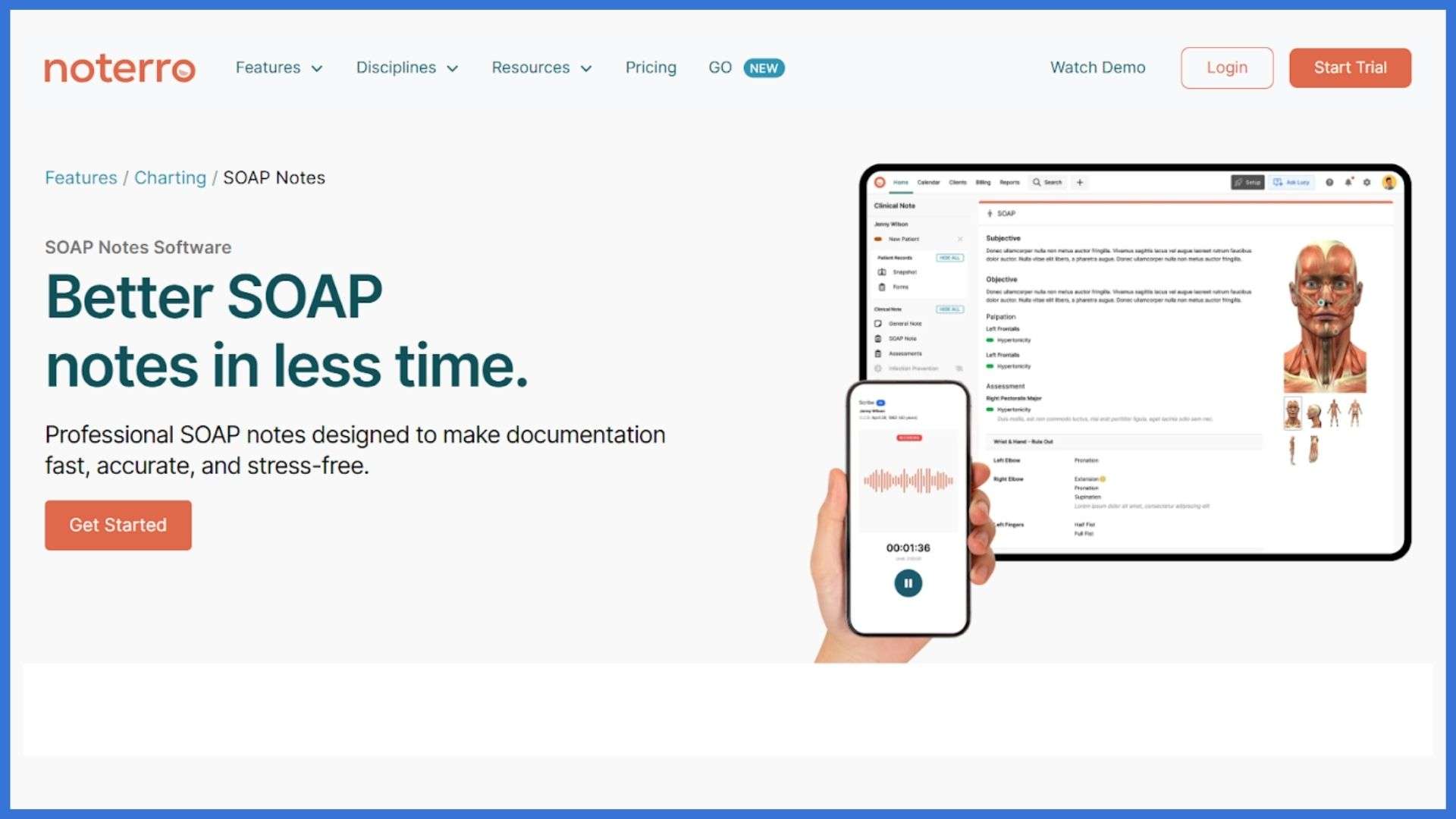
Why it stands out: Noterro is the top SOAP notes software built specifically for solo practitioners and small teams, not a hospital system trying to do everything.
Noterro Scribe lets you record patient encounters or dictate notes directly into the app. The AI transcribes your words and organises them into a clinical note format. It identifies speakers, filters out small talk, and structures the content so you spend less time editing.
This level of automation is especially powerful for clinics that rely on structured clinical documentation. Using SOAP notes software like Noterro ensures that subjective findings, objective observations, clinical assessments, and treatment plans are consistently captured in a compliant, easy-to-review format. Instead of manually formatting notes after each visit, practitioners can rely on AI-assisted workflows that align with professional documentation standards while reducing cognitive load and charting fatigue.
Beyond voice, Noterro offers predictive charting that suggests text as you type. Snippets let you save phrases you use constantly. Noterro stands out as the Best Chiropractic Software with AI helping practitioners automate charting, reduce admin time, and improve clinical accuracy without extra setup or add-ons. And the mobile app means you can chart from your treatment room without being tied to a desktop.
Key Features
- Voice-to-chart transcription with speaker identification
- Predictive charting that learns your patterns
- Snippets for saving phrases you use constantly
- Mobile app for charting from your treatment room
- HIPAA, PIPEDA, and PHIDA compliant
Pricing
- Starts at $28.05 per month
- Free trial: 14 days (no credit card required)
Best For
- Solo practitioners
- Mobile therapists
- Small clinics with tight budgets
- Practitioners who need speed over bells and whistles
Consider If You Need
- Charting to take under 10 minutes per patient with AI
- Mobile-first workflow
- Affordable pricing that doesn’t break the bank
2. Dragon Medical One
Why it stands out: Dragon Medical One by Nuance (now part of Microsoft) is a cloud-based speech recognition platform designed specifically for healthcare professionals. It allows you to dictate notes directly into most EMR systems.
Unlike traditional desktop dictation solutions, Dragon Medical One is cloud-based. Your profile, preferences, and custom vocabulary come along with you wherever you’re working. Log in from any computer and pick up right where you left off.
The software uses deep learning and neural network technologies. It delivers high accuracy out of the box with no upfront training required. The system adapts to your speaking patterns over time, which means fewer corrections the more you use it.
Dragon has been around since the 1980s. Over 10,000 healthcare organisations use it globally. That track record means stability and proven performance.
Key Features
- PowerMic Mobile support turns your smartphone into a wireless microphone
- Auto-formatting and smart punctuation for polished notes
- Custom commands and templates for everyday phrases and workflows
- Hands-free operation with voice commands like “wake up” or “go to next field”
- HIPAA-compliant cloud security through Microsoft Azure
Pricing
- $99 per month (1-year license)
- $89 per month (2-year license)
- $79 per month (3-year license)
- One-time implementation fee of $525
Best For
- Established practices with budget for premium tools
- Clinicians who dictate across multiple workstations
- Providers wanting proven, enterprise-grade accuracy
Consider If You Need
- Rock-solid speech recognition with decades of development
- Mobile flexibility with smartphone microphone support
- Integration with major EHR systems
3. Deepgram
Why it stands out: Deepgram offers an advanced speech-to-text API powered by deep learning and AI. It’s a strong choice for clinics and hospitals that need to connect health applications or build custom documentation workflows.
The Nova-3 Medical Model has been trained to understand complicated medical terminology, medications, symptoms, and diagnoses. It handles the specialized vocabulary that general dictation tools miss.
Smart formatting tools punctuate, paragraph, and auto-expand abbreviations and acronyms. Your notes come out readable without manual cleanup. Speaker identification makes it easy to differentiate who is speaking in a recording. That’s helpful for multi-party conversations.
Deepgram supports multiple languages and accents. If you work with diverse patient populations, that flexibility matters.
Key Features
- Medical-grade accuracy trained on healthcare terminology
- Smart formatting with automatic punctuation and paragraphing
- Speaker identification for multi-party conversations
- Multi-language support for diverse patient populations
- Flexible API integration with EHR and other medical software
Pricing
- Free trial with $200 in credits (about 45,000 minutes of transcription)
- Growth Plan: $4,000-$10,000 per year
- Enterprise Plan: Custom pricing with dedicated support
Best For
- Tech-forward clinics building custom documentation workflows
- Practices with developer resources for API integration
- Multi-location healthcare systems needing scalable transcription
Consider If You Need
- High-volume transcription at scale
- Custom integration with existing health software
- Medical-specific vocabulary recognition
4. SimplePractice
Why it stands out: SimplePractice added an AI tool called Note Taker that records sessions and generates draft progress notes. It works during telehealth appointments or through dictation after in-person visits.
The tool converts your recordings into structured documentation using advanced soap notes software. You can choose SOAP, DAP, or BIRP formats based on your practice needs. As the AI learns from your edits over time, the notes begin to match your voice and style more closely.
One thing to know. Note Taker currently works best with telehealth sessions. In-person recording through the mobile app is available but still newer. And dictation is only available on web browsers and iOS.
SimplePractice connects scheduling, billing, and charting together. Your appointment details auto-populate into charts. Insurance verification is built in. If you want everything in one system and plan to grow your team, this platform scales well.
The downside is price. You’re paying for a full practice management suite whether you use all the features or not.
Key Features
- Note Taker AI for session recording and dictation
- Multiple note formats (SOAP, DAP, BIRP)
- Self-learning AI that adapts to your style
- Integrated scheduling and billing
- Patient portal for online bookings and payments
Pricing
- $60 to $80 per month (depending on plan)
- Note Taker included in subscription
Best For
- Therapists and mental health practitioners
- Small clinics wanting full integration
- Practices handling their own billing
- Teams planning to grow beyond solo practice
Consider If You Need
- Everything connected in one place
- Built-in scheduling and billing
- A platform that scales with your clinic
5. Freed
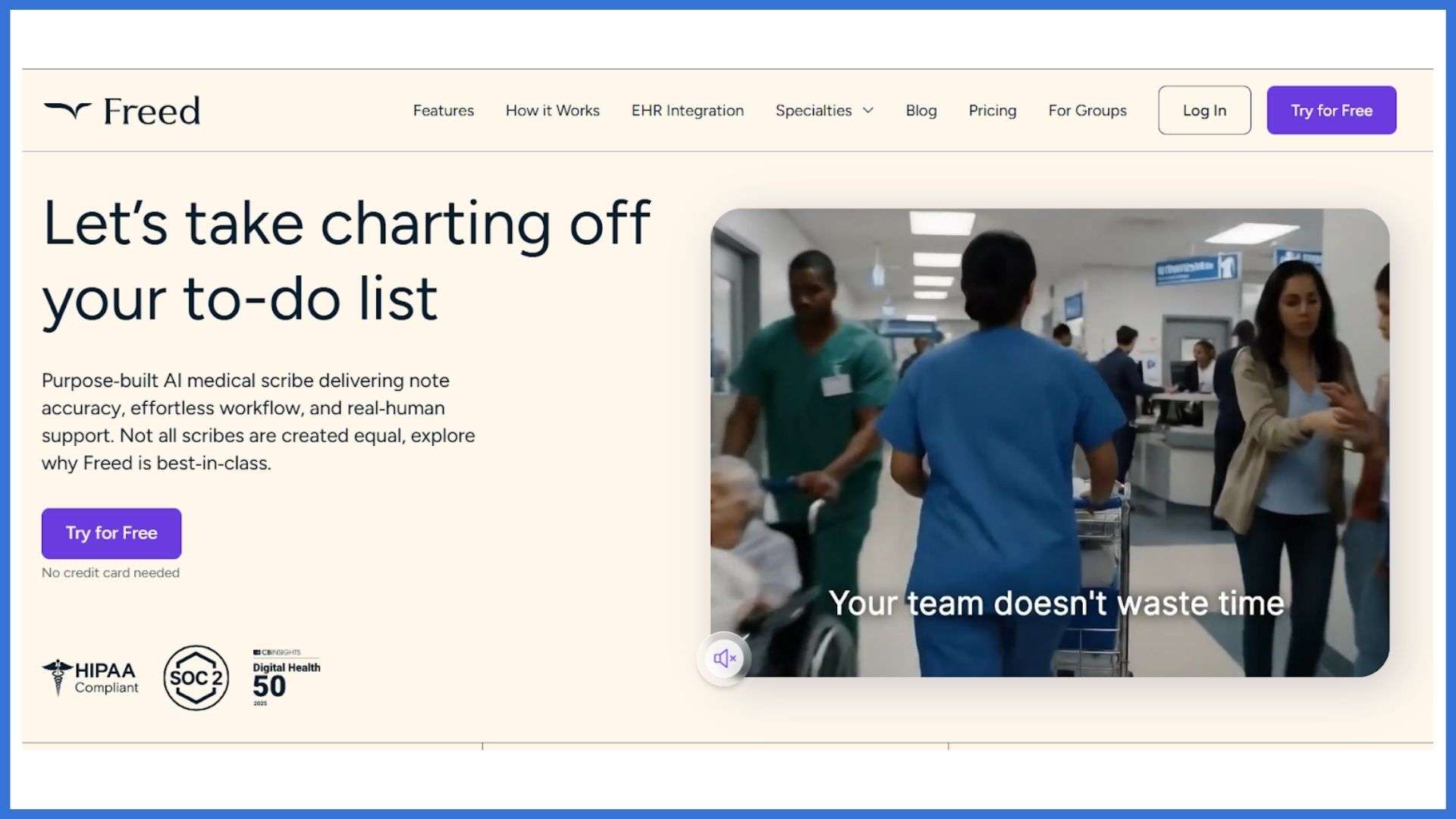
Why it stands out: Freed positions itself as an AI scribe built specifically for clinicians who hate charting. You press a button, have your patient conversation, and receive a structured SOAP note within minutes.
The tool captures audio in real time during visits. It transcribes the conversation, identifies medical terminology, and organizes the content into clinical format. Processing usually takes under two minutes even for longer encounters.
One feature that stands out in modern soap notes software is its self-learning capability. When you edit a note, Freed remembers. Over time, future notes align more closely with your preferences, so you spend far less time fixing the same details again and again.
Freed works with any web-based EHR through copy and paste. A Chrome extension helps speed up the process. Direct integrations are still in development, so you’ll need to manually transfer notes for now.
At $99 per month, Freed costs more than some competitors. But you get unlimited notes with no usage caps. For high-volume practices, that flat rate makes sense.
Key Features
- Real-time ambient listening during patient visits
- SOAP notes generated in under 2 minutes
- Self-learning AI that adapts to your style
- Works across desktop, mobile, and tablet
- HIPAA compliant with SOC 2 Type II certification
Pricing
- $99 per month (or ~$90 annually)
- Unlimited notes included
- 7-day free trial with 10 free visits
Best For
- Busy clinicians seeing high patient volumes
- Practices wanting ambient AI rather than dictation
- Providers who prefer flat-rate pricing
Consider If You Need
- AI that listens during visits, not after
- Unlimited charting without usage caps
- A tool that learns your documentation style
Which One Actually Saves You Time
All five tools work. The right choice depends on what matters most to you.
If you’re watching every dollar, Noterro is among the top SOAP notes software for solo and small clinics. At $28.05 per month, it’s the most affordable option with built-in voice-to-text. You go from 30-minute charting sessions down to 10. That’s hours back every week from one tool.
If you’re a therapist who needs everything connected, SimplePractice makes sense. The Note Taker feature works well for telehealth, and the platform scales as your practice grows.
If you see high patient volumes and want ambient AI that listens during visits, Freed delivers. The $99 flat rate covers unlimited notes.
The honest truth is, you won’t know which one fits until you try it. Most offer free trials. Spend a week with the top two that caught your eye. See which one feels natural. Charting shouldn’t feel like fighting the software.


💬 Comments 0
No comments yet. Be the first to share your thoughts! 💬
✍️ Leave a Comment