Category: SEO Guides

  • How to Do SEO Without Link Building in 2025

    How to Do SEO Without Link Building in 2025

    seo without link building

    Ever wondered why your website struggles in Google search results despite solid on-page SEO and content quality? SEO without link building is achievable when focusing on search engine optimization through technical SEO, internal linking, and content quality. Although quality backlinks remain a powerful ranking factor, you can still rank on Google without backlinks by optimizing meta descriptions, improving site speed, and targeting long-tail keywords. 

    This guide presents a complete framework covering keyword research, on-page SEO, internal linking, CTR optimization, UX, and content reoptimization. You’ll discover how to optimize every aspect that helps search engines understand your page on your website, ensuring strong visibility in the SERP, all without traditional link building.

    Is It Possible To Do SEO Without Link Building?

    The short answer: Yes, it is entirely possible to do SEO without link building, albeit with a strong focus on other SEO elements. While quality backlinks remain a significant ranking factor, websites can still rank on Google without backlinks by optimizing for on-page SEO, improving site speed, and delivering valuable content. Search engines like Google assess various signals, including user experience, content quality, and technical SEO performance.

    By focusing on keyword research, crafting effective meta descriptions, and using long-tail keywords, you can enhance your visibility in the search engine rankings. Additionally, internal linking helps search engines understand the structure and importance of each page on your website.

    Furthermore, creating new content regularly, optimizing for local SEO, and enhancing your click-through rate (CTR) can signal relevance to Google’s algorithm. Thus, it is undoubtedly possible to rank without external links if you strategically improve other core SEO strategies.

    Strategies To Do SEO Without Link Building

    1. Keyword Research:

    Keyword Research

    Keyword research is vital for SEO without link building because it helps match intent with search behavior. Focus on long-tail keywords to improve SEO performance and avoid competitive battles for short, high-volume terms. Search engines like Google reward relevance, so choose terms that answer real user queries. Moreover, optimize content around those terms for better organic traffic and visibility. Content marketing built on research ensures you provide relevant information that users want. Insert keywords naturally in titles, headers, and body content. Targeting the right keyword can help your website without backlinks rank well in search engine rankings.

    2. Topical Authority:

    Topical Authority

    Establishing topical authority is key when you’re pursuing ranking without backlinks. It shows search engines you’re a trusted source on specific topics. Publish content without fluff and focus on depth across related subtopics using targeted keywords. Google’s algorithm recognizes when your site thoroughly covers a niche and rewards it with a better ranking. Additionally, structure your content marketing to answer multiple queries from a single domain. Use consistent internal linking between those pages to signal subject strength. Your site’s visibility and trust improve over time. SEO without link building succeeds when search engines understand your topical depth and relevance.

    3. Internal Linking:

    Internal Linking

    Internal linking is a powerful way to transfer authority across your page on your website. It allows you to pass link equity internally, reducing dependency on quality backlinks. Moreover, well-structured internal links help search engines like Google crawl and index your site more effectively. Use descriptive anchor text with relevant keywords to signal context. Organize links hierarchically to enhance user experience and page relevance. This structure also improves your chances of ranking higher in search engine rankings. If done properly, internal linking increases session duration and SEO performance, helping your website without backlinks rank higher in search results.

    4. Click-Through Rate (CTR) Optimization:

    Optimizing click-through rate (CTR) improves visibility in search results and tells Google’s algorithm your content matches intent. A high percentage of people who click signal relevance and boost your position in the SERP. Use compelling meta descriptions and headlines with emotional triggers and relevant keywords. Add numbers, urgency, or value in titles like “10 Ways to Rank Without Backlinks.” Additionally, include infographics or review stars to visually stand out. The better your CTR, the more users and search engines trust your page. Therefore, CTR optimization is a direct signal that can help you rank well without building external links.

    5. Content Reoptimization:

    Content reoptimization allows you to improve SEO without constantly creating new content or earning quality backlinks. Update underperforming pages with relevant keywords, improved site speed, and better formatting. Compare against current search engine rankings and adjust for readability, depth, and value. Moreover, enhance meta descriptions and headlines to boost click-through rate. Add multimedia like infographics or FAQs to increase engagement and dwell time. Consequently, reoptimized content often performs better than fresh posts. Ensure your content without updates doesn’t stagnate or drop from the first page of Google. This simple tactic greatly boosts SEO performance without relying on external links.

    6. UX Optimization:

    Optimizing user experience (UX) helps you rank higher in search even without backlinks. A website that takes too long to load loses visitors and lowers ranking signals. Therefore, enhance site speed, responsive design, and intuitive navigation for better performance. Use clear CTAs, easy menus, and logical layout to improve user experience. Add visual content, such as infographics, to support reading flow. Search engines like Google monitor bounce rates and interaction metrics when evaluating SEO elements. Hence, great UX gives strong signals to search engines that users value your site. Better UX directly impacts your ability to rank without external efforts.

    Conclusion

    This article shows how strong SEO strategies can let you rank higher in search without link building. By combining technical SEO, purposeful keyword research, and internal linking, you signal relevance to search engines like Google. Optimize CTR, UX, and content quality to boost organic traffic and search engine rankings. Reusing and improving existing content also sustains performance on the first page of Google. Altogether, these SEO elements form a robust system that reduces dependency on quality backlinks. Are you ready to implement these techniques and observe your site’s enhanced visibility in search results?

    FAQs

    1. Can I do SEO without any backlinks at all?
    Yes, by using strong on-page SEO, technical SEO, and writing content without relying on external links.

    2. What helps my site rank if I don’t build links?
    Focus on keyword research, fast site speed, and providing valuable content that matches search intent.

    3. Do search engines care about internal links?
    Yes, internal linking helps search engines understand which pages are important and how they relate to each other.

    4. Is content more important than backlinks now?
    For many sites, yes. Content quality often outweighs link building in certain search engine rankings.

    5. How often should I publish content without links?
    Consistency matters. Creating new content regularly helps improve visibility in Google search results.

  • 5 Best Affordable SEO Tools in 2025

    5 Best Affordable SEO Tools in 2025

    affordable seo tools

    Finding the right SEO tool can feel overwhelming when expensive tools dominate the market. Most beginners and small businesses face challenges due to budget limits, lack of technical knowledge, or too many tools to choose from. In 2024, 61% of small business owners dropped SEO tools due to high monthly costs. That means affordability is not just a wish, it’s a real SEO requirement. The good news is that several affordable SEO tools that provide great features now exist. This guide shares tools to create, analyze, and optimize your SEO efforts, whether you’re new to SEO or experienced.

    What Makes an SEO Tool Affordable and Effective in 2025?

    An SEO tool becomes effective in 2025 when it offers comprehensive SEO features at an affordable price. Small businesses expect rank tracking, on-page SEO analysis, and a reliable keyword research tool without bloated costs. Free versions and free trials are now standard, especially for technical SEO and SEO audit capabilities.

    Comparatively, an affordable SEO tool should still support optimization for search engine results and SEO content clarity. Moreover, tools that combine all-in-one SEO solutions with scalable support stand out more. Accordingly, usability, depth of analysis, and consistent updates define the best SEO tools on the market today.

    How Small Businesses Define Value in SEO Software

    Small businesses often value SEO software that simplifies complex SEO efforts without overwhelming their limited resources. Keyword research, rank tracking, and SEO audit tools must work efficiently within budget constraints. Free SEO tools or those offering a generous free version make a significant impact initially. Furthermore, affordable SEO tools with built-in on-page SEO features help target relevant search results accurately.

    Additionally, usability and real-time SEO performance reporting also add measurable value. Hence, when small companies find an affordable SEO solution that delivers results consistently, they prioritize retention. Eventually, the balance between cost, support, and features dictates the tool’s real value.

    5 Best Affordable SEO Tools For Small Businesses

    1. Semrush:

    Semrush remains one of the best affordable SEO tools with full-suite features and competitive data insights. It supports local SEO, technical SEO audits, and provides essential SEO metrics in a single dashboard. Many SEO professionals use this tool to analyze competitors’ SEO campaigns and streamline daily SEO tasks. (Starting at $129.95/month)

    Key features:

    • Keyword research with competitive insights
    • SEO reporting tools with automated scheduling
    • All-in-one SEO toolkit for small SEO teams
    • Backlink audit and link building suggestions
    • Site audit feature for technical SEO issues

    2. Moz:

    Moz is a reliable SEO platform, particularly for beginners and small businesses needing a user-friendly interface. The tool helps optimize your SEO strategy by highlighting technical SEO issues and tracking keyword performance. Moreover, Moz’s SEO checker offers consistent insights that improve SEO site structure and page rankings. (Starting at $99/month)

    Key features:

    • Keyword suggestions and rank tracking
    • On-page SEO grader for individual URLs
    • SEO analysis with visual graphs
    • Page optimization recommendations
    • Easy-to-use interface for new to SEO users

    3. SEO PowerSuite:

    SEO PowerSuite is an all-in-one SEO software preferred by agencies needing robust offline capabilities. It includes SEO SpyGlass for backlink analysis and supports both free and paid SEO features. Unlike many tools on the market, this platform runs on desktop, making data storage secure and customizable. (Free version available with paid licenses starting at $299/year – approx. $25/month)

    Key features:

    • SEO SpyGlass for backlink audits
    • Technical SEO checker in Website Auditor
    • Supports white-label SEO reporting
    • All-in-one SEO platform for teams
    • Offers a comprehensive SEO toolkit offline

    4. Mangools:

    Mangools is known for simplicity and effective SEO insights for small teams. It combines five tools in one suite to meet basic SEO requirements affordably. Beginners often favor it because it balances design, usability, and core features without the cost of expensive tools. (Starting at $29.90/month)

    Key features:

    • KWFinder for keyword research and SEO data
    • SERPChecker for search engine result analysis
    • Backlink Miner for link building efforts
    • SERPWatcher for rank tracking
    • On-page SEO data simplified for beginners

    5. Ubersuggest:

    Ubersuggest stands out among cheap SEO tools that provide actionable data for small SEO campaigns. It helps with SEO tasks like content ideas, backlink audits, and keyword suggestions. Comparatively, this tool provides essential SEO features without charging as much as full-scale platforms. (Starting at $29/month)

    Key features:

    • SEO insights based on competitors’ SEO strategies
    • Keyword tracking with daily updates
    • Site audit for technical SEO performance
    • Content ideas from top-performing pages
    • Built-in reporting tools for regular SEO analysis

    Best Cheap SEO Tools That Offer Full-Suite Features

    Some of the best SEO tools in 2025 combine multiple features in one affordable platform. Tools like SEO PowerSuite, Mangools, and Ubersuggest offer keyword research, backlink tracking, and SEO reporting tools altogether.

    Accordingly, these tools support SEO professionals, agencies, and small businesses with consistent SEO data. Unlike tools that require separate purchases, these affordable SEO tools offer a complete SEO solution without excessive upselling.

    Most of them even support technical SEO audits and SEO plugin integrations to strengthen overall SEO efforts. Eventually, the right tools improve visibility while staying within a small business budget.

    Free Performance Tracking and Keyword Research Tool

    1. Google Search Console:

    Google Search Console is a webmaster tool that provides essential SEO data for site performance and indexing. It highlights technical SEO issues, identifies optimization opportunities, and helps SEO professionals track organic search traffic. Moreover, it plays a crucial role in local SEO performance monitoring.

    Key features:

    • Free SEO platform for site owners
    • Real-time indexing status and crawl reports
    • Keyword insights from search results
    • Technical SEO checker with Core Web Vitals
    • Click-through rate (CTR) and impression tracking

    2. Google Keyword Planner:

    Google Keyword Planner is a free tool ideal for keyword research and PPC SEO strategies. Small businesses use it to find search volume estimates and identify high-performing keywords at low cost. Furthermore, it supports SEO campaigns when combined with other SEO tools available in the market.

    Key features:

    • Free keyword research tool
    • Volume trends across multiple locations
    • Competitor keyword comparisons
    • Cost-per-click (CPC) data for ads and SEO
    • Ideal tool for new to SEO users with limited budget

    Conclusion

    Many tools on the market promise great results, but only a few truly match real-world SEO needs. This list focused on tools to help with technical SEO audits, keyword tracking, and content strategy. Cheap SEO tools that provide complete features allow beginners and small businesses to stay competitive. Experienced SEO professionals also rely on these tools to analyze results and reduce unnecessary spending.

    Whether you’re starting your SEO journey or scaling campaigns, using the right platform matters. Have you used these tools before or do you have a favorite that deserves to be on this list?

    To better understand the long-term value of search visibility, this guide explains exactly why SEO is important for any online strategy.

    FAQs

    1. How do SEO tools improve ranking?

    SEO tools help identify issues, optimize content, and track keyword performance for better search visibility.

    2. Can I use multiple SEO tools at once?

    Yes. Many SEO professionals use a combination of tools for content, audits, and backlink tracking.

    3. Is there an all-in-one SEO platform for small businesses?

    Yes. SEO PowerSuite and Mangools offer affordable all-in-one SEO solutions for small business needs.

    4. How often should I run SEO audits?

    Run technical SEO audits monthly. This helps you catch issues early and keep your site optimized.

    5. Do SEO tools help with local SEO?

    Absolutely. Tools like Semrush and Moz include features that support location-based SEO campaigns effectively.

  • SEO for Cybersecurity: Key Strategies to Improve Online Visibility

    SEO for Cybersecurity: Key Strategies to Improve Online Visibility

    seo for cybersecurity

    Cybersecurity firms work hard to protect businesses from online threats, but many struggle to gain visibility in search results. Without a strong online presence, even the best cybersecurity solutions can go unnoticed. This is where SEO for cybersecurity becomes essential it helps companies improve their rankings, attract the right audience, and establish authority in the cybersecurity industry. Most of the online experience begins with a search engine, meaning businesses that fail to optimize their websites risk losing potential clients to competitors.

    To stand out, SEO for cybersecurity must focus on on page SEO, keyword optimization, technical improvements, and content marketing. Additionally, tracking SEO performance through tools like Google Search Console ensures continuous growth. This guide provides effective SEO strategies for cybersecurity websites, helping firms rank higher in search and reach businesses actively searching for cybersecurity solutions. If your firm is not showing up in search results, these strategies will help you fix that.

    The Importance of SEO for Cybersecurity Companies

    Cybersecurity companies need search engine optimization to compete effectively in an industry filled with high-stakes solutions. A well optimized cybersecurity website can improve search engine rankings and bring in organic traffic from relevant searches. Without strong SEO strategies, even high-quality cybersecurity services may struggle to reach the target audience.

    “SEO is not just about ranking high on Google search; it’s about getting the right traffic.” – Neil Patel

    This highlights the necessity of strategic keyword research, avoiding keyword stuffing, and focusing on long-tail keywords that align with search terms people use to find cybersecurity solutions.

    Eventually, a strong SEO marketing strategy enhances online presence, improves search results, and positions a cybersecurity business as a trusted industry leader.

    How SEO Benefits Cybersecurity Firms in a Competitive Market

    Cybersecurity firms face tough competition, requiring them to optimize their search engine results for better visibility. Proper SEO strategies help businesses attract the right audience, ensuring their cybersecurity services appear prominently on Google Search.

    Moreover, technical SEO plays a crucial role in enhancing website speed and security, which directly impacts search engine results pages. Integrating unified SASE solutions can further strengthen site protection and performance. Implementing meta descriptions, structuring content with relevant keywords, and ensuring mobile friendliness improve overall search engine optimization.

    Consequently, firms with strong SEO strategies can position themselves as industry leaders, gaining authority through well placed backlinks and high quality content that addresses cyber threats.

    Increasing Visibility with SEO for Cybersecurity Business:

    • Properly optimized cybersecurity websites rank higher in search engine rankings and attract more potential clients.
    • Using long tail keywords enhances targeting precision and improves organic traffic from niche audiences.
    • High quality backlinks from reputable sites boost credibility and elevate search engine results.
    • Avoiding keyword stuffing ensures content remains natural and aligns with search terms used by clients.
    • Strong technical SEO measures improve site security, loading speed, and overall SEO performance.

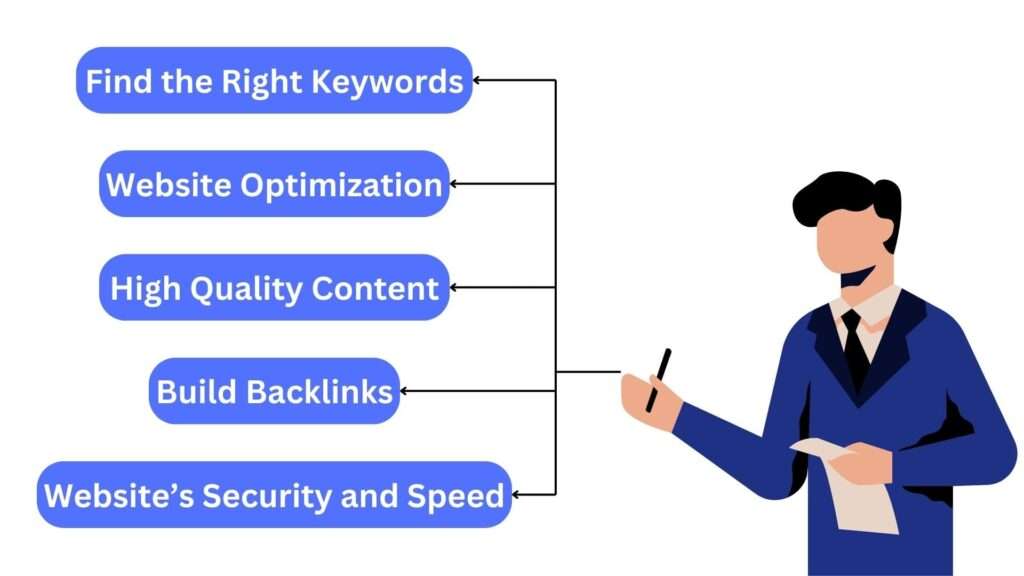
    SEO for Cybersecurity: 5 Key Strategies

    SEO Strategies for Cybersecurity

    1. Find the Right Keywords for Your Cybersecurity Business:

    Finding the right keywords is the first step to making your cybersecurity firm show up in search results. Using tools like Google Keyword Planner helps figure out what terms people type when searching for cybersecurity solutions. You need to mix broad and specific keywords, like “cybersecurity services for small businesses” or “network security expert” to attract the right audience. Also, placing these keywords naturally in your content makes sure search engine crawlers understand what your website is about. But don’t overstuff them Google ranks content better when it’s helpful, not just packed with words.

    2. Optimize Your Website with On Page SEO:

    On-page SEO is all about making your website easier for search engines like Google to read. That means using clear title tags, meta descriptions, and structured URLs. A page about cybersecurity SEO strategy should have a URL like yoursite.com/cybersecurity-seo-strategy instead of something messy like yoursite.com/page12345. Also, adding internal linking helps users navigate better while telling Google which pages are important. Image alt text is another must it helps search engine crawlers understand images while improving accessibility. These simple fixes can improve search rankings and help your site load faster, which is another SEO ranking factor. To further analyze and improve your website’s speed, tools like Feedthebot can provide insights on how to optimize your site’s performance and boost its SEO ranking.

    3. Create High Quality Content on Cybersecurity Topics:

    Content is king when it comes to SEO for cybersecurity websites. Writing blog posts, guides, and whitepapers on trending cybersecurity topics helps bring more visitors to your site. However, content needs to be useful, not just stuffed with keywords. Try answering questions that people are searching for, like “How to protect small businesses from cyber threats”. It’s also helpful to refine your content to ensure clarity and readability — many creators use online tools to rephrase complex ideas and make their writing more engaging. Adding case studies and real-world examples makes content even stronger. Also, updating old articles regularly keeps them fresh and relevant. Search engines like Google prefer websites that keep up with the latest cybersecurity trends, so make sure your site isn’t outdated.

    4. Build Backlinks to Improve SEO Performance:

    Backlinks are like votes of confidence from other sites. When high-authority websites link to your content, Google sees your site as trustworthy. Cybersecurity firms can get backlinks by writing guest posts for industry blogs, sharing expert SEO tips, and creating valuable research reports. Another way is reaching out to cybersecurity professionals and collaborating on content. The key is getting quality backlinks, not just a bunch of random ones. A single link from a well-respected cybersecurity industry site is better than ten from low-quality directories.

    5. Improve Your Website’s Security and Speed:

    Google ranks secure websites higher because it wants to protect users from threats. That’s why every cybersecurity firm needs SSL encryption (HTTPS) without it, Google might warn visitors that your site isn’t safe. Besides security, site speed is also critical. Pages that take too long to load make users leave fast, hurting SEO rankings. Compressing images, reducing unnecessary code, and using fast hosting services can improve search performance. If a website loads quickly and stays secure, it ranks better in search results while providing a better user experience.

    Local SEO for Cybersecurity Businesses

    If your cybersecurity business serves a specific area, local SEO is a must. Here’s what it includes:

    • Google Business Profile: Make sure your profile is claimed, accurate, and regularly updated.
    • Consistent NAP (Name, Address, Phone Number): Keep business info the same across directories.
    • Local Listings: Get listed on cybersecurity-related business directories for better visibility.
    • Localized Content: Write articles and service pages that mention your city or region.
    • Customer Reviews: Encourage happy clients to leave positive reviews on Google and other platforms.

    How to Set Up Local SEO for Your Cybersecurity Firm?

    First, claim your Google Business Profile and add all details, like services, photos, and operating hours. Then, make sure your business name, address, and phone number are exactly the same everywhere online.

    Next, list your firm in directories related to cybersecurity and tech services. Additionally, creating localized blog content can attract clients searching for cybersecurity help in your area.

    Lastly, focus on getting customer reviews Google ranks businesses with real, positive feedback higher.

    With the right local SEO strategies, cybersecurity firms can reach more potential clients in their area and build a strong online presence.

    SEO for Cybersecurity: The Power of Backlinks

    Backlinks serve as a major ranking factor in search engine optimization, helping cybersecurity websites establish authority and trustworthiness. A well structured SEO strategy should include acquiring high quality links from industry-relevant sources to improve search engine rankings.

    Moreover, backlinks from authoritative sources signal to Google search that the content is credible, positively impacting search engine results pages. This is particularly crucial for cybersecurity firms, as trust is a key factor in securing clients. 

    Ultimately, acquiring high-quality backlinks boosts SEO performance, increases organic traffic, and strengthens the online presence of cybersecurity businesses in a competitive market.

    The Impact of Digital Marketing on Local SEO Performance

    Digital marketing significantly enhances local SEO, making it easier for cybersecurity companies to reach regional clients. Since many small businesses require cybersecurity solutions, optimizing for local SEO ensures these firms appear in search engine results when potential customers search for security services. Additionally, maintaining Google search listings with accurate business details, customer reviews, and location based search terms helps improve credibility.

    Local SEO involves refining content with relevant keywords that align with regional interests, further improving search engine rankings. Best SEO software for businesses can streamline this process by optimizing local search efforts and tracking performance. Consequently, effective SEO marketing strategies not only boost a cybersecurity business’s presence but also position them as a trusted option in their geographical area.

    Conclusion

    Improving SEO for cybersecurity websites requires a combination of keyword optimization, on page SEO, expert SEO techniques, and strong backlink-building strategies. Furthermore, search engine crawlers favor well structured content that helps search engines understand the relevance of your services. SEO marketing isn’t just about rankings it establishes credibility in the cybersecurity field, making your firm a trusted resource for clients searching for cybersecurity solutions.

    However, successful SEO isn’t a one time effort. SEO involves optimizing continuously, tracking results through Google Search Console, and adapting strategies based on the latest cybersecurity trends. Now, ask yourself is your current SEO approach helping you rank higher in search, or is it time to rethink your strategy?

    FAQs

    1. What role does content play in SEO for cybersecurity?
    High-quality, relevant content establishes authority and improves search engine visibility.

    2. How can I measure the success of my SEO efforts?
    Utilize tools like Google Search Console to monitor search rankings and website performance.

    3. What are common SEO mistakes to avoid in the cybersecurity industry?
    Avoid keyword stuffing, neglecting mobile optimization, and ignoring analytics data.

    4. How often should I update my cybersecurity content for SEO?
    Regular updates keep content relevant, which is favored by search engines.

    5. Can local SEO benefit my cybersecurity firm?
    Yes, optimizing for local search can attract clients in your specific geographic area.