
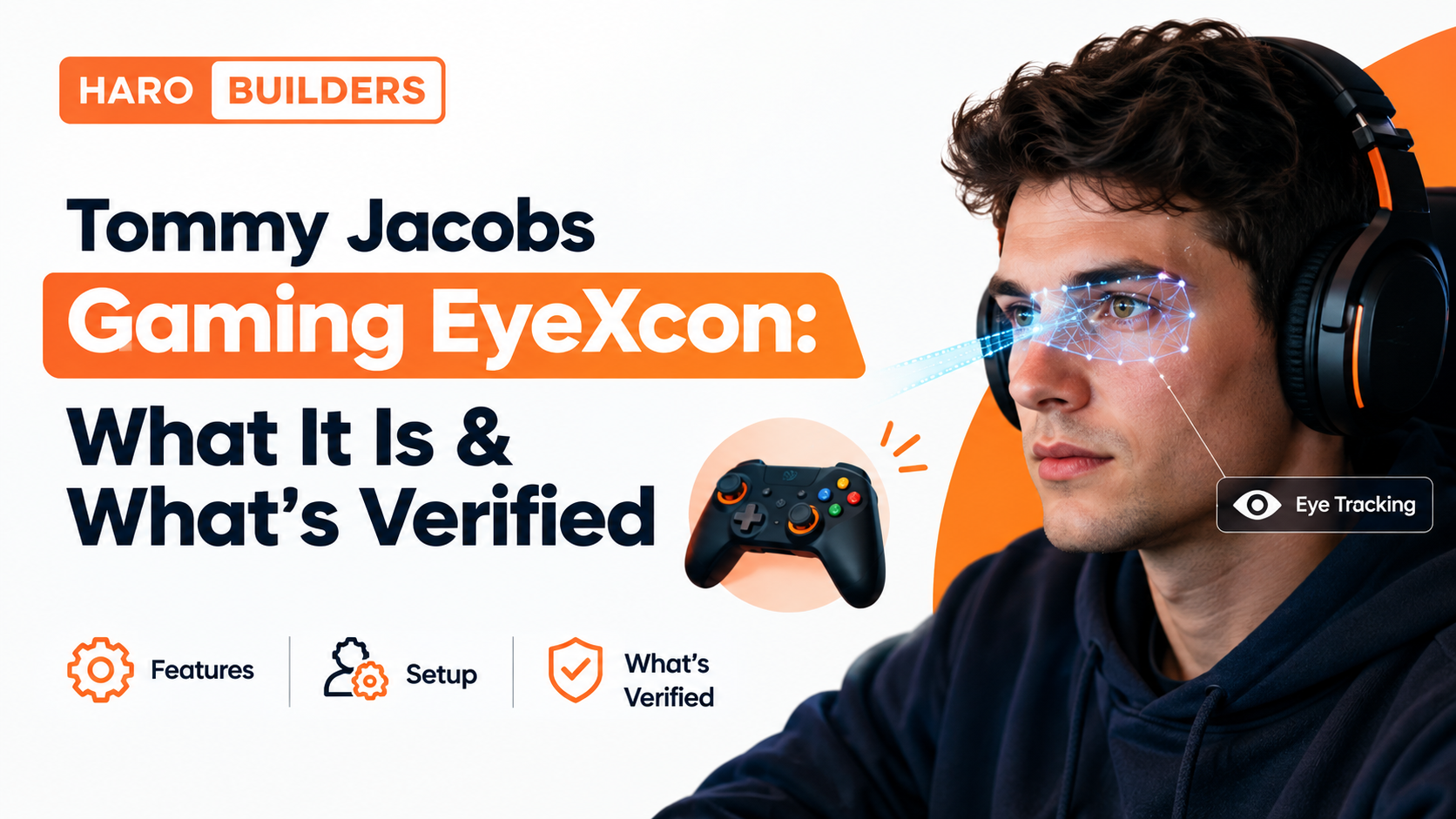
If you searched for Tommy Jacobs Gaming EyeXcon, you may have found articles describing EyeXcon as a gaming device, eye-tracking system, event, platform, or futuristic gaming technology. The problem is that these descriptions are not consistent. EyeXcon does publish gaming-related content and uses the Tommy Jacobs byline, but the available evidence does not establish one clearly documented commercial product with confirmed specifications, official compatibility lists, or independent technical testing.
The safest way to understand the topic is to separate what EyeXcon itself publishes, what other websites claim, and what is independently established about eye-tracking technology in gaming.
Quick Answer: What Is Tommy Jacobs Gaming EyeXcon?
Tommy Jacobs Gaming EyeXcon is a search term associated with EyeXcon.com, Tommy Jacobs bylined content, and a collection of online claims about gaming and eye-tracking technology. However, the available evidence does not establish a consistently documented commercial EyeXcon gaming device with independently verified specifications.
EyeXcon does have gaming-related articles and a PC & Consoles section. Its website also contains articles by Tommy Jacobs, including gaming content. At the same time, third-party pages describe EyeXcon in conflicting ways, including as a gaming accessory, console, event, or eye-tracking system.
That distinction matters. Eye tracking is a real gaming technology, but that does not automatically verify every claim made about EyeXcon.
What Can Be Verified About Tommy Jacobs Gaming EyeXcon?
The available evidence supports several facts, while other claims remain uncertain.
| Question | What the available evidence shows |
|---|---|
| Does EyeXcon publish gaming content? | Yes. EyeXcon has a PC & Consoles category and gaming-related articles. |
| Does Tommy Jacobs appear as an EyeXcon author? | Yes. Multiple EyeXcon articles carry the Tommy Jacobs byline. |
| Is EyeXcon consistently described as one specific gaming product? | No. Online descriptions vary considerably. |
| Is eye tracking itself real gaming technology? | Yes. Eye tracking is used in established gaming and VR systems. |
| Is a specific EyeXcon hardware specification independently established? | Not sufficiently from the sources reviewed. |
| Is there a reliable universal EyeXcon compatibility list? | No authoritative list was established from the sources reviewed. |
| Should every online EyeXcon feature claim be treated as confirmed? | No. Individual claims should be checked against reliable primary or independent evidence. |
EyeXcon’s own content includes gaming-related posts, such as its article about Roblox, which is published under the Tommy Jacobs name. It also has an article specifically titled “Tommy Gaming Eyexcon: The Ultimate Game Changer in Your Setup.” Those pages establish the existence of the content and terminology, but they do not by themselves establish independent verification of the product specifications described in those articles.
Who Is Tommy Jacobs?
Tommy Jacobs is a byline used on EyeXcon content.
The available EyeXcon material shows the name attached to articles covering gaming and technology as well as subjects outside gaming. For example, Tommy Jacobs is credited on EyeXcon articles about Roblox, Path of Exile 2 community tools, and industrial technology.
That broad range is important when evaluating claims about the person behind the phrase Tommy Jacobs Gaming EyeXcon.
There is not enough reliable evidence in the sources reviewed to establish a detailed professional biography describing Tommy Jacobs as a documented gaming-hardware engineer, founder of a confirmed eye-tracking hardware company, or creator of a commercially verified EyeXcon device.
Therefore, it is better to describe Tommy Jacobs as an author/byline associated with EyeXcon content unless stronger primary evidence establishes additional details.
What Is EyeXcon?
EyeXcon is the name used by the website EyeXcon.com, which publishes content across multiple subjects.
The site has a PC & Consoles category and publishes gaming articles. Some articles discuss EyeXcon-related gaming concepts, while others cover ordinary gaming topics such as Roblox and community tools.
This creates an important distinction:
EyeXcon as a website/content identity is verifiable.
EyeXcon as one clearly documented commercial gaming hardware product is not established to the same standard.
That is why searches for terms such as “EyeXcon gaming setup,” “EyeXcon features,” and “EyeXcon compatible games” can produce conflicting information.
Why Is There So Much Confusion About EyeXcon?
The phrase sounds like the name of a conventional technology product:
Tommy Jacobs + Gaming + EyeXcon
A reader could reasonably interpret that combination as:
- a person
- a company
- a gaming product
- an eye-tracking platform
- a gaming convention
- or a hardware system
Different websites have used different interpretations.
Some articles describe EyeXcon as a gaming accessory. Others describe it as a console, event, gaming ecosystem, or eye-tracking concept.
The problem is not that all of these descriptions have been independently established. The problem is that the descriptions themselves are inconsistent.
A useful verification process therefore looks for:
- an identifiable manufacturer
- official product documentation
- model numbers
- technical specifications
- software or driver documentation
- supported operating systems
- confirmed compatible games
- retailer information
- warranty information
- independent reviews
- demonstrations from identifiable hardware
- developer documentation or SDK information
When those elements are missing, product claims should be treated cautiously.
Is EyeXcon a Real Gaming Product?
There is evidence that EyeXcon is a real website and that EyeXcon publishes gaming-related material.
That is different from proving that every product described in those articles exists as a commercially available hardware product.
One EyeXcon article describes “Tommy Gaming Eyexcon” as a gaming accessory and discusses features such as controls, ergonomics, latency, and compatibility. However, those descriptions should not automatically be treated as independently verified hardware specifications.
A stronger product verification standard would require evidence such as:
- An official product page identifying the exact model.
- Technical documentation.
- A manufacturer or responsible company.
- Software or firmware documentation where applicable.
- Confirmed compatibility information.
- Independent hands-on testing.
- Retail or distribution evidence.
- Support and warranty information.
Without those elements, it is safer to describe specific EyeXcon hardware claims as reported or unverified, rather than confirmed specifications.
Does EyeXcon Use Eye Tracking?
This is where the topic requires careful distinction.
Eye tracking is a real technology used in gaming.
An eye tracker can use sensors and illumination to estimate where a player is looking and provide that information as an additional input channel. Tobii explains that gaming eye tracking can use illuminators and sensors to calculate a user’s gaze point on the screen.
Established gaming hardware also demonstrates that eye tracking can be integrated into real products.
For example, PlayStation VR2 includes eye tracking and uses gaze information in conjunction with other VR features. Sony also documents foveated rendering, where rendering resources are concentrated around the area the player is looking at.
However:
The existence of real eye-tracking technology does not independently prove that a particular EyeXcon product implements those capabilities.
That distinction is essential.
How Does Eye Tracking Work in Gaming?
A typical eye-tracking system uses sensors to estimate the user’s gaze.
The general process looks like this:
Eyes → Sensors → Gaze estimation → Software → Game/application
The system attempts to determine where the user is looking and then makes that information available to compatible software.
Depending on the implementation, gaze information can be used for:
- interface selection
- camera interaction
- aiming assistance
- menu navigation
- accessibility
- player-attention analysis
- immersive interactions
- rendering optimization
Not every eye-tracking system supports every function.
Gaze Detection
The hardware estimates the direction of the user’s gaze.
This normally requires a suitable camera or sensor arrangement and software capable of interpreting the captured information.
Calibration
Calibration helps the system associate the user’s eye position with locations on the display or within a virtual environment.
A well-designed system needs calibration because users have different eye positions, facial structures, seating distances, and viewing angles.
Gaze-Based Interaction
In compatible applications, the player’s gaze can become an additional input.
For example, a game might allow the player to look toward an object and use that gaze information as part of an interaction.
This does not necessarily replace a mouse, keyboard, or controller.
Foveated Rendering
Foveated rendering is a different application of eye tracking.
The basic idea is to allocate more rendering detail to the region the player is looking at while reducing unnecessary rendering work elsewhere.
Sony describes this approach in PS VR2 documentation, where foveated rendering concentrates graphical fidelity around the area being viewed.
This is an established application of eye tracking, but it should not be attributed to EyeXcon unless EyeXcon-specific evidence confirms it.
EyeXcon Features: What Is Actually Verified?
Online articles mention a variety of EyeXcon features, but they should not all be treated equally.
| Feature or claim | Evidence status |
|---|---|
| EyeXcon has gaming-related online content | Confirmed |
| Tommy Jacobs appears as an EyeXcon author | Confirmed |
| EyeXcon discusses gaming technology | Confirmed |
| EyeXcon is definitely a commercial eye-tracking peripheral | Not sufficiently independently verified |
| Specific EyeXcon latency improvements | Not independently established |
| Universal game compatibility | Not independently established |
| Specific hardware specifications | Not independently established |
| Foveated rendering specifically provided by EyeXcon | Not independently established |
| Eye-only gaming controls from a verified EyeXcon device | Not independently established |
| Eye tracking as a general gaming technology | Established |
This is one of the most important points for anyone researching the topic.
A feature appearing on several websites does not necessarily mean that several independent sources verified it. Multiple articles can repeat the same underlying claim.
Is There an Official EyeXcon Setup Guide?
There is not enough verified technical documentation to present a detailed official EyeXcon hardware setup procedure as fact.
That means you should be careful with articles that provide highly specific instructions such as:
- exact sensor placement
- official calibration values
- exact drivers
- specific firmware versions
- universal game mappings
- guaranteed latency settings
- model-specific compatibility instructions
Unless those instructions come from identifiable official documentation for a real product model, they should not be presented as official EyeXcon instructions.
What Does a Normal Eye-Tracking Gaming Setup Require?
A legitimate eye-tracking setup generally involves:
- Compatible eye-tracking hardware.
- Required drivers or software.
- Correct physical positioning.
- User calibration.
- Compatible games or applications.
- Testing and adjustment.
- Appropriate privacy settings.
The exact process depends on the hardware and software being used.
For example, an established VR system can integrate eye tracking directly into the headset rather than requiring a separate monitor-mounted tracker.
Does EyeXcon Have Confirmed Compatible Games?
A reliable compatibility list should identify:
- the exact hardware
- operating system
- game version
- supported API or integration method
- required software
- specific supported features
A generic statement that EyeXcon works with “many games” is not enough to establish compatibility.
If a compatibility list is not supported by official documentation or independent testing, treat it as unverified.
This is particularly important for competitive games, where input behavior, anti-cheat systems, peripherals, and supported APIs can vary.
Can Eye Tracking Improve Gaming?
Eye tracking can provide useful capabilities, but it does not automatically make every player faster or more accurate.
Its usefulness depends on the game, implementation, hardware, software integration, and the player’s needs.
Accessibility
Eye tracking can provide an alternative interaction method for users who have difficulty using conventional controls.
That can make gaze-based interfaces particularly interesting for accessibility-focused applications.
Immersion
In supported games and VR applications, gaze can become part of the interaction model.
Instead of interacting only through physical controls, the system can incorporate where the player is looking.
Interface Interaction
Gaze can sometimes be used to select or highlight objects, navigate menus, or provide contextual interactions.
Rendering Optimization
Eye tracking can support foveated rendering in systems designed for it.
PS VR2 is a documented example of a gaming platform combining eye tracking with foveated rendering.
Player Analytics
Eye tracking can also be used to study where players look and how they interact with visual information.
That is different from using gaze as a direct game-control method.
Eye Tracking vs Mouse and Controller
Eye tracking should generally be viewed as an additional input method, not a universal replacement for conventional controls.
| Input Method | Main Strength | Limitation | Typical Role |
|---|---|---|---|
| Eye tracking | Uses gaze as an additional input signal | Requires compatible hardware/software | Interaction, accessibility, VR |
| Mouse | Precise physical pointing | Requires hand movement | PC gaming and desktop interaction |
| Keyboard | Fast physical commands | Requires physical key input | PC gaming and general computing |
| Controller | Integrated physical controls | Less direct pointer precision | Console and controller-based gaming |
A mouse, keyboard, or controller can remain essential even when eye tracking is available.
For readers comparing traditional gaming input devices, HaroBuilder’s guides to computer mice, keyboards, and HSS gamepad connectivity provide useful background.
EyeXcon vs Traditional Gaming Controls
The most useful comparison is not “which technology is better?” but what type of interaction does each technology provide?
Mouse
A mouse translates physical hand movement into pointer or camera movement.
It remains particularly useful for precision-based PC interaction.
Keyboard
A keyboard provides discrete physical commands.
Games can map keys to movement, abilities, inventory controls, menus, and other functions.
Gamepad
A controller combines analog sticks, buttons, triggers, and other controls into a compact gaming interface.
Eye Tracking
Eye tracking adds information about where the player is looking.
That information can complement traditional input rather than replacing it.
For many applications, the most practical model is therefore:
Gaze + physical controls
rather than:
Gaze instead of every physical control.
What Gamers Should Check Before Trusting an EyeXcon Claim
If you encounter a new EyeXcon feature or product claim, use this checklist.
1. Find the Primary Source
Look for the manufacturer’s or developer’s official documentation.
Do not rely only on articles repeating one another.
2. Look for a Specific Product Identity
A real commercial device should normally have a recognizable model or product name.
3. Check Technical Documentation
Look for:
- specifications
- operating-system support
- software
- firmware
- installation documentation
- compatibility information
4. Look for Independent Testing
Independent hands-on testing is more useful than repeated promotional descriptions.
5. Verify Compatibility
Do not assume that eye-tracking hardware works with every game.
6. Check Privacy Information
Eye tracking can involve information about gaze behavior and interaction patterns.
Users should understand what data software collects and how it is handled.
7. Check Support Information
A legitimate commercial product should normally have some form of support, documentation, warranty, or contact information.
Common Misconceptions About Tommy Jacobs Gaming EyeXcon
Misconception 1: EyeXcon automatically means eye-tracking hardware
Not necessarily.
The phrase is associated with gaming and eye-tracking discussions, but the existence of eye-tracking technology does not prove that every EyeXcon claim describes a functioning eye-tracking device.
Misconception 2: Several articles repeating a feature prove it is real
They do not.
Ten articles can repeat one original claim without providing ten independent confirmations.
Misconception 3: Eye tracking replaces the mouse
Not generally.
Eye tracking can provide an additional input signal, while a mouse may remain better suited to precise physical pointing.
Misconception 4: Eye tracking automatically improves FPS performance
There is no universal guarantee.
A benefit depends on the game, implementation, player, hardware, and type of interaction.
Misconception 5: Eye tracking and foveated rendering are the same thing
They are related but different.
Eye tracking determines where the player is looking. Foveated rendering uses that information in supported systems to prioritize rendering detail around the viewed region.
Misconception 6: EyeXcon’s online feature lists are automatically official specifications
They should be verified before being treated as official technical documentation.
Is Tommy Jacobs the Creator of EyeXcon?
Online articles make different claims about Tommy Jacobs’ relationship with EyeXcon.
What can be established from EyeXcon itself is that Tommy Jacobs is used as an author name on EyeXcon content.
A stronger claim—such as being the documented founder, engineer, hardware creator, or owner of a commercially verified EyeXcon product—requires additional reliable evidence.
It is therefore better to avoid presenting those roles as established facts without primary documentation.
Is EyeXcon the Same as Eyexcon?
The terms EyeXcon and Eyexcon are used interchangeably across some online content.
However, spelling variations alone do not establish that every page using either spelling refers to the same product, company, or technology.
When researching the topic, evaluate the actual source and context rather than assuming that every occurrence refers to one verified commercial entity.
Should Gamers Download EyeXcon Software?
Do not download software simply because an article claims that it belongs to EyeXcon.
Before installing any gaming software:
- verify the official source
- check the publisher
- inspect the domain
- confirm the software name
- check whether documentation exists
- review permissions
- scan downloads where appropriate
- avoid unknown executable files
- verify that the software matches the hardware it claims to support
If an article gives a download link but cannot establish who created the software or what hardware it supports, caution is appropriate.
Frequently Asked Questions
What is Tommy Jacobs Gaming EyeXcon?
It is a search phrase associated with EyeXcon.com, Tommy Jacobs bylined content, and online discussions about gaming and eye-tracking technology. EyeXcon publishes gaming content, but the available evidence does not establish one consistently documented commercial EyeXcon gaming product with independently verified specifications.
Who is Tommy Jacobs?
Tommy Jacobs is an author name used on EyeXcon content. The name appears on gaming and technology articles as well as content covering other subjects. The available sources do not provide enough reliable evidence to establish a detailed professional biography as a gaming-hardware creator.
What is EyeXcon?
EyeXcon is the name of a website that publishes content across multiple topics, including gaming and technology. Online sources also use EyeXcon in connection with gaming-product and eye-tracking claims, but those descriptions are not consistently verified.
Is EyeXcon a real gaming product?
The EyeXcon website and its gaming content are real and verifiable. However, the available evidence reviewed here does not establish a single commercial gaming product with consistently documented hardware specifications, official compatibility information, and independent testing.
Does EyeXcon use eye tracking?
Eye tracking is a real gaming technology, but a general explanation of eye tracking should not be treated as proof that a specific EyeXcon product implements it. EyeXcon-specific hardware claims need their own evidence.
How does eye tracking work in gaming?
Eye-tracking hardware uses sensors to estimate where a player is looking. Compatible software can then use gaze information for interaction, accessibility, analytics, VR features, or rendering optimization.
What is foveated rendering?
Foveated rendering is a graphics technique that allocates greater rendering detail to the area the player is looking at while reducing detail elsewhere. Eye tracking can provide the gaze information required for dynamic versions of this technique.
Is there an official EyeXcon setup guide?
A detailed official hardware setup procedure could not be reliably established from the sources reviewed. General eye-tracking setups can involve hardware, software, positioning, calibration, compatible applications, and testing.
What games are compatible with EyeXcon?
A reliable universal EyeXcon game-compatibility list could not be established from the reviewed evidence. Compatibility should be confirmed for the exact hardware, software, and game combination.
Can eye tracking improve gaming performance?
It can add useful interaction capabilities, accessibility options, immersion, or rendering optimization in supported systems. It does not automatically improve competitive performance for every player or game.
Is EyeXcon the same as eye tracking?
No. Eye tracking is an established technology. EyeXcon is a specific name used by a website and various online gaming discussions. A real technology should not automatically be treated as proof of a specific product.
Should I trust every EyeXcon feature list online?
No. Check whether the information comes from an identifiable primary source, technical documentation, independent testing, or simply another article repeating the same claim.
Key Takeaways
- Tommy Jacobs Gaming EyeXcon is a search phrase associated with EyeXcon content and gaming-related claims.
- EyeXcon has a real website with gaming and PC/console content.
- Tommy Jacobs appears as an author on EyeXcon articles.
- Online descriptions of EyeXcon’s supposed gaming product or system are inconsistent.
- Specific EyeXcon hardware specifications should not be treated as confirmed without stronger evidence.
- Eye tracking itself is an established gaming technology.
- Eye tracking can support interaction, accessibility, VR experiences, analytics, and foveated rendering in compatible systems.
- Eye tracking does not automatically replace a mouse, keyboard, or controller.
- A repeated claim across multiple websites is not necessarily independent verification.
- Gamers should verify hardware, software, compatibility, documentation, privacy, and support before trusting or installing an unfamiliar technology.
Conclusion
The phrase Tommy Jacobs Gaming EyeXcon is more complicated than many online articles make it appear.
There is clear evidence that EyeXcon operates a website, publishes gaming-related content, and uses the Tommy Jacobs byline. There are also numerous online descriptions of EyeXcon as a gaming product or eye-tracking system. However, those descriptions are not consistent enough to treat every claimed feature, specification, compatibility statement, or performance benefit as independently verified.
The underlying technology is different. Eye tracking is real and already used in established gaming and VR systems. It can support gaze-based interaction, accessibility, immersive interfaces, and technologies such as foveated rendering.
For anyone researching EyeXcon, the most useful approach is therefore simple: separate the verified technology from the unverified product claims.
If you want to explore more computer and gaming technology topics, HaroBuilder’s technology resources provide additional guides covering input devices, gaming peripherals, computing concepts, and related technologies.


💬 Comments 0
No comments yet. Be the first to share your thoughts! 💬
✍️ Leave a Comment