
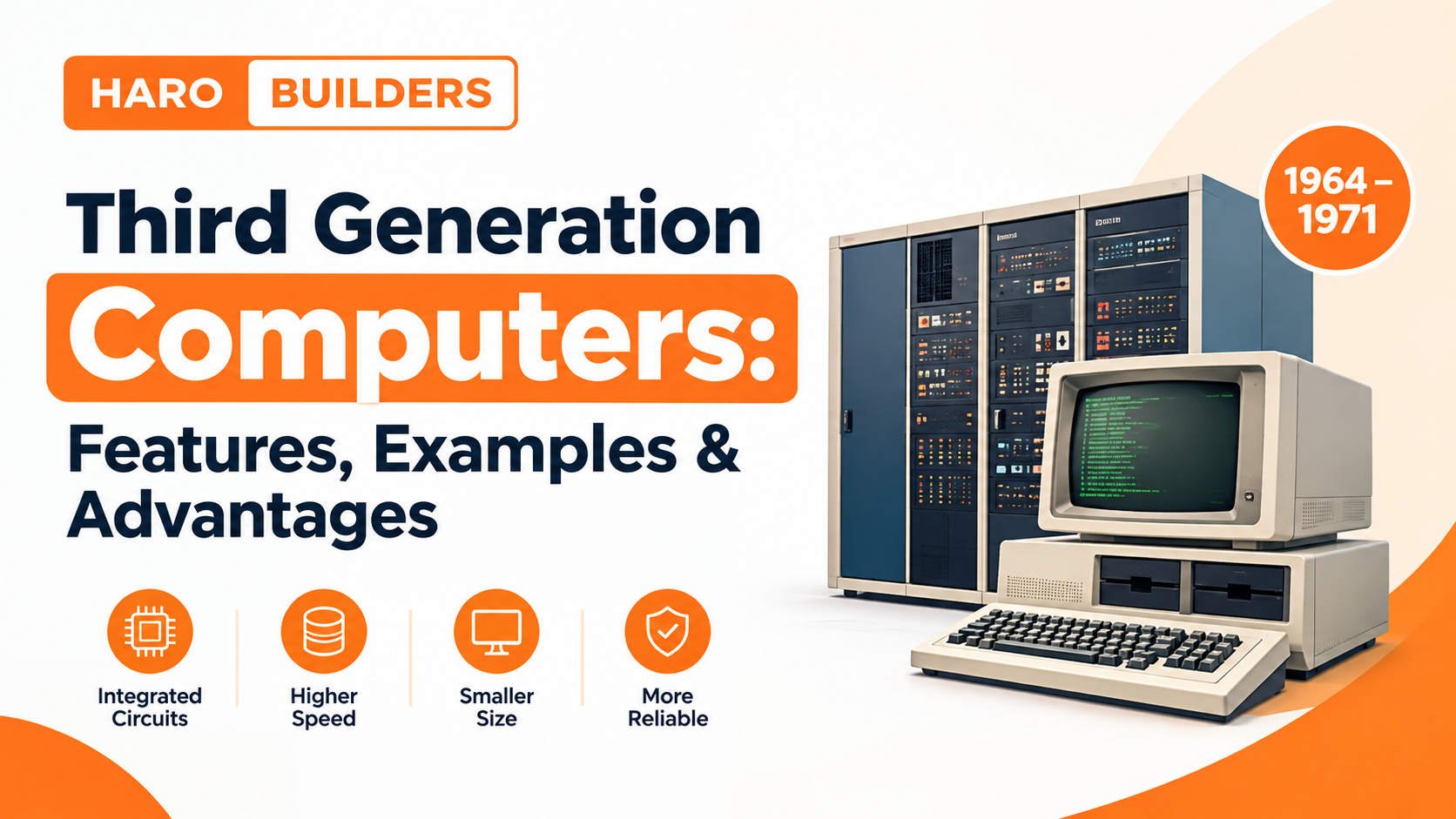
Computers have developed through several major technological generations, and third generation computers marked an important shift from transistor-based systems to computers built around integrated circuits (ICs). This change made computers smaller, more reliable, more capable, and easier to use for a wider range of business, scientific, and organizational tasks.
The third generation is commonly associated with the mid-1960s through the early 1970s, although the exact dates vary depending on how historians define the transition between generations. IBM’s System/360, introduced in 1964, is often used as an important starting point for this era.
This guide explains the history, technology, characteristics, features, examples, applications, advantages, disadvantages, and major differences between third generation computers and the generations before and after them.
Quick Answer: What Are Third Generation Computers?
Third generation computers were computer systems that used integrated circuits instead of relying primarily on individual transistors. The use of IC technology allowed manufacturers to place multiple electronic components into compact semiconductor circuits, helping computers become smaller, faster, more reliable, and more efficient. This generation also saw wider use of operating systems, high-level programming languages, multiprogramming, and time-sharing.
Key points
- Main technology: Integrated circuits (ICs)
- Common period: Approximately 1964 to the early 1970s
- Previous generation: Transistor-based computers
- Next generation: Microprocessor-based computers
- Examples: IBM System/360, PDP-8, CDC 6600 and other contemporary systems
- Major developments: Multiprogramming, time-sharing, improved storage and operating systems
- Typical uses: Business, science, engineering, education, government and data processing
For more computer technology resources, you can also explore HaroBuilder.
When Were Third Generation Computers Introduced?
There is no single universally accepted date that marks the exact beginning and end of the third generation.
Many educational resources use 1964–1971 as a convenient period. IBM documentation specifically describes the introduction of the IBM System/360 in 1964 as signaling the start of the third generation. The early 1970s then brought microprocessor technology that helped establish the next major stage of computer development.
So, a useful way to describe the period is:
Third generation computers emerged in the mid-1960s and dominated much of computing until the early 1970s, with the transition to fourth-generation computing occurring gradually rather than on one exact date.
This distinction matters because computer generations are historical classifications, not strict technological boundaries.
History of Third Generation Computers
The third generation developed from the limitations of earlier transistor-based computers.
From Vacuum Tubes to Transistors
First generation computers relied heavily on vacuum tubes. These systems were large, consumed substantial power, produced considerable heat, and required significant physical space.
Second generation computers replaced vacuum tubes with transistors. Transistors were smaller, more reliable, and more efficient than vacuum tubes, but complex systems still required large numbers of individual electronic components.
As computers became more sophisticated, manufacturers faced another problem: the number of components and connections required to build increasingly complex circuits was becoming difficult to manage.
The integrated circuit offered a solution.
The Development of Integrated Circuits
Jack Kilby demonstrated an early integrated circuit at Texas Instruments in 1958. Robert Noyce independently developed an approach that became important for practical silicon-based IC manufacturing. The Nobel Prize later recognized Kilby’s contribution to the invention of the integrated circuit.
The basic idea was significant: instead of assembling many individual electronic components separately, multiple components could be incorporated into a compact semiconductor circuit.
That made it possible to build increasingly complex electronic systems in less physical space.
IBM System/360
One of the defining computer families of this era was the IBM System/360, introduced on April 7, 1964.
IBM designed System/360 as a compatible family of computers that could address both business and scientific workloads. Its architecture also allowed customers to move between models while maintaining software compatibility to a significant degree.
This was important because earlier computer users could face major compatibility problems when moving to a different system.
System/360 therefore represented more than a hardware change. It helped establish a more flexible model of computer architecture and software compatibility.
What Technology Was Used in Third Generation Computers?
The defining technology of this generation was the integrated circuit.
However, third-generation computers were not simply “IC computers.” Several technologies worked together to improve their capabilities.
1. Integrated Circuits
An integrated circuit combines multiple electronic components within a compact semiconductor structure.
Compared with using separate components, IC technology made it possible to build more complex circuits while reducing physical size and improving reliability.
The Nobel Prize describes the integrated circuit as a foundation of modern information technology and notes its role in enabling miniaturization and mass production of electronic circuits.
2. Semiconductor Technology
Third-generation systems increasingly benefited from advances in semiconductor manufacturing.
These advances allowed manufacturers to integrate more electronic functions into smaller physical spaces.
3. Magnetic Core Memory
Magnetic core memory remained important during this period.
It provided the main memory used by many computer systems before semiconductor memory eventually became dominant.
For a broader understanding of computer memory, see HaroBuilder’s guide to types of RAM in computers.
4. Magnetic Storage
Magnetic tape and magnetic disk systems were used for storing programs and data.
Disk technology was particularly useful because it provided more direct access to stored information than sequential magnetic tape.
5. Improved Input and Output
Third-generation systems could use a wider variety of input and output equipment, including:
- Punch-card equipment
- Magnetic tape units
- Disk drives
- Printers
- Terminals
- Keyboards
- Displays
Interactive terminals became increasingly important as time-sharing systems developed.
For a modern explanation of computer input devices, see HaroBuilder’s guide to what a computer keyboard is and how it works.
Characteristics of Third Generation Computers
The major characteristics of third generation computers included:
| Characteristic | What It Meant |
|---|---|
| Integrated circuits | Multiple electronic components could be incorporated into compact circuits |
| Smaller physical size | ICs reduced the space required by complex electronic systems |
| Better reliability | Fewer individual component connections could reduce some failure points |
| Higher processing capability | More sophisticated systems could handle increasingly complex workloads |
| Lower power requirements | IC-based systems generally improved efficiency compared with earlier designs |
| Better storage | Magnetic disks and tapes provided improved data-storage options |
| Operating systems | More sophisticated operating-system capabilities became common |
| Multiprogramming | Systems could manage multiple programs more efficiently |
| Time-sharing | Multiple users could interact with a computer system |
| High-level languages | Languages such as FORTRAN and COBOL supported application development |
| Broader applications | Computers became useful across more business and scientific environments |
These characteristics were interconnected. The move toward ICs was not an isolated hardware improvement; it helped create conditions for more sophisticated computer systems and software.
Features of Third Generation Computers
The main features included:
Integrated Circuit Technology
ICs replaced large numbers of individually connected electronic components in many parts of computer systems.
Improved Processing
The technology allowed manufacturers to build more capable systems within smaller physical packages.
Advanced Operating Systems
Operating systems became increasingly important for managing resources and running multiple programs.
Multiprogramming
Multiprogramming allowed a computer system to keep several programs in memory and switch between them as needed.
Instead of allowing the processor to remain idle whenever one program was waiting for input or another operation, the system could work on another available task.
Time-Sharing
Time-sharing extended this idea to interactive computing.
A central computer could serve multiple users by rapidly allocating processing time among their sessions.
This helped make computers more interactive instead of relying entirely on batch-style processing.
High-Level Programming Languages
High-level languages made software development easier than programming directly in machine language.
Languages used during this broader era included:
- FORTRAN
- COBOL
- BASIC
- ALGOL and other higher-level languages
The exact languages available depended on the computer and application.
Programming Languages Used in Third Generation Computers
FORTRAN
FORTRAN was particularly important in scientific and engineering computing.
It was designed to make numerical and scientific programming more practical.
COBOL
COBOL became strongly associated with business and data-processing applications.
Its design was suited to handling structured business information and records.
BASIC
BASIC was developed to make programming more accessible, particularly in educational and interactive environments.
DEC’s historical material, for example, documents the use of BASIC with PDP-8-based educational systems during the late 1960s.
Operating Systems in Third Generation Computers
Operating systems became increasingly sophisticated during this period.
Instead of simply loading and executing one job at a time, systems increasingly needed to manage:
- Memory
- Programs
- Users
- Input/output devices
- Files
- CPU time
- Peripheral equipment
Multiprogramming
Multiprogramming allowed several jobs to be managed within the same computing environment.
Time-Sharing
Time-sharing allowed multiple users to interact with the same computer system through terminals.
These developments helped transform computers from machines primarily operated through batch processing into more interactive, multi-user systems.
Examples of Third Generation Computers
Several historically important computer systems are associated with this era.
| Computer | Manufacturer | Type / Role | Why It Matters |
|---|---|---|---|
| IBM System/360 | IBM | Mainframe family | Major compatible computer family introduced in 1964 |
| PDP-8 | Digital Equipment Corporation | Minicomputer | Important commercially successful minicomputer |
| CDC 6600 | Control Data Corporation | Supercomputer | Noted for very high performance in its era |
| PDP-8/I | Digital Equipment Corporation | Minicomputer | An early DEC system implemented with integrated circuits |
| Apollo Guidance Computer | MIT Instrumentation Laboratory | Guidance computer | Important early use of ICs in a compact specialized computer |
The Computer History Museum identifies the PDP-8 as the first commercially successful minicomputer, while its historical timeline records the 1964 introduction of the CDC 6600 and IBM System/360.
DEC’s historical timeline also records the PDP-8/I, introduced in 1968, as its first 12-bit computer implemented with integrated circuits.
IBM System/360
The IBM System/360 is one of the most important examples of the period.
IBM introduced the family in 1964 with several models covering a wide performance range. IBM designed the architecture to support both commercial and scientific applications.
PDP-8
The PDP-8 helped establish the minicomputer category.
The Computer History Museum records its introduction in 1965 and notes that it sold for $18,000, significantly less than a low-end IBM/360 mainframe at the time.
CDC 6600
The CDC 6600 was a high-performance scientific computer.
The Computer History Museum records that it could perform up to three million instructions per second and held the distinction of being the world’s fastest computer until the CDC 7600 surpassed it in 1968.
Apollo Guidance Computer
The Apollo Guidance Computer provides another useful example because it shows how integrated circuits could support a highly specialized computing system.
The Computer History Museum notes that it was one of the early uses of integrated circuits and used core memory and magnetic rope memory.
Applications of Third Generation Computers
Third-generation computers were used for a broad range of workloads.
Business Data Processing
Organizations used computers for:
- Payroll
- Accounting
- Inventory
- Records
- Billing
- Business reporting
Banking and Financial Processing
Computerized systems could process large volumes of structured financial data more efficiently than manual methods.
Scientific Research
High-performance systems were used for:
- Numerical calculations
- Scientific simulations
- Engineering analysis
- Research computing
Education
Minicomputers and time-sharing systems created new opportunities for educational institutions to provide computing access to multiple users.
Government
Government organizations used computers for large-scale data processing, administration, scientific programs and other information-management tasks.
Engineering and Aerospace
Computing systems were increasingly useful for complex calculations, control systems and specialized engineering applications.
The Apollo Guidance Computer demonstrates how integrated-circuit technology was also being applied to highly specialized aerospace computing.
Advantages of Third Generation Computers
1. Smaller Than Earlier Systems
Integrated circuits reduced the physical space required for many electronic functions.
Third-generation systems were still large by modern standards, but they represented a significant step away from earlier computer designs.
2. Greater Reliability
Replacing large numbers of individually connected components with integrated circuits could improve system reliability.
3. Better Processing Capability
More advanced circuits allowed systems to perform increasingly complex workloads.
4. Lower Power Requirements
IC-based systems generally required less power than earlier vacuum-tube systems.
5. Less Heat
Reduced power consumption also helped decrease heat production compared with earlier technologies.
6. Better Storage
Magnetic disks and other storage technologies supported larger and more practical data collections.
7. More Advanced Software
Operating systems and high-level programming languages became increasingly sophisticated.
8. Multi-User Computing
Time-sharing allowed multiple people to interact with the same central computer.
9. Wider Applications
Computers expanded further into business, science, education, government and engineering.
Disadvantages of Third Generation Computers
Despite their improvements, these computers had significant limitations.
1. High Cost
Large computer installations were still expensive to purchase and operate.
2. Specialized Maintenance
Organizations required trained technical staff to install, maintain and operate complex systems.
3. Large Physical Infrastructure
Although smaller than previous generations, many systems still required dedicated computer rooms and supporting equipment.
4. Limited Computing Power by Modern Standards
A system that was advanced in the 1960s had extremely limited processing and storage capabilities compared with modern computers.
5. Complex Manufacturing
Producing reliable integrated circuits and sophisticated computer hardware required specialized manufacturing processes.
6. Limited Accessibility
Computers were still far from being everyday personal devices. Access was generally concentrated in organizations, institutions, laboratories and specialized environments.
Second Generation vs Third Generation Computers
| Feature | Second Generation | Third Generation |
|---|---|---|
| Main technology | Transistors | Integrated circuits |
| Approximate era | Late 1950s–mid-1960s | Mid-1960s–early 1970s |
| Physical size | Smaller than first generation | Generally smaller and more compact |
| Reliability | Better than vacuum-tube systems | Further improved |
| Processing | Improved over first generation | More capable and efficient |
| Programming | Assembly and high-level languages | Greater use of high-level languages |
| Operating systems | Developing | More sophisticated |
| Multiprogramming | Limited/emerging | More widely implemented |
| Time-sharing | Emerging | Became increasingly important |
| Storage | Magnetic storage | Improved magnetic storage |
| Applications | Business/scientific | Broader business, scientific and institutional applications |
The key difference is the transition from individual transistors toward integrated circuits.
Third Generation vs Fourth Generation Computers
The next major transition centered on the microprocessor.
| Feature | Third Generation | Fourth Generation |
|---|---|---|
| Main technological identity | Integrated circuits | Microprocessors and increasingly dense semiconductor integration |
| Typical period | Mid-1960s–early 1970s | Beginning in the 1970s and continuing through later decades |
| Computer size | Smaller than previous generations but often room/cabinet-based | Much smaller systems became practical |
| Processing | IC-based CPUs | CPU functions increasingly integrated into microprocessors |
| Personal computing | Not the dominant model | Became increasingly important |
| Semiconductor integration | ICs including SSI/MSI and related technologies | Increasing LSI/VLSI integration |
| Cost | Still high for many systems | Computing became increasingly accessible |
| Examples | System/360, PDP-8 | Microprocessor-based systems and personal computers |
The transition was gradual. Intel’s 4004, announced in 1971, is an important milestone because it was a general-purpose programmable microprocessor. Intel’s historical documentation describes it as a major step toward implementing computing functions more cheaply and on a larger scale.
First to Fourth Generation Computers at a Glance
| Generation | Approximate Era | Defining Technology | General Development |
|---|---|---|---|
| First | 1940s–1950s | Vacuum tubes | Electronic computing becomes practical |
| Second | Late 1950s–mid-1960s | Transistors | Smaller, more reliable systems |
| Third | Mid-1960s–early 1970s | Integrated circuits | More capable, reliable and interactive systems |
| Fourth | 1970s onward | Microprocessors / dense semiconductor integration | Smaller and increasingly accessible computers |
These dates are approximate because technological generations overlap. A computer can also contain technologies associated with more than one conventional generation.
Timeline of Third Generation Computer Development
1958 — Early Integrated Circuit
Jack Kilby demonstrated an early integrated circuit at Texas Instruments.
1964 — IBM System/360
IBM introduced the System/360 family, an important milestone in the development of general-purpose computer systems.
1965 — PDP-8
DEC introduced the PDP-8, which became the first commercially successful minicomputer.
1965 — CDC 6600
Control Data Corporation introduced the CDC 6600, a landmark high-performance scientific computer.
1968 — PDP-8/I
DEC introduced the PDP-8/I, an early PDP-8 model implemented using integrated circuits.
1968 — Apollo Guidance Computer
The Apollo Guidance Computer represented an important early use of IC technology in aerospace computing.
1971 — Intel 4004
Intel announced the 4004 general-purpose programmable microprocessor, helping mark the transition toward the next major era of computing.
Why Were Third Generation Computers Important?
The importance of third generation computers goes beyond the simple replacement of transistors with ICs.
The deeper change was the combination of hardware miniaturization, improved reliability, better operating systems, more sophisticated programming languages, and interactive computing.
The progression looked roughly like this:
Vacuum tubes
↓
Transistors
↓
Integrated circuits
↓
More compact and reliable computer systems
↓
Multiprogramming and time-sharing
↓
Greater access to computing
↓
Microprocessors
↓
Modern computing
The IBM System/360 illustrates this transition particularly well. Its compatible family architecture allowed customers to scale between models while retaining significant software compatibility, changing how organizations could plan and expand their computing infrastructure.
Common Questions About Third Generation Computers
What are third generation computers?
Third generation computers are computer systems associated primarily with integrated-circuit technology. They emerged in the mid-1960s and supported improvements in processing, reliability, storage, operating systems, programming languages, multiprogramming and time-sharing.
What technology was used in third generation computers?
The defining technology was the integrated circuit. Systems also used semiconductor components, magnetic core memory, magnetic tape and disk storage, and increasingly sophisticated input/output equipment.
When did third generation computers begin?
The third generation is commonly dated from around 1964, when IBM introduced the System/360. However, computer generations are approximate historical classifications, so different sources may use slightly different boundaries.
What are the main characteristics of third generation computers?
Important characteristics include integrated circuits, smaller physical designs, improved reliability, better processing capability, improved storage, operating systems, multiprogramming, time-sharing and wider use of high-level programming languages.
What are the examples of third generation computers?
Examples include the IBM System/360, DEC PDP-8, CDC 6600 and other systems from the same technological era. Some specialized systems, such as the Apollo Guidance Computer, also demonstrated early IC-based computing.
What are the advantages of third generation computers?
Their advantages included smaller size, improved reliability, better processing capabilities, lower power requirements, improved storage, more advanced software and broader applications.
What are the disadvantages of third generation computers?
They were still expensive, required specialized infrastructure and technical expertise, and had computing and storage capabilities that are extremely limited compared with modern systems.
Why were integrated circuits important in third generation computers?
ICs allowed multiple electronic components to be incorporated into compact semiconductor structures. This supported miniaturization and helped manufacturers build more complex and reliable systems.
How were third generation computers different from second generation computers?
The main technological difference was that second-generation computers were primarily transistor-based, while third-generation systems increasingly used integrated circuits.
How were third generation computers different from fourth generation computers?
Third-generation systems are primarily associated with integrated circuits, while fourth-generation computers are associated with microprocessors and increasingly dense semiconductor integration.
What programming languages were used in third generation computers?
Languages used during this period included FORTRAN, COBOL, BASIC and other high-level languages. The choice depended on the computer system and application.
Did third generation computers use operating systems?
Yes. Operating systems became increasingly sophisticated during this period, supporting functions such as resource management, multiprogramming and time-sharing.
Key Takeaways
- Third generation computers were primarily associated with integrated circuits.
- The commonly cited period is approximately 1964 to the early 1970s, although boundaries vary.
- IBM’s System/360 is a major milestone of this era.
- The PDP-8 helped establish commercially successful minicomputing.
- The CDC 6600 represented high-performance scientific computing.
- Third-generation systems increasingly supported multiprogramming and time-sharing.
- High-level languages such as FORTRAN, COBOL and BASIC became important.
- Computers became smaller, more reliable and more capable than earlier systems.
- The emergence of the Intel 4004 in 1971 helped lead into the microprocessor era.
- The transition to later generations was gradual rather than an exact overnight change.
Conclusion
Third generation computers represent an important stage in the history of computing because they brought integrated circuits into increasingly capable computer systems.
The move from individual transistors toward IC-based designs helped reduce physical size, improve reliability and support greater system complexity. At the same time, advances in operating systems, programming languages, storage, multiprogramming and time-sharing changed how computers were used.
Systems such as the IBM System/360, PDP-8 and CDC 6600 demonstrate the diversity of this period, from business and general-purpose computing to minicomputing and high-performance scientific systems.
The generation eventually gave way to microprocessor-based computing, but its influence can still be seen in the architectural and software developments that shaped later computer technology.
For readers continuing their computer-technology research, HaroBuilder’s guides to computer memory and computer keyboards provide useful related background.

💬 Comments 0
No comments yet. Be the first to share your thoughts! 💬
✍️ Leave a Comment