
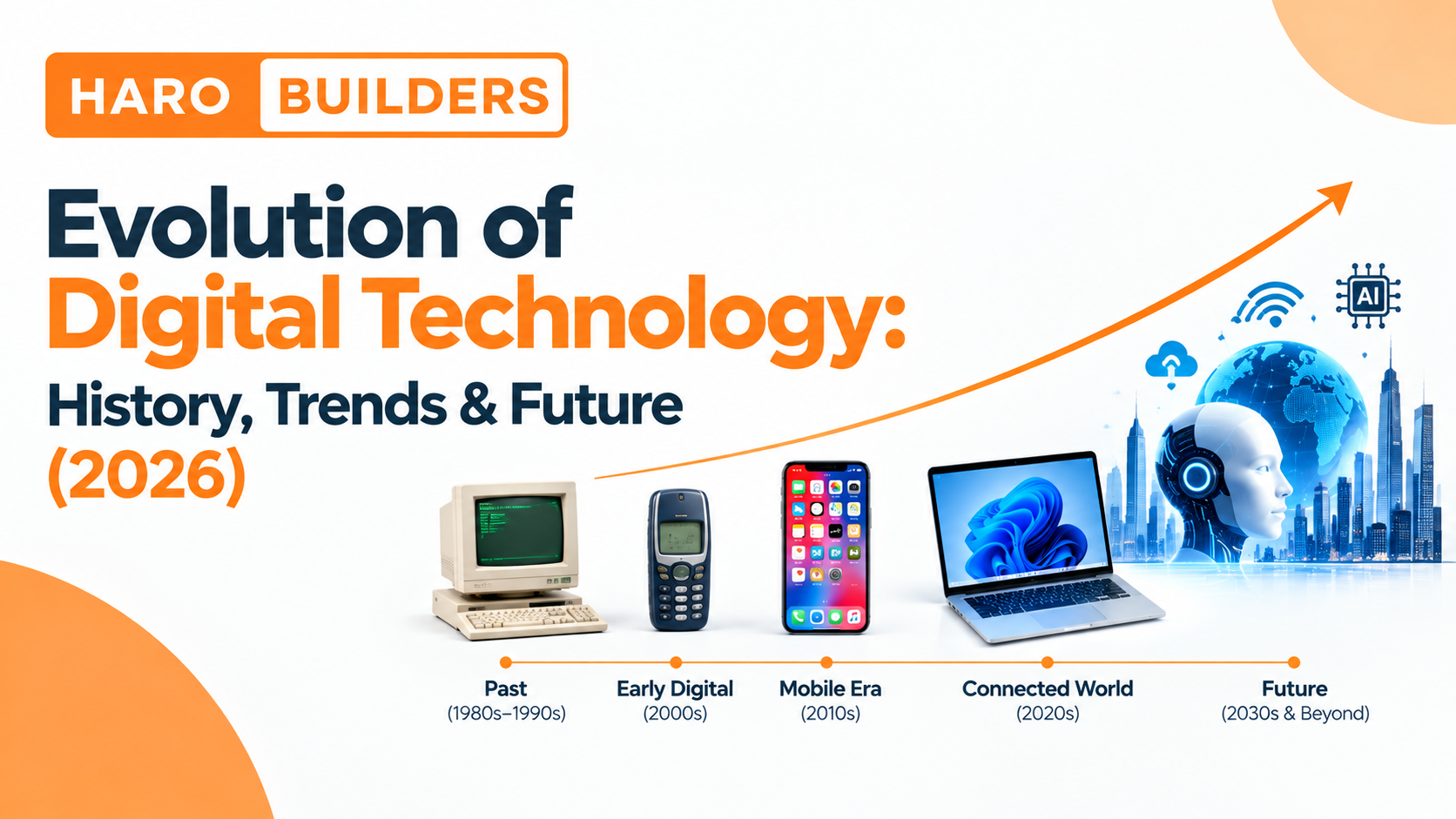
Digital technology has evolved from early electronic computing systems into a connected ecosystem of computers, mobile devices, cloud platforms, sensors, data systems and artificial intelligence. Each major stage increased the ability to process, store, communicate or act on information, eventually creating today’s highly connected digital environment.
The evolution was not a single technological breakthrough. It was a chain of developments involving semiconductors, computers, software, networks, the Internet, mobile computing, cloud infrastructure, big data, artificial intelligence and automation.
This guide explains the major stages of digital technology, how they connect, what changed during each stage, the technologies shaping 2026, and what may come next.
Quick Answer: What Is the Evolution of Digital Technology?
The evolution of digital technology is the gradual development of technologies that create, process, store, transmit and use information in digital form. It progressed from electronic computers and semiconductor technology to personal computers, the Internet, smartphones, cloud computing, connected devices, big data and artificial intelligence.
A simple way to view this progression is:
Electronic computing → personal computing → Internet → mobile computing → cloud and data → AI and intelligent systems
The boundaries between these stages overlap. New technologies usually build on earlier ones rather than completely replacing them.
How Has Digital Technology Evolved?
Digital technology evolved through several interconnected breakthroughs.
Early electronic computers demonstrated that machines could automate complex calculations. Transistors then made electronic systems smaller and more reliable. Integrated circuits allowed many electronic components to be combined into compact semiconductor structures.
Microprocessors pushed computing toward smaller and more accessible machines. Personal computers brought computing into homes, schools and offices. Computer networking and the Internet connected previously separate systems, while the World Wide Web made online information easier to access.
Mobile computing then put powerful computers into people’s pockets. Cloud computing changed how organizations obtained computing resources, while big-data technologies made it practical to process increasingly large datasets.
The latest stage is increasingly defined by artificial intelligence, including machine learning, generative AI and emerging agentic systems.
The broader pattern is:
| Stage | Major development | What changed |
|---|---|---|
| Early electronic computing | Electronic computers | Automated complex calculations |
| Semiconductor era | Transistors and ICs | Smaller and more reliable systems |
| Microprocessor era | CPUs on chips | More compact computing |
| Personal computing | PCs | Computing became widely accessible |
| Internet era | Networking and Web | Global information connectivity |
| Mobile era | Smartphones | Computing became portable |
| Cloud era | Cloud infrastructure | On-demand scalable computing |
| Data era | Big data and analytics | More sophisticated data-driven decisions |
| AI era | ML and generative AI | Systems can increasingly interpret, generate and automate |
This historical progression is consistent with the broader history of computing described by MIT Press, which traces developments from early digital computation through semiconductors, personal computers, the Internet, smartphones and related technologies.
A Timeline of Digital Technology
Early Electronic Computing
Before modern digital devices became common, computation involved mechanical, electromechanical and specialized systems.
The development of electronic computing changed the scale and speed of automated calculation. Early machines were large, expensive and generally designed for specialized scientific, military, governmental or organizational workloads.
The important development was not convenience. It was the ability to perform large numbers of calculations electronically.
Transistors and Semiconductor Technology
The transistor became one of the most important foundations of modern electronics.
Compared with vacuum tubes, transistors could be smaller, more reliable and more energy-efficient. Their development helped make increasingly complex electronic systems practical.
This eventually led toward integrated circuits, where multiple electronic components could be incorporated into semiconductor structures.
Integrated Circuits
Integrated circuits represented another major step in miniaturization.
Instead of constructing every electronic component separately, manufacturers could place multiple components into a compact circuit.
This enabled:
- smaller systems
- improved reliability
- greater circuit complexity
- lower physical space requirements
- increasingly powerful computing systems
Third-generation computers provide a useful example of this transition. They are commonly associated with integrated circuits and the move toward more sophisticated operating systems, programming languages, multiprogramming and time-sharing.
For more detail on this stage of computing history, see HaroBuilder’s guide to third-generation computers.
Microprocessors and Personal Computers
The microprocessor brought an increasingly complete processing unit onto a single chip.
This was a major step toward smaller and more accessible computing systems.
As semiconductor integration increased, computers became progressively smaller and more affordable. Personal computers eventually moved computing from specialized organizational environments into homes, classrooms and ordinary workplaces.
This changed the role of computers from institutional infrastructure into everyday tools.
Computer Networking
Standalone computers were useful, but connecting them created another major technological shift.
Networks allowed computers to exchange information and share resources.
This led to increasingly sophisticated forms of:
- file sharing
- remote communication
- distributed computing
- electronic messaging
- network applications
- information exchange
Networking became a foundation for the Internet.
The Internet and World Wide Web
The Internet connected networks across geographical boundaries.
The World Wide Web then provided a widely accessible system for publishing and navigating interconnected information.
This distinction matters:
The Internet is the underlying network infrastructure, while the Web is a system of interlinked resources that operates over the Internet.
The result was a major change in how people searched for information, communicated, published content and conducted business.
Mobile Computing
Mobile phones initially focused on communication. Over time, smartphones combined communication, computing, photography, navigation, entertainment, payments and Internet access into increasingly powerful portable devices.
Mobile computing changed the expectation that digital services should be available from a fixed computer.
Instead, computing became increasingly:
- portable
- connected
- location-aware
- sensor-driven
- continuously available
Cloud Computing
Cloud computing changed how organizations obtain computing resources.
Instead of purchasing and maintaining all computing infrastructure locally, organizations can obtain computing, storage and other resources through cloud platforms.
Cloud computing supports:
- scalable infrastructure
- remote access
- distributed applications
- managed services
- large-scale data processing
- AI workloads
Scalability became particularly important because modern digital systems may need to handle rapidly changing workloads.
For a deeper explanation of this concept, see HaroBuilder’s guide to scalability.
Big Data and Analytics
As computers, mobile devices, websites, sensors and business systems generated more information, organizations gained access to increasingly large datasets.
The challenge changed from simply storing data to:
- collecting useful data
- organizing it
- processing it
- analyzing it
- protecting it
- extracting useful insights
This created stronger demand for databases, data engineering, analytics and machine-learning systems.
Internet of Things
The Internet of Things, or IoT, extends connectivity beyond traditional computers and smartphones.
Sensors and connected devices can collect information about:
- location
- temperature
- movement
- equipment condition
- energy consumption
- environmental conditions
- industrial processes
The data can then be transmitted to other systems for monitoring, analysis or automation.
Artificial Intelligence and Machine Learning
Artificial intelligence introduced another major change.
Traditional software generally follows rules and logic explicitly implemented by developers. Machine-learning systems can instead learn patterns from data.
AI can therefore support tasks such as:
- classification
- prediction
- language processing
- image recognition
- recommendation
- content generation
- anomaly detection
- decision support
Generative AI expanded this further by enabling systems to produce text, images, audio, code and other outputs.
What Are the Major Stages of Digital Technology?
There is no single universally accepted list of stages. A useful analytical model is:
1. Electronic Computing
Machines perform calculations electronically.
2. Digitalization of Information
Information is increasingly represented and processed digitally.
3. Networked Computing
Computers communicate and share information through networks.
4. Personal Computing
Computing becomes accessible to individuals and small organizations.
5. Mobile Computing
Computing becomes portable and continuously connected.
6. Cloud Computing
Computing resources become increasingly available as scalable services.
7. Data-Driven Computing
Organizations use large datasets and analytics to support decisions and automation.
8. Intelligent Computing
AI systems increasingly interpret information, generate content and assist with decisions.
9. Emerging Agentic and Physical Systems
AI systems are increasingly being designed to interact with tools, coordinate tasks and operate in physical environments.
These stages overlap. A modern smartphone, for example, may simultaneously use semiconductor technology, mobile networking, cloud services, IoT sensors and AI.
From Digitization to Digital Transformation
Three terms are frequently confused: digitization, digitalization and digital transformation.
They describe related but different concepts.
| Concept | Meaning | Example |
|---|---|---|
| Digitization | Converting information into digital form | Scanning a paper document |
| Digitalization | Using digital technology to improve a process | Replacing manual document handling with a digital workflow |
| Digital transformation | Broader organizational change using digital technologies | Redesigning operations around cloud, data and AI |
What Is Digitization?
Digitization means converting analog information into digital information.
For example, converting a paper document into a digital file is digitization.
What Is Digitalization?
Digitalization goes further by using digital information and technologies to improve an existing process.
A company might replace a paper-based approval process with an automated digital workflow.
What Is Digital Transformation?
Digital transformation is broader.
It can involve changing:
- business processes
- organizational workflows
- customer experiences
- products
- services
- infrastructure
- decision-making
- operating models
Technology is therefore only one part of transformation.
Technologies That Drove the Evolution of Digital Technology
Semiconductors and Microprocessors
Semiconductor advances enabled smaller and increasingly powerful electronic systems.
Microprocessors then helped move computing into personal devices and eventually smartphones, embedded systems and specialized computing platforms.
Internet and Networking
Networking transformed isolated computing systems into connected environments.
The Internet provided the foundation for global digital communication and online services.
Mobile Technology
Mobile devices extended computing beyond desks and fixed locations.
Smartphones combined computing, communication, sensors and Internet access in a portable format.
Cloud Computing
Cloud platforms made computing infrastructure more accessible and scalable.
Modern cloud systems also provide the infrastructure needed by many data-intensive and AI applications.
Big Data
Large datasets created demand for scalable storage, processing and analytics.
Internet of Things
IoT expanded the digital environment by connecting physical objects and sensors.
Artificial Intelligence
AI added increasingly sophisticated capabilities for analyzing information, recognizing patterns, generating content and automating tasks.
Automation
Automation allows software or machines to perform tasks with limited human intervention.
Cybersecurity
As digital systems became more connected, protecting them became increasingly important.
Security now affects:
- devices
- networks
- applications
- identities
- data
- cloud infrastructure
- AI systems
5G and Advanced Connectivity
Faster and more capable connectivity supports mobile applications, connected devices, industrial systems and other data-intensive services.
How Modern Digital Technologies Work Together
The evolution of digital technology is easier to understand when technologies are viewed as an ecosystem.
A modern connected system may look like this:
Sensors and devices → networks → edge/cloud infrastructure → data → analytics → AI → automation → human or machine action
For example, an industrial machine could contain sensors that collect temperature and vibration information.
The information can be transmitted to an edge or cloud platform. Analytics can identify unusual patterns. An AI system may help classify the problem. An automated workflow can then alert an engineer or trigger an appropriate response.
This is why technologies such as IoT, cloud, data analytics and AI increasingly overlap.
The OECD describes digital technologies as interconnected and emphasizes that their combined capabilities can create effects beyond what individual technologies provide independently.
Traditional Technology vs Modern Digital Technology
| Traditional model | Modern digital model |
|---|---|
| Manual processing | Automated processing |
| Standalone systems | Connected systems |
| Local infrastructure | Cloud and distributed infrastructure |
| Limited datasets | Large-scale data |
| Fixed workflows | Software-driven workflows |
| Human-only analysis | Human + AI-assisted analysis |
| Periodic communication | Continuous connectivity |
| Physical records | Digital information |
| Reactive operations | Increasingly predictive operations |
This does not mean modern digital systems are automatically better in every situation.
Modern systems can introduce new costs, dependencies, security requirements and operational risks.
The real benefit depends on whether the technology solves a genuine problem.
Why Has Digital Technology Evolved So Quickly?
Several factors reinforce one another.
1. Semiconductor Progress
Smaller and more capable semiconductor technology has supported increasing computing power.
2. Lower Computing Costs
As technologies mature and scale, computing capabilities become available to more users and organizations.
3. Better Connectivity
Networks allow systems, people and devices to exchange information.
4. Increasing Data Availability
Digital activity produces large amounts of information that can be processed and analyzed.
5. Cloud Infrastructure
Cloud platforms make computing resources more flexible and scalable.
6. Software Innovation
Software can rapidly extend what existing hardware can do.
7. AI Development
AI provides new capabilities for analyzing information, generating content and automating increasingly complex tasks.
8. Business Demand
Organizations continuously look for ways to reduce friction, improve productivity, understand customers and create new digital services.
Impact of Digital Technology on Businesses
Digital technology affects businesses in several ways.
Productivity
Software can automate repetitive work and reduce manual processing.
Data-Driven Decision-Making
Organizations can use analytics to identify patterns, monitor operations and support planning.
Customer Experience
Digital channels allow businesses to provide services through websites, mobile applications, messaging systems and personalized experiences.
Collaboration
Cloud-based systems allow teams to work with shared information across locations.
Scalability
Digital infrastructure can allow organizations to increase capacity without rebuilding every system from scratch.
Scalability is particularly important for websites, cloud applications, databases and software platforms.
New Business Models
Digital technology has enabled subscription services, marketplaces, software-as-a-service products, digital platforms and other models that were difficult or impossible to operate at comparable scale using purely physical infrastructure.
Industry Applications of Digital Technology
Healthcare
Digital technology supports electronic records, telehealth, medical imaging, analytics, connected devices and AI-assisted applications.
Finance
Financial organizations use digital systems for transactions, risk analysis, fraud detection, customer service, trading and automation.
Manufacturing
Factories can use sensors, robotics, industrial networks, analytics and predictive-maintenance systems.
Retail
Retailers use digital technology for online commerce, inventory management, customer analytics, payments and personalization.
Education
Digital platforms support online learning, collaboration, research, assessment and increasingly AI-assisted learning.
HaroBuilder’s guide to AI tools for students provides a practical example of how AI is becoming part of modern educational workflows.
Transportation
Digital systems support navigation, fleet management, logistics, route optimization and increasingly connected vehicles.
Energy
Digital technologies can help monitor infrastructure, forecast demand and optimize energy operations.
Agriculture
Connected sensors, satellite data, automation and analytics can support precision agriculture and resource management.
Benefits of the Evolution of Digital Technology
Faster Information Processing
Digital systems can process information much faster than many manual workflows.
Greater Accessibility
Online services can make information and tools available across geographical boundaries.
Automation
Software and machines can automate repetitive or predictable tasks.
Scalability
Digital services can often serve larger numbers of users through distributed infrastructure.
Better Data Analysis
Organizations can analyze larger and more complex datasets.
Improved Communication
Digital networks enable rapid communication across locations.
New Forms of Innovation
Developers can combine APIs, cloud services, AI models, databases and connected devices to create new applications.
Personalization
Digital systems can adapt experiences based on user preferences and available data.
Challenges and Risks
Digital technology also creates significant challenges.
Cybersecurity
Greater connectivity creates more opportunities for unauthorized access, disruption and abuse.
Privacy
Organizations may collect and process large amounts of information, creating privacy and governance responsibilities.
Digital Divide
Not everyone has equal access to devices, reliable Internet connections, digital skills or advanced technologies.
Skills Gaps
Organizations may struggle to find people with the skills required to implement and manage new technologies.
Legacy Systems
Older systems can be difficult or expensive to integrate with modern platforms.
Technology Costs
New systems may require spending on software, infrastructure, training, security and ongoing maintenance.
Data Quality
AI and analytics systems depend heavily on the quality and relevance of the information they use.
👉AI Reliability and Governance
AI systems introduce additional considerations around accuracy, security, privacy, transparency, evaluation and responsible use.
NIST’s AI Risk Management Framework is designed to help organizations consider trustworthiness throughout the design, development, deployment, use and evaluation of AI systems.
Latest Digital Technology Trends in 2026
The technology landscape in 2026 is increasingly centered on AI, but AI is not developing in isolation.
AI-Native Development
Software development is increasingly incorporating AI directly into development environments, workflows and platforms.
The emphasis is shifting from simply using AI as a separate assistant toward designing development processes around AI capabilities.
AI Agents and Multiagent Systems
Some AI systems are moving beyond single-response interactions toward systems that can use tools, coordinate tasks and perform sequences of actions.
Multiagent approaches involve multiple AI agents or specialized components working together on complex tasks.
These systems still require appropriate evaluation, permissions, security controls and human oversight.
Generative AI
Generative AI can produce text, images, audio, video, code and other forms of content.
Its importance comes not only from content generation but from its integration into software, search, productivity, education, customer service and other workflows.
AI Supercomputing and Infrastructure
AI workloads require substantial computing resources.
This is increasing demand for specialized processors, high-bandwidth memory, networking, data-center infrastructure and energy-efficient computing.
Domain-Specific AI
Instead of relying only on broad general-purpose models, organizations are increasingly interested in systems optimized for particular industries, workflows or knowledge domains.
Edge Computing
Edge computing moves some processing closer to where data is generated.
This can reduce latency and limit the amount of information that must travel to centralized infrastructure.
Physical AI
Physical AI refers broadly to AI systems that interact with physical environments, including robotics and other embodied systems.
Confidential Computing
Confidential computing aims to protect data while it is being processed through specialized hardware and security mechanisms.
AI Security
As organizations deploy more AI systems, security requirements increasingly include model behavior, data protection, access control, supply-chain concerns and attacks against AI systems.
Digital Provenance
As synthetic and AI-generated content becomes more common, proving where digital content originated and how it changed becomes increasingly important.
Quantum Computing
Quantum computing remains an emerging field rather than a general replacement for conventional computing.
Its potential applications include certain classes of scientific and optimization problems, but practical capabilities and use cases continue to develop.
Current 2026 technology research from Gartner groups strategic technology developments around foundational AI and computing infrastructure, emerging systems such as multiagent AI and physical AI, and trust, governance and security.
How Is AI Changing Digital Technology?
AI is changing digital technology in several important ways.
First, software can increasingly interpret unstructured information such as text, images, audio and video.
Second, AI can generate new content rather than simply retrieve stored information.
Third, AI can support prediction, classification and decision-making.
Fourth, AI can be integrated into workflows and software applications.
Finally, emerging agentic systems can increasingly interact with tools and execute sequences of actions.
This changes the role of software from:
Store and process information
toward:
Interpret information → generate outputs → recommend actions → automate tasks
However, AI does not remove the need for reliable infrastructure, data, cybersecurity, governance and human judgment.
What Is the Future of Digital Technology?
The future is likely to involve greater convergence between computing, connectivity, data and AI.
More Intelligent Software
AI capabilities are likely to become increasingly embedded into everyday applications rather than appearing only as separate chatbot interfaces.
Greater Human-AI Collaboration
Many systems are likely to combine human judgment with AI assistance rather than replacing every human task.
More Edge and Distributed Computing
As connected devices generate more information, some workloads can benefit from processing closer to the source.
Physical AI and Robotics
AI systems are increasingly being connected to machines that can perceive and interact with physical environments.
Stronger Digital Security
As systems become more connected and automated, security will need to be designed into infrastructure, software and AI workflows.
More Specialized AI
Industry-specific and task-specific AI systems may become increasingly important where specialized knowledge, reliability or compliance requirements matter.
Continued Cloud and AI Convergence
Cloud infrastructure will remain important for storing data, running applications, training models and providing scalable computing resources.
Quantum Computing as an Emerging Field
Quantum computing may eventually contribute to specialized workloads, but its practical development should be evaluated based on demonstrated capabilities rather than hype.
How to Evaluate an Emerging Technology Before Adopting It
Organizations should not adopt technology simply because it is new.
A practical evaluation process is:
1. Define the Problem
Start with the business or operational problem.
2. Determine Whether Technology Is Necessary
Some problems are better solved through process changes rather than new software.
3. Assess Technology Maturity
Determine whether the technology is proven, emerging or experimental.
4. Evaluate Security and Privacy
Understand what data the system handles and what risks it introduces.
5. Check Integration Requirements
Determine whether the technology can work with existing systems.
6. Estimate Total Cost
Consider:
- software
- infrastructure
- implementation
- training
- maintenance
- security
- integration
7. Run a Controlled Pilot
Test the technology on a limited scale before committing to a major deployment.
8. Measure Outcomes
Define measurable criteria for success.
9. Review the Results
Compare actual results with the original problem and expected benefits.
10. Scale Carefully
Only expand deployment when the technology demonstrates useful results and manageable risks.
Digital Technology Evolution at a Glance
| Period | Core technology | Major change |
|---|---|---|
| Early computing | Electronic computers | Automated computation |
| Semiconductor era | Transistors and ICs | Miniaturization |
| PC era | Microprocessors | Personal computing |
| Internet era | Networks and Web | Global connectivity |
| Mobile era | Smartphones | Portable computing |
| Cloud era | Cloud infrastructure | Scalable digital services |
| Data era | Big data and analytics | Data-driven operations |
| AI era | ML and generative AI | Intelligent information processing |
| Emerging era | Agents, physical AI and advanced computing | Greater automation and interaction |
Frequently Asked Questions
What is the evolution of digital technology?
The evolution of digital technology is the progression from early electronic computing and semiconductor systems toward personal computers, networks, mobile devices, cloud infrastructure, connected devices, big data and artificial intelligence.
How has digital technology evolved?
Digital technology evolved through improvements in computing hardware, software, networking, storage, connectivity and data processing. Each major development enabled new applications and often created demand for the next stage.
What are the major stages of digital technology?
A useful model includes electronic computing, digitization, networked computing, personal computing, mobile computing, cloud computing, data-driven computing and intelligent computing.
What are the latest digital technology trends in 2026?
Important 2026 technology developments include AI-native development, AI agents, multiagent systems, generative AI, AI infrastructure, domain-specific AI, physical AI, edge computing, confidential computing, AI security and digital provenance.
How is AI changing digital technology?
AI is allowing software to interpret increasingly complex information, generate content, identify patterns, support decisions and automate workflows. Emerging agentic systems are also expanding software’s ability to interact with tools and complete sequences of tasks.
What is the difference between digitization and digital transformation?
Digitization converts analog information into digital form. Digitalization uses digital technology to improve processes. Digital transformation involves broader organizational changes to products, services, operations or business models.
What technologies drove the digital revolution?
Important technologies include semiconductors, integrated circuits, microprocessors, computers, networking, the Internet, smartphones, cloud computing, big data, IoT and artificial intelligence.
What are the most important emerging digital technologies?
Emerging areas include AI agents, physical AI, specialized AI systems, edge computing, confidential computing, digital provenance and quantum computing. Their maturity and practical value vary.
How does digital technology affect businesses?
Digital technology can improve automation, communication, scalability, analytics, customer experiences and operational efficiency. It can also create new security, privacy, skills and infrastructure challenges.
What is the future of digital technology?
The future is likely to involve increasing convergence between AI, cloud computing, data, networking, robotics, edge computing and advanced semiconductor technologies. The pace and practical impact of individual technologies will vary.
What technologies will shape the future?
AI, advanced computing, cloud infrastructure, edge computing, robotics, connected devices, cybersecurity and specialized computing architectures are among the technologies likely to influence future digital systems.
What are the benefits of digital technology?
Benefits can include faster information processing, automation, improved communication, scalable services, better data analysis, greater accessibility and new digital products and services.
What are the biggest risks of digital technology?
Major risks include cybersecurity threats, privacy problems, digital inequality, technology dependence, skills gaps, poor data quality, legacy-system constraints and risks associated with AI reliability and governance.
Key Takeaways
- Digital technology evolved through connected advances rather than one single invention.
- Semiconductors and integrated circuits enabled increasingly compact and capable computing.
- Microprocessors helped move computing toward personal devices.
- Networking and the Internet transformed information exchange.
- Smartphones made computing increasingly portable and continuously connected.
- Cloud computing introduced scalable infrastructure and services.
- Big data increased the importance of data processing and analytics.
- IoT connected physical devices and environments to digital systems.
- AI is adding increasingly sophisticated capabilities for interpretation, generation and automation.
- 2026 technology development is strongly influenced by AI, but cloud, computing infrastructure, security, connectivity and data remain essential.
- Emerging technologies should be evaluated based on practical problems, maturity, security, cost and measurable outcomes rather than hype.
Conclusion
The evolution of digital technology is best understood as a chain of interconnected advances.
Early electronic computers demonstrated the potential of automated digital computation. Transistors and integrated circuits made electronic systems smaller and more reliable. Microprocessors and personal computers expanded access to computing. Networks and the Internet connected information globally. Smartphones made computing mobile, while cloud platforms and big-data systems created scalable digital infrastructure.
Artificial intelligence represents another major stage because software can increasingly interpret information, generate content and support or automate tasks.
The next phase is likely to be defined less by one individual technology and more by the convergence of AI, cloud infrastructure, data, connectivity, cybersecurity, robotics and advanced computing.
Understanding that progression makes it easier to evaluate new technologies realistically. The most useful question is not simply which technology is newest, but what problem it solves, how mature it is, how it fits into existing systems, and what measurable value it creates.
For more technology resources, explore HaroBuilder’s related technology guides and practical resources.


💬 Comments 0
No comments yet. Be the first to share your thoughts! 💬
✍️ Leave a Comment